Life Path Number 6: Learning to Care Without Carrying Everything

Life Path 6 describes a life repeatedly shaped through encounters with care, responsibility, beauty, belonging and repair. It brings someone close to situations in which something needs tending: a relationship has become strained, a promise must be kept, a vulnerable person needs protection, a place feels neglected or part of ordinary life is asking to be restored.
Through meeting these situations, the 6 path may develop a powerful capacity to make life more humane. Care becomes practical. Beauty becomes part of how shared life is made habitable. Love acquires hands, timing, memory and form.
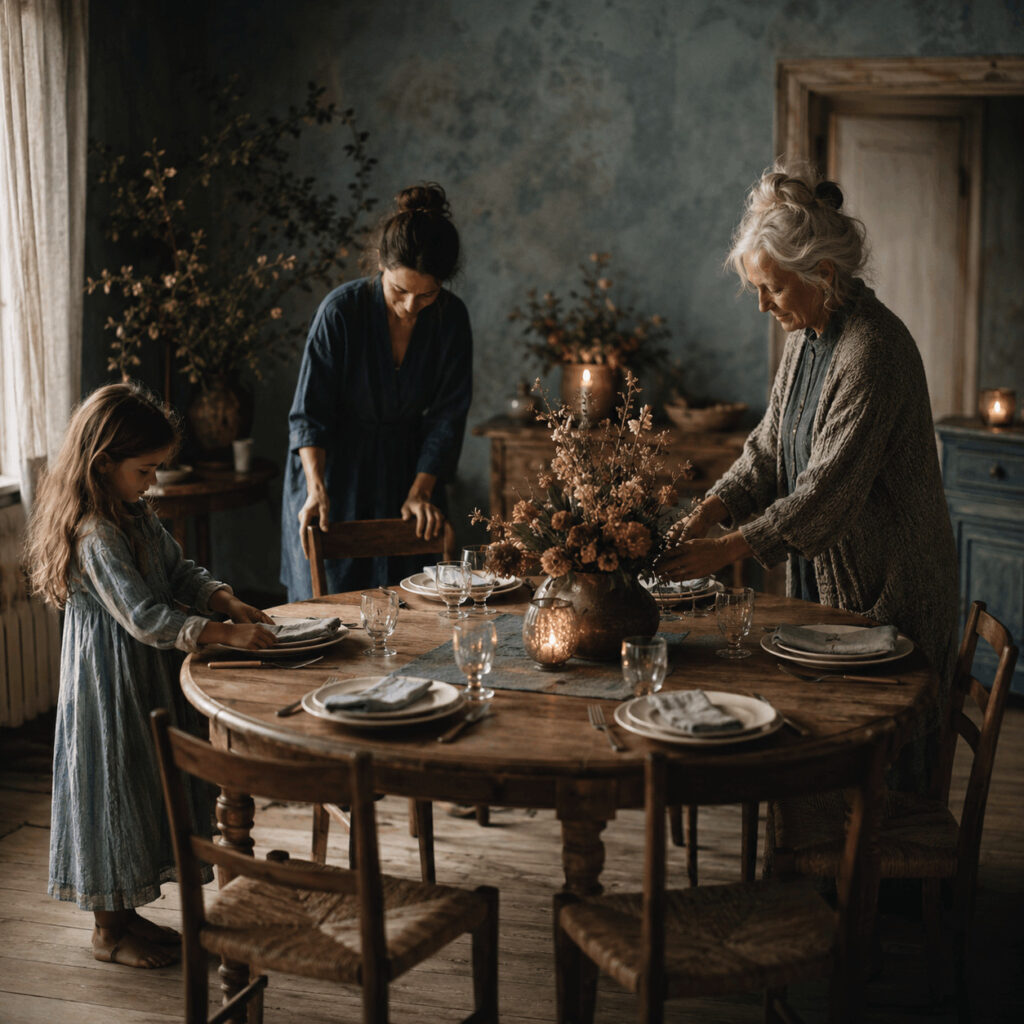
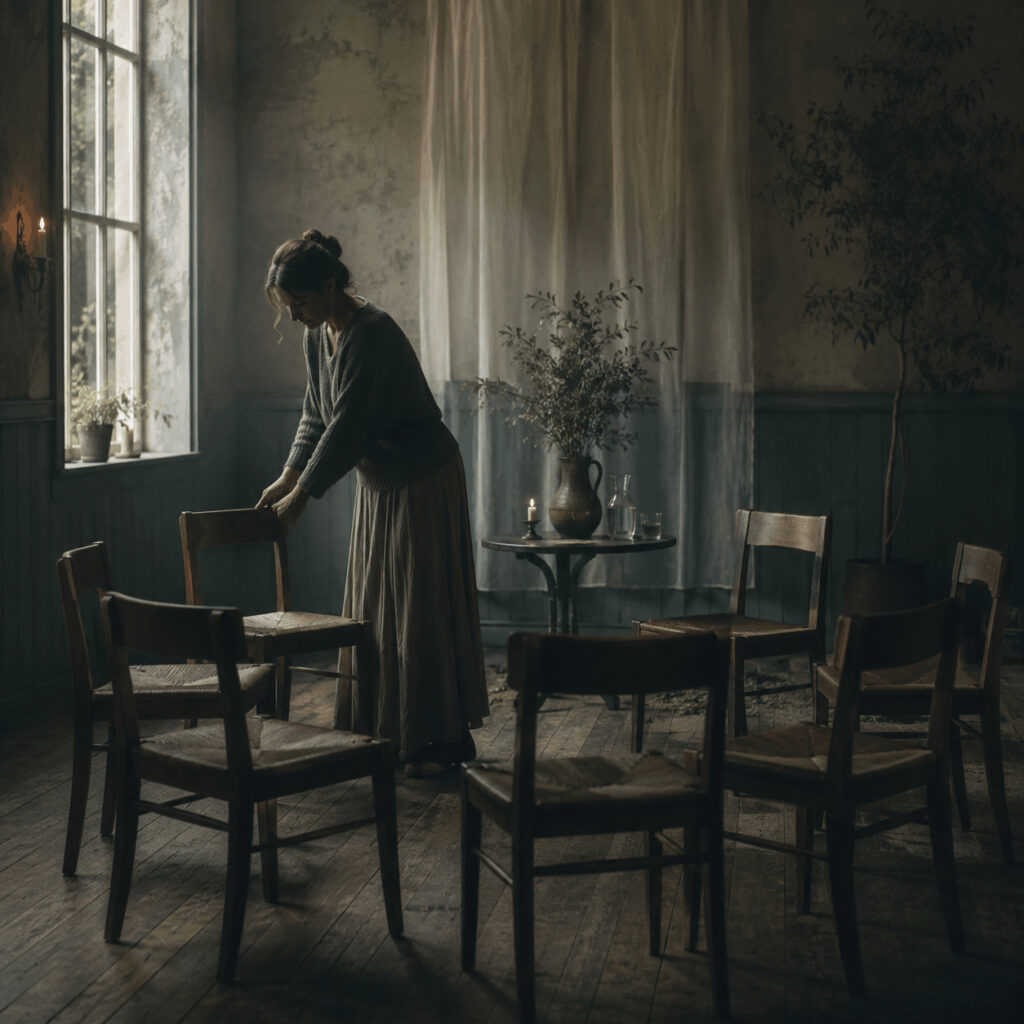
You can see the pattern in an ordinary room during a meal. You are finally relaxed, absorbed in a conversation you care about, when your eyes catch the empty glasses at the far end of the table. You know you could leave them. The people sitting there could ask, or get up, or refill them themselves. Yet the need has entered your awareness, and once you have seen it, continuing to sit still begins to feel almost like neglect. The choice is small but familiar: stay inside your own experience, or step out of it to care for the room.
This is how care often enters the 6 path: as the quiet pull to leave your own moment and tend to someone else’s comfort.
Life Path 6 can appear nurturing, resistant, exacting, artistic, protective or fiercely concerned with justice. The pattern may emerge through teaching, design, safeguarding, craftsmanship or a private sense that something important has been left uncared for. Some encounter the 6 through a strong resistance to being needed because they have already carried too much.
The deeper issue is what repeated encounters with care are teaching you about love, responsibility and your own place within the life you help to sustain.
The work of Life Path 6 is learning to let awareness, responsibility and choice remain separate long enough for care to find its rightful form.
At a Glance
| Attribute | Life Path 6 meaning |
|---|---|
| Core meaning | Care, responsibility, beauty, harmony, service and repair |
| Road of formation | Repeated encounters with what needs tending, protecting, improving or restoring |
| Central theme | Habitable love |
| Primary gift | A capacity this path may develop for making people, places and systems more humane and cared for |
| Strengths that may develop | Devotion, reliability, restorative intelligence, ethical care, guidance, beauty-making and protective warmth |
| Shadow pattern | Taking responsibility before it has been requested or shared |
| Named framework | The Hearth Test |
| Love | Learning to be known, cared for and valued beyond usefulness |
| Compatibility | Strongest where care and responsibility can circulate between both people |
| Career | Work involving care, education, guidance, design, hospitality, mediation, restoration or humane systems |
| Money | Provision and generosity may become entangled with love, guilt or duty |
| Wellbeing | The body may be noticed only after everybody and everything else has been attended to |
| Spiritual meaning | Allowing care to become a freely chosen blessing grounded in consent and shared responsibility |
| Correspondences | Venus, The Lovers, the hearth, the shared table, the hexagon and the mended vessel |
| Best next step | Pause before stepping in and ask whether the responsibility is yours, shared or someone else’s |
| Soul-breadcrumb | The 6 seeks a form of love strong enough to become a home. |
What Is a Life Path Number and How Do You Calculate It?
A Life Path Number describes recurring terrain through which a life may be formed. It illuminates the situations, pressures, gifts and questions that repeatedly shape someone over time.
The Life Path speaks from one part of the chart. The Personality Number concerns outer presentation and how someone may initially be experienced, while other chart numbers reveal different dimensions of longing, capacity and expression.
To calculate a Life Path Number, reduce the month, day and year of birth separately. Stop if 11, 22 or 33 appears within any of those three components. Add the resulting month, day and year values, then reduce the final total, again stopping if it becomes 11, 22 or 33. Do not flatten the full date into one uninterrupted string of digits.
Take 15 March 1986:
- Month: March = 3
- Day: 15 → 1 + 5 = 6
- Year: 1 + 9 + 8 + 6 = 24 → 2 + 4 = 6
- Final total: 3 + 6 + 6 = 15 → 1 + 5 = 6
The Life Path Number is therefore 6.
The calculation gives you the number. Its meaning begins to emerge through the experiences that repeatedly ask something of you. The rest of the numerology chart, along with upbringing, culture, relationships, temperament and choice, remains part of the larger pattern. How you answer that pattern is up to you.
How I Read Life Path 6
I begin a Life Path 6 reading by looking for the recurring encounters through which care, responsibility, beauty and repair have become charged. Labels such as nurturing, family-oriented or selfless are too narrow to reveal the path itself.
I look instead at the situations that keep appearing around the person. Where have they repeatedly found themselves close to something that needs care? What happens when a relationship becomes strained, a standard slips, a home becomes unsettled, someone is overlooked or a system begins treating people badly? Do they step forward, withdraw, correct, beautify, teach, organise, protect or decide that they are no longer carrying any of it?
The 6 pattern can take many outward forms. One person may meet it through parenthood or caring work. Another may encounter it through design, hospitality or restoring old buildings. Someone else may become the person who remembers what was promised, notices where a policy is hurting people or insists that a piece of work should be made with greater care.
Sometimes the pattern is less dramatic. Everybody says they are happy with any restaurant, while one person quietly ends up researching the menu, checking the parking and making the booking.
Resistance can also belong to the path. Someone who has spent years being recruited into responsibility may eventually refuse every demand that resembles care. The refusal may reveal how heavily the question has already been carried.
What I love about the 6 is its insistence that life can be made kinder, warmer and more beautiful through attention. A meal can be prepared. A frightened person can be accompanied. A neglected detail can be restored. A harsh space can be softened. Something broken can be mended rather than discarded.
I read that instinct by asking what kind of care allows life to grow and what kind quietly makes the giver responsible for holding the whole world together.
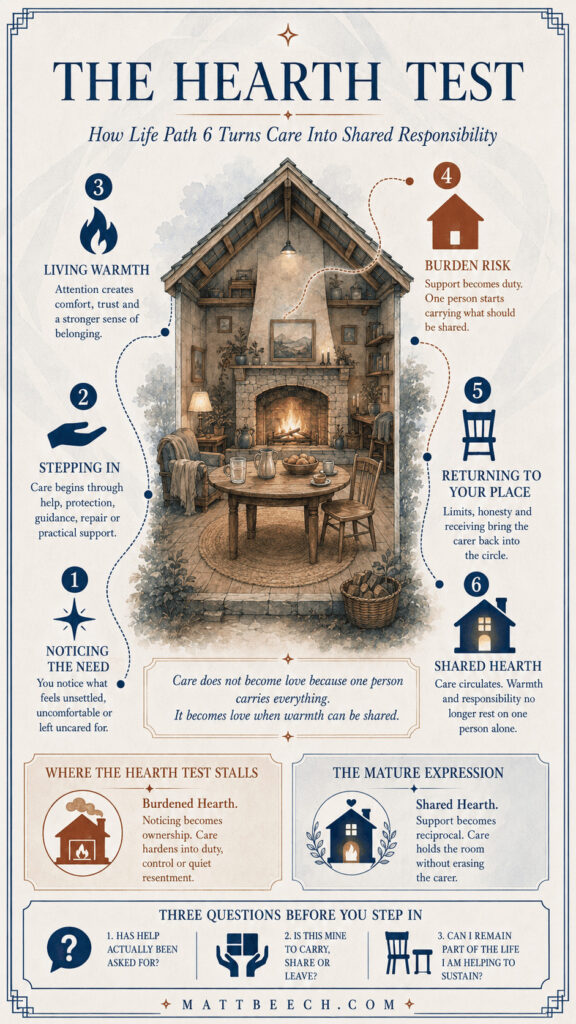
The Hearth Test
How Life Path 6 Turns Care Into Shared Responsibility
The Hearth Test is my name for the pattern by which Life Path 6 encounters what needs care, learns to create warmth and repair, risks turning love into endless responsibility, and may eventually discover a shared form of devotion in which care can circulate.
The framework maps a recurring encounter: someone finds themselves near discomfort, neglect, disorder or need and must decide what relationship they will have with it.
The hearth is an old image of warmth, nourishment and shared life. It is where food is prepared, stories are exchanged and people return from the cold. A hearth also needs tending. If one person alone must remain beside the fire while everybody else enjoys its warmth, the centre of the home has become a place of captivity.
The Hearth Test unfolds through six movements:
- The Disturbance — Something feels neglected, unsettled, unattractive, unsafe or out of relationship.
- The Tending Hand — A response becomes possible through help, protection, organisation, guidance, beauty, advocacy or repair.
- The Living Hearth — Attention creates greater warmth, coherence, trust or belonging. Life becomes more habitable.
- The Burdened Hearth — Responsibility expands beyond what was requested or agreed. Care begins turning into duty, control, guilt or quiet resentment.
- The Carer’s Chair — The person tending the fire returns to the shared life through honest need, limits, delegation, consent and receiving.
- The Shared Hearth — Care circulates. Love becomes dependable because responsibility no longer rests on one disappearing person.
This entire movement can happen in a few seconds. You notice someone struggling and, before checking what they want or what you can actually give, your mind begins organising the solution. Arrangements are made, time is offered and other commitments are quietly moved aside. The care may be sincere. It may also contain an unspoken assumption that noticing a need makes you responsible for meeting it.
The Hearth Test becomes useful in the space between noticing and taking ownership:
Is this mine to carry, mine to share or mine to leave with the person it belongs to?
The question returns choice, consent and proportion to the act of care.
The Deeper Meaning
Life Path 6 explores the human capacity to notice what makes life uninhabitable and respond through care, beauty, responsibility and relationship.
A room can become uninhabitable without anything visibly breaking. The conversation turns sharp. Nobody acknowledges what happened. Someone is repeatedly ignored. The objects remain intact, but the atmosphere no longer holds the people inside it.
Sometimes the response is emotional: an apology, a conversation, a hand resting on a shoulder. Sometimes it is practical: food, transport, protection, a repaired object, a clear plan. Sometimes it is aesthetic. Light, colour, order, music and beauty can alter how a life feels from the inside.
This is why six has long been associated with Venus and The Lovers. The symbolism reaches through romance into attraction, value, relationship and the instinct to bring life into a more pleasing form. The Lovers asks what we choose to unite ourselves with and which values will govern that union.
The hexagon offers another useful image. Its distinct sides meet precisely to create one stable shared form. Belonging arises through relationship while each part retains its own place and function. The honeycomb carries a similar suggestion. Each chamber has its own shape, yet the whole becomes stronger through relationship.
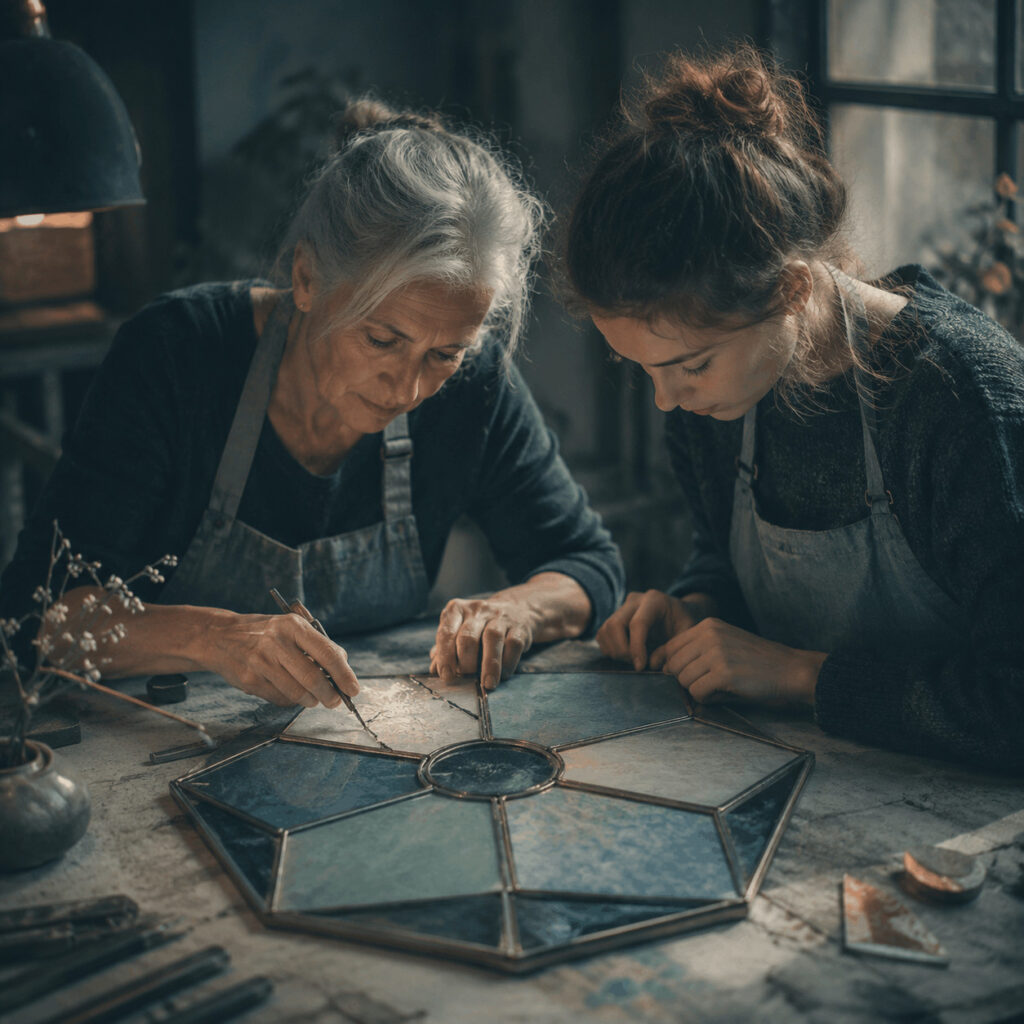
The mended vessel adds a different dimension. Repair acknowledges the damage and allows what was broken to re-enter life without allowing the break to become its entire identity.
A loving intention can still create dependency. A beautiful home can become a place where nobody is allowed to disturb the appearance of harmony. Advice can conceal a refusal to let another person find their own way. Protection can become possession. High standards can improve a system or make everyone inside it afraid to make a mistake.
Harmony, in this symbolic field, means right relationship rather than permanent agreement or a pleasing surface. Care, truth, difference, consent, responsibility and personal freedom must all retain a place. Sometimes mending the room means soothing what has become strained. Sometimes it means naming what everyone has avoided, allowing disagreement or refusing an arrangement that depends upon one person’s silence.
These distortions reveal the need for care that serves life while preserving the agency of everyone involved.
There is something quietly sacred in the ordinary acts associated with this path: preparing a place for someone, keeping a promise, mending an object that matters, protecting a person who has less power or creating beauty where life has become grey and mechanical. These acts say that the condition of the shared world matters.
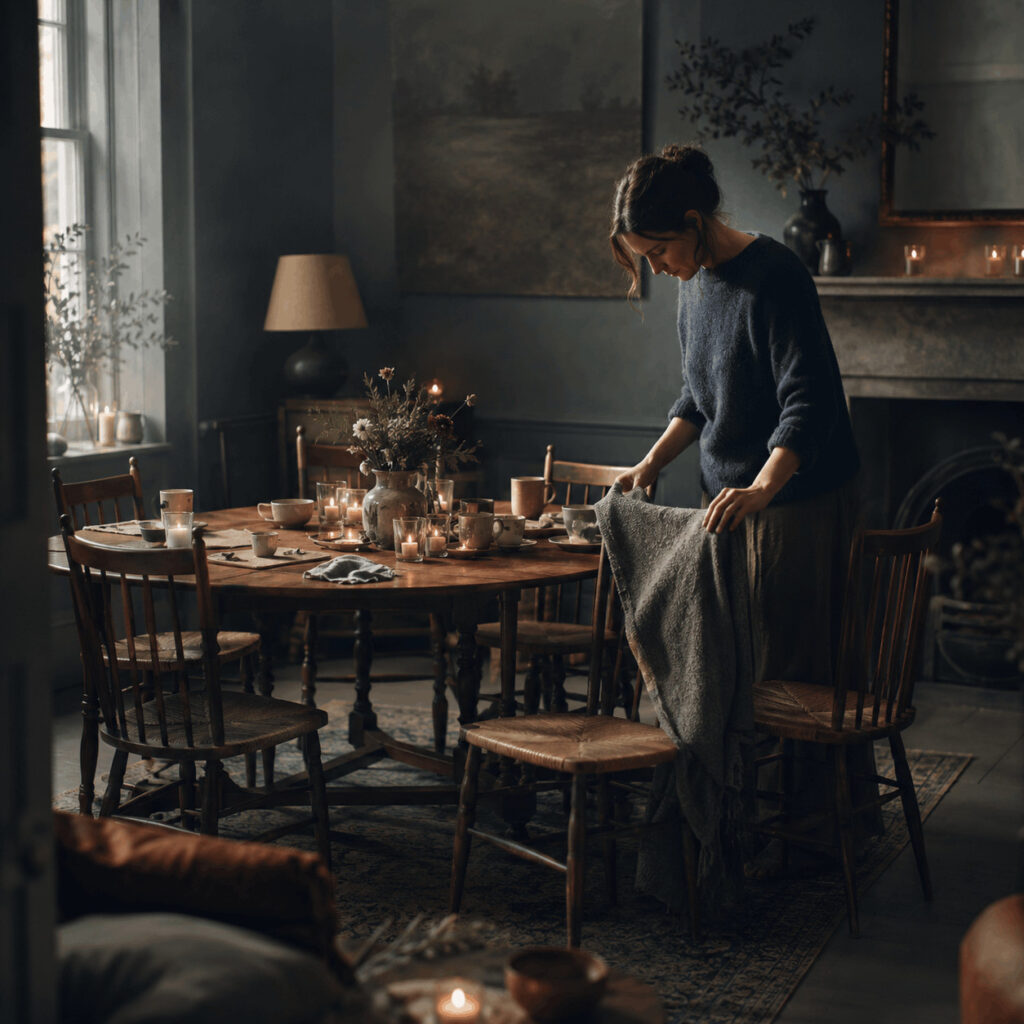
A habitable world, however, must contain the person who helps to make it habitable. The hand smoothing the cloth also belongs at the table.
Traits & Strengths
The strengths associated with Life Path 6 are capacities that may develop through repeated encounters with care, responsibility, beauty and repair.
Some people will recognise these capacities early. Others will build them slowly through work, relationships, mistakes and changing responsibilities. They may also appear unevenly: someone can be dependable at work and uncertain in intimacy, or deeply caring in private while resisting visible service roles.
- Restorative attention: Repeated contact with neglect or disorder can develop an ability to notice what needs repairing, reconnecting or bringing back into care.
- Dependable devotion: The path can strengthen the ability to give love practical form through presence, consistency, remembered details and promises kept.
- Protective warmth: Experience may teach someone how to create safety and welcome without needing to dominate the centre of attention.
- Beauty-making: The 6 journey can deepen sensitivity to how atmosphere, craft, colour, comfort and arrangement influence the way people feel and live.
- Ethical responsibility: Recurring responsibility can develop a strong awareness of promises, consequences and the wellbeing of those affected by a decision.
- Guidance and teaching: The wish to help life grow may find expression through encouragement, instruction, mentoring, standards and thoughtful correction.
- Relational repair: Meeting conflict and fracture can cultivate the ability to apologise, mediate, mend and help people return to shared ground.
These gifts often reveal themselves in details that look almost too ordinary to count: remembering what somebody cannot eat, making sure the new person is included, refusing to let poor workmanship become somebody else’s problem or noticing that a reasonable-looking rule is causing unnecessary harm.
The 6 contribution appears far beyond obvious acts of nurturing. An editor who protects the integrity of a book, a designer who makes a public space more humane and a manager who refuses to treat employees as disposable may all be giving form to the same deeper concern.
They are asking whether the world in front of them has been made with enough care.
At its fullest, that question gathers people back into a world where care can be felt in the workmanship, welcome, fairness and attention of ordinary things.
Weaknesses & Shadow Side
The shadow of Life Path 6 begins when noticing a need becomes an automatic claim of responsibility.
Imagine that the phone rings late in the evening. You are already tired, but the person on the other end is upset. They say they do not know what to do. Before you have asked what they need, whether anybody else can help or whether you have the capacity, you hear yourself offering time, money, transport or a solution. Your shoulders tighten and your mind starts rearranging tomorrow.
Later, perhaps while washing a cup or lying awake, resentment arrives. It feels shameful because nobody forced you to help. You volunteered. But the offer was made so quickly that it never passed through a genuine choice.
You can become so fluent in everybody else’s discomfort that your own needs begin to feel like an interruption.
Several shadow patterns may form around this pressure:
- The rescue reflex: Moving into solutions before another person has asked for help or had the chance to act for themselves.
- Care as control: Using advice, protection or high standards to manage uncertainty and direct other people’s choices.
- Unspoken accounting: Giving freely on the surface while privately remembering every effort that has not been returned.
- Perfected harmony: Treating disagreement, mess or imperfection as evidence that more intervention is required.
- Guilt around receiving: Feeling selfish, demanding or exposed when support begins moving in the opposite direction.
- Usefulness as belonging: Becoming most secure when needed and uncertain about your place when nobody requires anything.
- Resentful withdrawal: Continuing past capacity, then suddenly pulling away when the accumulated burden becomes unbearable.
The private reasoning beneath these patterns can be difficult to hear because it often sounds responsible: If I do not do it, it may not be done properly. If I say no, somebody may suffer. If I ask for anything, I am adding to the burden. If I am no longer useful, will I still belong here?
Calling this pattern selflessness can hide the point at which the person has lost access to genuine choice. Sometimes stepping in genuinely made a situation safer. Perhaps adults were unreliable. Perhaps peace depended on somebody noticing the mood of the room. Perhaps competence was praised while need was ignored.
The problem is not that you cared.
The problem is that a response which once helped may have become a standing contract nobody consciously signed.
Repair begins with a pause. The need remains visible, but concern has not yet become obligation. There is time to ask what has actually been requested, who else is involved and what can be given freely.
For a moment, the phone remains in your hand and the keys stay on the table. Choice has returned to the room.

Over the Course of Your Life
Life Path 6 can take very different forms depending on family, culture, relationships, work, health, resources and available choice. The stages below describe changing contexts rather than a fixed ascent from early care through exhaustion into later wisdom.
Earlier Life: When Care Enters Before You Have Chosen It
In earlier life, the 6 pattern may appear through sibling responsibility, keeping peace, helping adults, protecting someone more vulnerable or becoming known as “the mature one.”
It may also emerge more quietly through creating order or beauty in a private space, noticing what other people overlook or feeling responsible for the emotional temperature of the home.
In a supportive environment, these capacities can be welcomed while responsibility remains appropriate to the child’s age and place. In a less stable one, they may be recruited too early, so that care begins to feel less like a choice and more like the price of keeping things together.
Wider Adult Life: When Responsibility Expands
As life widens, so does the field of care. Partnership, work, friendship, home, community and ageing relatives can all increase the number of people, promises and practical demands asking for attention.
At this stage, the central issue is deciding what genuinely belongs to you. Some responsibilities belong to the role. Some belong to the relationship. Some need to be shared by a family, team or community. Others belong to the person whose life is directly affected.
The challenge is allowing visible needs to remain shared, negotiated or owned by the person whose life they concern.
Later Life: When Care Becomes More Deliberate
Later in life, the 6 pattern may become more selective. Care can take a quieter and more distilled form through mentoring, hospitality, craft, advocacy, community, teaching or the willingness to say no when stepping in would no longer be helpful.
Care may become quieter and more enduring: experience passed on, a place kept welcoming, a tradition preserved, a younger person encouraged or a hard-earned distinction named clearly.
What remains is the encounter with the condition of shared life: what has been neglected, what needs restoring and how care can move among everyone who belongs there.
The room changes, the body changes and the people around the table change. The enduring work is to let responsibility change hands as well.
What Changes and What Remains
Across these different stages, the circumstances change more than the underlying question.
A child trying to settle every argument, a professional improving an uncaring institution and an older person creating a place where others feel welcome may all be meeting the 6 pattern in different rooms.
What changes is the scale of responsibility, the body’s capacity, the authority someone holds, the support available and the freedom to choose a response.
What often remains is the encounter with the condition of shared life: what is being neglected, what needs restoring and whether care can be offered without one person being required to carry it all.
What Pop Numerology Gets Wrong
Popular descriptions of Life Path 6 often begin with genuine symbolism and then narrow it into a social role. The result is a portrait of the endlessly nurturing homemaker: loving, selfless, responsible, domestic and devoted to family.
That image may fit some lives. It cannot carry the whole number.
Life Path 6 Can Take Many Social and Creative Forms
The stereotype is understandable. Six is traditionally associated with home, family, harmony, relationship and Venus.
Life Path describes a recurring field of formation. Gender expression, sexuality, family structure, relationship status and the desire for children arise from a much larger human life.
The care-and-repair pattern may appear through friendship, art, ethics, design, work, teaching, activism, community or the restoration of places and systems. A single person with no interest in parenthood may be walking this path no less deeply than someone whose life centres on family.
When the number is reduced to domesticity, many people are wrongly made to feel that they do not fit their own calculation.
Life Path 6 Is Not a Command to Become a Selfless Healer
Service is a real part of the 6 symbolism, which is why the “natural healer” description feels attractive.
The problem is that it can turn exhaustion into spiritual evidence. Giving too much becomes proof of love. Being indispensable becomes proof of purpose. Exploitation is renamed devotion.
A Life Path Number does not assign a healing profession or require somebody to save other people. The path may develop caring capacities, but those capacities still need to be judged by what they produce. Do they strengthen the recipient’s agency? Are they freely chosen? Can responsibility be shared? Does the giver remain alive inside the exchange?
Martyrdom is not the perfected form of six.
Life Path 6 Seeks Harmony Through Truthful Relationship
For Life Path 6, harmony means right relationship: care, difference, truth, consent and responsibility held in living proportion. Someone walking this path may encounter conflict precisely because these qualities have fallen out of relation.
The number may become significant precisely because disharmony keeps demanding a response. High standards, frustration, conflict sensitivity and critical attention can all gather around the desire to make things better. Someone may care so strongly about harmony that they become controlling. Another may abandon harmony altogether because maintaining it has cost too much.
The deeper pattern is learning what creates genuine relationship and what merely creates a pleasing surface.
Some numerology approaches place domestic responsibility and family life much closer to the centre of six. I treat those as important possible expressions of the number, but not as its complete meaning. My broader reading begins with care, value, beauty, responsibility and repair, then asks what forms those forces actually take in a particular life.
Love & Relationships
In love, the Life Path 6 pattern can develop a beautiful capacity for tangible devotion. Affection becomes remembered details, practical support, loyalty and the wish to create a relationship that can survive ordinary life.
The difficulty begins when care replaces intimacy.
Your partner sits on the sofa after a difficult day. Before they have finished explaining what happened, you are suggesting what to say, what to change and how the problem could be prevented next time. The advice may be intelligent. It may also move both of you away from the more vulnerable experience of being there together without immediately fixing anything.
People shaped by repeated responsibility can become easier to rely upon than to know. Need may be hidden because it feels inconvenient. Preferences may be expressed as practical suggestions. Disappointment may appear as criticism of how something was done. Love may be given in enormous quantities while the giver waits for another person to notice what has never been spoken.
This creates an odd loneliness. The relationship may depend upon you, appreciate you and still fail to meet you.
Receiving care can feel more exposing than offering it. When giving, you know your role. When receiving, you have to let another person encounter a need they may not fulfil perfectly.
That vulnerability belongs to the 6 path and helps make love habitable. One simple sentence can change the movement of an ordinary conversation:
Do you want help, witness or company?
It makes room for the other person’s agency and gives care more than one available language. Their answer may be help, witness, company or a request that asks you to remain present without taking control.
Intimacy deepens because both people are allowed to shape what care becomes.

Romantic Compatibility
Life Path 6 compatibility rests on whether care, responsibility, freedom and emotional labour can move between two people without becoming fixed roles.
| Pairing | Relationship pattern |
|---|---|
| 1 & 6 | Warmth and initiative can work well, but 1 may resist 6’s advice or protection. |
| 2 & 6 | Deeply attentive, though both may hide needs and wait to be understood. |
| 3 & 6 | Creative and affectionate, but 6 may carry the practical weight. |
| 4 & 6 | Loyal and dependable, though duty can crowd out play and softness. |
| 5 & 6 | Freedom meets stability, but spontaneity and responsibility need negotiation. |
| 6 & 6 | Devoted and welcoming, with a risk of overgiving or rescuing each other. |
| 7 & 6 | Quietly loyal, but 6 may seek closeness while 7 protects space. |
| 8 & 6 | Strong and capable, though control and authority can become contested. |
| 9 & 6 | Compassionate and service-minded, but the relationship may revolve around others. |
| 11 & 6 | Sensitive and idealistic, but 11’s intensity may overwhelm 6’s need for steadiness. |
| 22 & 6 | Capable of building something lasting, though responsibility can become heavy or unevenly shared. |
| 33 & 6 | Deeply caring and service-oriented, with a strong risk of martyrdom or mutual overgiving. |
The whole numerology chart matters, as do maturity, history, communication and lived behaviour. The pairing describes a possible movement; the relationship itself is shaped by the people living it.
A supportive relationship recognises care, shares responsibility and allows honest need to enter without threatening the bond.
The shared hearth stays warm because both people can tend it, rest beside it and say when the room needs changing.
Careers & Jobs
Life Path 6 may find meaningful expression in work that improves how people are cared for, taught, protected, welcomed or supported. It may also appear in work that makes environments, services and systems more beautiful or humane.
These fields show where the pattern may become useful; they are possibilities rather than assigned vocations:
- Care and wellbeing: Counselling, nursing, therapy, social work, rehabilitation, safeguarding, support services and wellbeing roles.
- Teaching and development: Teaching, training, coaching, mentoring, learning design, pastoral care and child development.
- Beauty, design and environment: Interior design, architecture, visual design, styling, floristry, hospitality, food, craft, conservation and restoration.
- People, mediation and community: Human resources, people operations, mediation, customer success, charity work, community management and nonprofit roles.
- Standards, protection and improvement: Advocacy, law, editing, quality assurance, service design, ethics, compliance, user experience and work that makes systems safer or more humane.
The distinct pattern is improving the lived condition of a person, place, relationship or system.
A teacher gives knowledge a form another person can inhabit. A designer changes the emotional quality of a room. An editor protects the reader from careless work. A safeguarding professional notices where responsibility has failed. A hospitality worker creates an atmosphere in which strangers feel expected rather than tolerated.
When I read the 6 in relation to work, I pay particular attention to the responsibilities being carried outside the formal role. Competence can attract unlimited expectation. The person becomes the one who remembers, smooths, listens, organises and picks up whatever everybody else has left behind.
Role clarity gives care a structure: what belongs to you, what belongs to the team and what remains with the person being helped. The work becomes more sustainable as responsibility moves through explicit roles, agreements and support instead of depending upon private sacrifice.
Money & Wealth
Money can carry strong relational meaning along the Life Path 6 journey because resources often become connected with safety, generosity, comfort and responsibility.
A shared bill is rarely just a number on a screen once it has gathered the emotional charge of provision. Paying may mean, I will not let the people I love go without. Giving a gift may mean, I remembered you. Creating a beautiful home may mean, You are safe and welcome here.
These expressions can be generous and deeply human, but money becomes complicated when it starts doing emotional work that has never been named.
You may cover a cost to prevent discomfort, then feel unseen when the gesture is treated casually. You may spend on other people without hesitation and feel guilty buying something purely for yourself. You may undercharge for caring or creative work because asking for money appears to contaminate the goodness of what you offer.
Money can also become a way of keeping the hearth under control: ensuring there is enough, fixing every emergency and protecting other people from the consequences of their own choices.
The same payment can carry freely chosen care, guilt, fear or a bid for belonging. The figure on the screen cannot reveal which one is present; the choice, agreement and emotional aftermath usually can.
Money becomes easier to understand when it is allowed to provide resources without being made responsible for proving anybody’s goodness.
Wellbeing
The Life Path 6 wellbeing challenge often concerns whether someone who understands care and nourishment can also receive them.
When attention is repeatedly trained outward, bodily needs can become background information. Hunger is noticed after the task is finished. Tiredness becomes visible once everybody has gone home. The shoulders rise while a problem is being managed, but the tension enters awareness only when the room is quiet.
This is an embodied question opened by the symbolism of the number, not a medical rule or diagnosis.
Notice what happens physically when responsibility enters the room. Breath may shorten. Movement may quicken. Rest can begin to feel like something that must be earned after everything has been resolved. Meals, sleep and pleasure become negotiable while another person’s need feels immediate.
Even self-care can become another performance of responsibility. The perfect routine or carefully organised evening becomes one more standard to maintain. The body may need inclusion more than another improvement project.
A meal is eaten before exhaustion. The earlier night remains in the plan. The appointment is kept, and the walk has no usefulness attached to it.
The person who notices everybody else has been included within the circle of care.
Spiritual Meaning

The spiritual invitation of Life Path 6 is to let care become devotion while the giver remains a living participant rather than an instrument for everybody else.
Spirituality is often imagined as ascent: leaving the ordinary world behind, entering altered states or reaching towards some greater reality. The 6 symbolism finds the sacred moving in another direction. It enters the ordinary and makes a dwelling there.
Food is prepared. A lamp is lit. A promise is honoured. A neglected person is welcomed. A damaged object is repaired because it still carries meaning. A room is arranged so that beauty can meet someone whose life has become harsh.
These acts matter because they embody attention, relationship and value. They need no claim of cosmic assignment to become sacred.
For me, this is where the 6 touches something larger than personality. The ordinary act of making a life more liveable can become a blessing, while the giver remains free to step away from the altar.
The Lovers offers an important spiritual image here. Love becomes meaningful through choice. It is not purified by becoming compulsory. Service offered through fear, guilt, superiority or the need to remain indispensable may appear virtuous while quietly diminishing both people.
The fruit reveals the quality of the care. Mature devotion restores dignity, strengthens agency and allows responsibility to circulate. The giver remains human—capable of fatigue, preference, refusal, pleasure and need—while the receiver remains a participant rather than a dependent object of rescue.
The sacredness of care lies in the quality of participation it creates: greater truth, freedom, responsibility and life shared among distinct people.
Bless without binding.
FAQs
How Do I Know When It Is My Responsibility to Help?
Notice the difference between recognising a need and being responsible for meeting it. Ask whether help has been requested, whether the responsibility is genuinely yours and whether other people are able to participate before you step in.
How Can I Care Without Overgiving?
Let care pass through choice. A clear no, a smaller offer or allowing someone to solve their own problem can protect the relationship from resentment while leaving your warmth intact.
What If People Have Become Used to Depending on Me?
Changing the pattern may disappoint people who benefited from you carrying more than your share. Begin by naming what you can still offer, what must now be shared and what you will no longer take responsibility for; their discomfort may simply show that a familiar arrangement is changing.
Closing Reflection
Return to the table from the beginning.
The meal is over. Some plates have been cleared, but not all of them. A glass remains empty. The cloth is slightly crooked. Nothing terrible happens.
Another person notices what needs doing and reaches for the glasses. Let them do it in their own way. The unfinished task has remained visible long enough for responsibility to find another pair of hands.
There is still one empty chair.
Sit in it.
Let one need, preference or limit enter the room without disguising itself as advice, efficiency or service. The life you have helped make warmer now has enough room to contain you.
The table becomes whole when the person who tends it can also belong there.
Sit in it.
Let one need, preference or limit enter the room without disguising itself as advice, efficiency or service. Let the life you have helped make warmer become warm enough to contain you.
The table is not whole until the person tending it is allowed to sit down.

The Whole Chart Changes the Meaning of the Room
Life Path 6 shows where care, responsibility, beauty and repair may repeatedly shape your life. It reveals one enduring question—but it does not answer for every part of you.
Elsewhere in your numerology chart are numbers that may resist this pattern, deepen it or carry you towards entirely different concerns. They speak to private desires, developing gifts, outward expression and the ways you instinctively meet the world.
Use the numerology calculator to uncover the rest of your chart. The fuller pattern may show where you are called to care, what supports or complicates that movement and which other parts of you must also be given a place at the table.
More Life Path Numbers
About Matt Beech

Matt Beech is a mystic, magician and spiritual philosopher who has spent more than twenty-two years studying and practising tarot, astrology, numerology, magick and ritual. His work explores how symbols connect the visible and unseen, how spiritual forces shape human experience, and how we can participate in those patterns with greater wonder, discernment and conscious intent. Learn more about Matt here.
Leave a Reply