Life Path 2: Hearing What Lives Between People

In numerology, Life Path 2 is the road of learning how to connect deeply with other people while still expressing what you feel, want and need.
Its distinctive gift is attunement. In simple terms, attunement is the sensitivity to notice small changes in tone, mood, body language and atmosphere. It can develop into empathy, emotional intelligence, patience and diplomacy: the ability to hear what each person is trying to protect, translate between different points of view and help people find common ground. This is why Life Path 2 is often called the diplomat, mediator or peacemaker. Its deeper gift is helping people meet without either side being ignored.
You may recognise this gift in a meeting, a family meal or an evening with friends. Someone begins to make a point, but another person interrupts before they can finish. They smile, lower their eyes and let the conversation move on. While everyone else follows the louder voice, you notice that they have stopped trying to speak. A few minutes later, you return to them: “You were saying something earlier. What did you want to add?” They begin again, and the group hears something it would otherwise have missed.
This is attunement in action: noticing where connection has quietly broken down and making enough room for someone to return.
Your Life Path number is not your whole personality. It describes a recurring kind of experience through which you may be shaped over time. Rather than assigning you a fixed set of traits, it points towards the questions, pressures and choices that repeatedly ask something of you. For Life Path 2, those experiences often arise through relationship: listening and responding to others while learning to give your own feelings, preferences and truth an equal place. The number does not decide who you become. It names a living pattern whose final form depends partly on how you meet it.
The symbolism of 2 begins whenever one life meets another: two voices in a conversation, two places at a table, two shores joined by a bridge. Harmony, in this sense, is right relationship between two distinct people. Each can listen, answer, influence and be influenced while remaining fully present. Like a bridge, the connection depends on both shores remaining intact. Life Path 2 asks how sensitivity can create that kind of meeting, so that different needs, preferences and truths can enter the relationship without threatening the bond.
At a Glance
| Attribute | Life Path 2 meaning |
|---|---|
| Core meaning | Sensitivity, cooperation, intuition, relationship and emotional awareness |
| Road of formation | Learning to build relationships where both people can speak, choose and remain fully present. |
| Primary gift | Attunement: noticing subtle emotional shifts and responding in ways that help people feel heard, understood and included. |
| Key strengths | Listening, diplomacy, patience, emotional insight, cooperation and subtle intuition |
| Weakness & Shadow | Keeping the peace by staying quiet, agreeing too quickly or hiding what you really want. |
| Love and relationships | Deeply attentive in love; relationships grow stronger when both people can say what they need and disagree honestly. |
| Compatibility | Works best where sensitivity, difference and direct communication can coexist |
| Career | Mediation, research, care, education, coordination, diplomacy and design, especially where different people or needs must be brought together. |
| Money pattern | Money may become entangled with fairness, belonging, generosity and guilt |
| Wellbeing | Often sensitive to atmosphere, emotional strain, noise, conflict and lack of restorative space |
| Spiritual lesson | Listen deeply while discerning what is yours, what belongs to others and what deserves trust. |
| Best next step | State one small preference before adapting to everyone else |
| Symbolic lenses | The Moon, the High Priestess, water, mirrors, two cups and bridges |
| Guiding image | A bridge holds because both shores remain. |
How I Read Life Path 2

What interests me about Life Path 2 is not simply that they notices feelings. But that it notices how those feelings affect the conversation and the relationship: who begins to hold back, who takes up more space, what each person is trying to protect and whether there is still room for both people to speak.
What matters next is how that awareness is used. A life path 2 may help both people communicate more clearly and relate more easily, or it may make them so focused on keeping the conversation comfortable that they stay quiet, agree too quickly or hide what they really think.
That tells me more than familiar descriptions such as kind, cooperative or diplomatic. Two people may both listen carefully, but one listens because they genuinely want to understand while the other listens because disagreement feels dangerous. The behaviour looks similar, but one creates a more honest conversation while the other keeps the peace by hiding what they think.
At its strongest, the intelligence of 2 is active. A well-timed question can bring someone back into a conversation. A mediator may recognise that an argument about money is really about trust, or that a disagreement over plans has grown because one person feels overlooked. Life Path 2 can help people stop arguing around the problem and begin discussing what is actually wrong.
I do not read this number as a permanent job description. It does not require you to become everybody’s helper, interpreter or keeper of the peace. Noticing that someone is upset does not mean you know exactly what they feel, and understanding their behaviour does not mean you have to accept it.
For me, the deeper question is what happens after you understand another person. Does that understanding help both of you speak more honestly and make a decision together, or does it lead you to keep adjusting until nobody knows what you want?
The Attunement Bridge
How Sensitivity Becomes Voice and Mutuality
The Attunement Bridge is my name for the pattern through which Life Path 2 learns to turn sensitivity into a relationship where both people can speak, influence what happens and remain themselves.
It begins whenever another person enters the picture. Their mood, needs, expectations and way of communicating create something that neither person could create alone. Life Path 2 often notices this shared atmosphere quickly, but the path is shaped by what happens after that noticing.
- Encounter — You enter a conversation, relationship or group in which different feelings, needs or points of view must meet.
- Attunement — You notice changes in tone, timing and body language. You sense who is comfortable, who is holding back and where tension may be forming.
- Erasure Risk — You begin trying to keep the connection comfortable by staying quiet, agreeing too quickly or putting the other person’s preferences before your own.
- Voice — You say what you think, feel or want while continuing to listen to the other person’s response.
- Mutuality — Both people help shape the relationship. Neither person has to become smaller in order for the connection to survive.
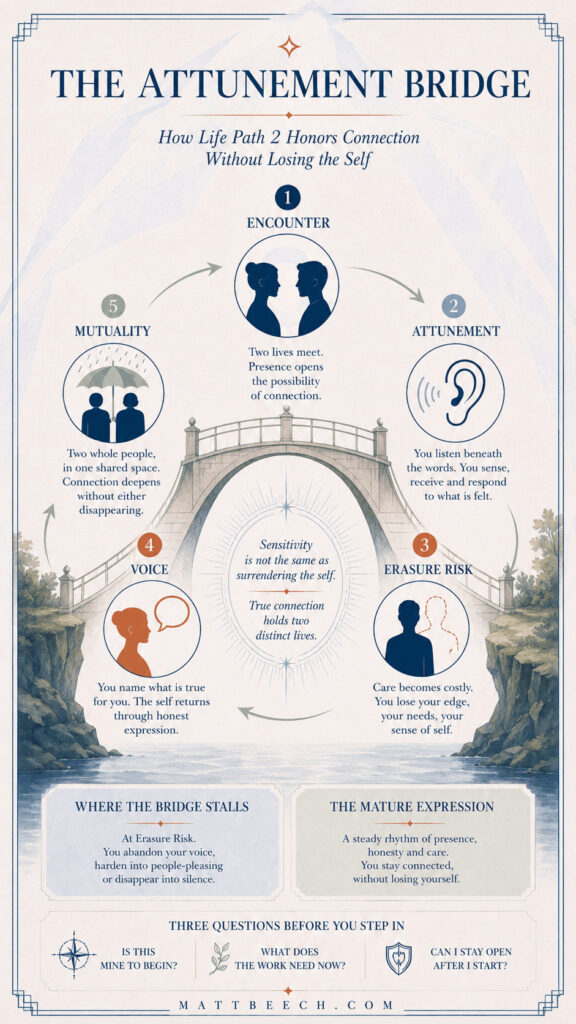
The image of a bridge matters because relationship depends upon two sides. Attunement helps you notice what is happening on the other shore, but it does not ask you to abandon your own. The bridge becomes unstable when one person is expected to cross every distance, absorb every tension and make every adjustment.
You may feel this pattern in small moments. A friend seems disappointed by the restaurant you have chosen, so you immediately offer to go somewhere else. Your partner sounds tired when you mention plans for the weekend, so you say it does not matter and drop the idea. A colleague objects to your suggestion, and before discussing the disagreement, you begin rewriting your position into something they will find easier to accept.
None of these responses is automatically wrong. Flexibility can be generous, and changing your mind can be wise. The question is whether you are responding freely or trying to prevent the discomfort of having two different preferences in the same relationship.
Voice enters when you allow the difference to remain long enough for a real conversation to happen. You might say, “I would still prefer this restaurant, but tell me what is bothering you,” or, “I can hear that you are tired, though this plan matters to me. Can we find a version that works for both of us?” You are still listening, but you are no longer treating your own preference as the easiest thing to remove.
This is where attunement becomes mutuality. The relationship is no longer being protected by one person’s constant adjustment. Both people can answer, negotiate, change their minds and discover what the connection is capable of holding.
The pattern stalls when peace is maintained by silence, automatic agreement or the quiet removal of your own needs. It moves forward when sensitivity helps two people understand one another without deciding in advance that only one person’s truth can remain.
Mature Life Path 2 is sensitivity with a voice, creating a bridge strong enough for both sides to cross.
The Deeper Meaning
Life Path 2 carries the mystery of what happens when one becomes two.
One stands alone. Two introduces another centre of experience: another will, another history and another way of seeing. Difference enters the world, but so does relationship.
Geometry gives this a simple form. One point marks a position. Two points create a line and an interval between them. That space is not empty. It creates direction, distance and the possibility of movement from one side to the other.
The mirror belongs naturally to this pattern. It receives the image before it without becoming the person reflected within it. Yet a mirror also reverses what it shows. What you sense in another person may carry truth, but it still passes through your own memories, expectations and emotional state. Attunement becomes discernment when an impression is allowed to meet the other person’s actual words.
Water carries the pattern further. A still pool reflects the sky, while the smallest disturbance moves across its surface in rings. In the same way, a change in tone or a moment of silence can alter an entire conversation before anybody names what has happened.
Water also needs form. A river moves because its banks give it direction, and a bowl can hold water because it has a boundary. Receptivity works in much the same way. Sensitivity becomes useful when it has enough shape to listen, respond and remain present without absorbing everything around it.
This is why many numerological traditions connect 2 with the Moon. The Moon shines through reflected light, moves the tides from a distance and passes through visible phases of fullness and concealment. Its influence is relational and rhythmic. It suggests that receptivity has timing: moments to listen, moments to wait and moments when what has been sensed must finally be spoken.
Tarot gives this field a human figure in card II, the High Priestess. She sits between two pillars, holding the tension between them without rushing to remove either side. Her stillness is structured. She listens to what moves beneath the surface while remaining present enough to judge what deserves trust, what needs time and what must be questioned.
For me, the bridge completes the pattern. A bridge begins with two shores and a distance between them. It does not remove the river or make the shores identical. It creates a passage through which each side can be reached.
This is the deeper meaning of harmony for Life Path 2. Harmony is right relationship between distinct lives. Each person can listen and answer, influence and be influenced, without becoming an extension of the other.
The sacred work of 2 is to keep that passage open. Two becomes more than division when truth, care and understanding can cross in both directions.

Traits and Strengths
Life Path 2 does not guarantee a fixed set of personality traits such as sensitivity, empathy, patience or diplomacy. It repeatedly brings you into situations where cooperation, partnership, emotional intelligence and conflict resolution matter. How you respond to different needs, feelings and points of view may gradually develop deep listening, compassion, tact, mediation skills and the ability to create harmony without silencing yourself.
Attunement is the beginning of that intelligence, but noticing alone is not the finished gift. Through repeated encounters with different needs, temperaments and points of view, this path may teach you how to help people listen to one another, work through differences and build more harmonious relationships in which both sides have room to speak.
What I love about Life Path 2 is that its influence can often be seen in the quality of the whole. A meeting becomes less dominated by the loudest voice. A family plan makes room for the person who usually gives way. Two people finally understand the same disagreement because somebody has found words that both can hear.
Common strengths that may deepen through this path include:
- Inclusive attention: Empathy and emotional awareness may help you notice who has been overlooked, interrupted or excluded, then make room for them to contribute.
- Relational judgement: Patience, tact and emotional intelligence can teach you when to ask a question, when to wait, when gentleness will help and when honesty needs to be direct.
- Emotional translation: Deep listening and intuition may help you express one person’s feelings or concerns in language another person can understand, making mediation and conflict resolution easier.
- Collaborative intelligence: Cooperation and teamwork can develop into an ability to combine different ideas, skills and working styles without allowing one voice to dominate the group.
- Trust-building consistency: Loyalty, kindness and supportive attention may appear through remembering what matters to people, keeping small promises and following through when others depend on you.
- Early repair: Sensitivity to mood and emotional tension can help you notice misunderstandings before they harden into resentment, giving people a chance to speak honestly and restore harmony.
- A sense of proportion: Diplomacy and perceptiveness may sharpen your feeling for balance, timing and rhythm, helping you recognise when one person’s needs, opinions or emotions have begun to overwhelm everyone else.
When these capacities are consciously developed, their value appears in what becomes possible around you. More people contribute, misunderstandings are addressed before they deepen, and cooperation no longer depends on the most accommodating person carrying the whole relationship. The effect may be quiet, but it is real: trust grows, decisions improve and people leave with a clearer sense that they were part of what happened.
This is one of the deeper strengths Life Path 2 can develop. Sensitivity becomes a way of shaping shared life so that different people can speak honestly, influence what happens and still remain connected. Harmony here does not require everyone to agree. It means creating relationships strong enough to hold more than one voice.

Weaknesses & Shadow Side
Sometimes the shadow of Life Path 2 does not look like open conflict. It looks like a conversation that ends pleasantly while something true has remained unsaid.
You may know this kind of experience. You are sitting around a table with family or friends, the conversation moving easily until someone says something that upsets you. It may be dismissive, unfair or simply at odds with what you believe. You are about to answer, but before the words come, you notice the room changing: one person looks down, another becomes unusually quiet, and the atmosphere tightens around the table.
Your attention shifts away from your own reaction and towards everyone else. You begin thinking about what might happen if you challenge the remark. The evening could become awkward. Someone may become defensive. Another person may feel caught in the middle. So you soften what you were going to say, turn it into a joke or let the conversation move somewhere safer. The tension passes, and everyone settles again.
Later, while washing a cup or lying awake replaying the moment, you realise that the calm was restored by hiding what the exchange was actually like for you.
The deeper problem is that the other person never sees what the moment was actually like for you. They may leave believing that you agreed, were unaffected or genuinely did not mind. The relationship stays comfortable, but it loses the chance to discover whether it can hear your disagreement, respond to your feelings and remain connected.
When Life Path 2’s gift of attunement becomes organised around preventing rupture, it may develop into patterns such as:
- Self-erasure and weak boundaries: You adapt so thoroughly to other people that your own feelings, needs and preferences barely enter the situation.
- Conflict avoidance: A disagreement can feel like evidence that the relationship itself is becoming unsafe.
- People-pleasing and approval-seeking: You agree quickly, offer reassurance or make yourself easy to accommodate before deciding what you actually think.
- Indirect communication: You hope another person will notice what you need because stating it clearly feels exposing or disruptive.
- Emotional absorption and over-responsibility: Another person’s mood begins to feel like something you must carry, soothe or repair.
- Indecision and decision deferral: Choices become difficult because every option might disappoint, inconvenience or exclude somebody.
- Hidden resentment: You give more than you freely chose, then feel hurt when nobody recognises a sacrifice they did not know you were making.
The private reasoning beneath these patterns is understandable: if you speak honestly, the atmosphere may change; if the atmosphere changes, the connection may no longer feel safe.
Some people learn early that disagreement can be handled safely. Others learn to watch the mood of the room because anger, silence or withdrawal might arrive without warning. A child in that kind of home may become very good at knowing when to speak, when to stay quiet and how to behave so that everyone remains calm.
Later, the same habit can look like kindness or emotional intelligence, even when it has become exhausting.
Someone walking Life Path 2 may not appear gentle or openly sensitive. Years of managing other people’s moods can make them guarded, private, blunt or difficult to reach. The sensitivity has not disappeared. It has learned to protect itself by keeping some distance.
Repair begins when the other person receives something real to respond to: a preference stated before it becomes resentment, a warm no, an honest objection or a disappointment that is allowed to remain visible.
The relationship may become briefly less comfortable. But it can now answer you. The other person can listen, negotiate, apologise, disagree or reveal the limits of what the bond can hold.
That is how performed harmony gives way to right relationship: peace is no longer purchased by one person’s disappearance, but created through two people meeting what is actually true.

Over the Course of Your Life
Life Path 2 does not unfold through one fixed story. The same awareness can take different forms as the environment, responsibilities and available choices change.
Earlier Life
In earlier years, the gift may appear as observation, imagination, loyalty or unusual awareness of the people nearby.
Some children walking this path become attentive companions. They notice who has been left out, remember how others feel and move easily between different personalities.
In a stable environment, this sensitivity may grow alongside confidence. The child learns that listening and speaking can coexist, that disagreement is survivable and that emotional subtlety has value.
In a more volatile or dismissive environment, the same sensitivity may become watchfulness. The child learns to read the room before entering it fully. They may stay quiet, adapt quickly or construct a tougher outer style that keeps their receptive nature protected.
Middle Life
As work, intimacy, family, money and care responsibilities become more complex, the gift begins carrying larger consequences.
Someone walking Life Path 2 may become the unofficial translator in a workplace, the person who knows why a team is not functioning even though every formal report says it should be. In a family, they may remember everybody’s needs and quietly organise the emotional movement between conflicting personalities.
At this point, invisible contribution often needs language. Cooperation works better when roles are clear, agreements are spoken and the person’s own judgement is recognised rather than merely absorbed into the background.
Some 2s discover that they are excellent leaders precisely because they notice what more directive leaders overlook. Others become more selective about where they offer their attention, realising that sensitivity is a resource rather than an unlimited public utility.
Later Life
Later expression may bring greater economy. Attention becomes more selective, and the person chooses which emotional movements deserve a response.
They may become a mentor, mediator or quietly influential presence who understands the difference between being available and being absorbent. Some become more direct with age. Others become playful, allowing ordinary preferences to remain ordinary rather than negotiating each one like an international treaty.
Maturity can appear at any point. What may change is the freedom with which the gift is carried. The underlying attunement remains recognisable while becoming less compulsory and more deliberately given.

What Pop Numerology Gets Wrong
Simplified numerology often turns Life Path 2 into the gentle helper who avoids conflict and supports more important people. The stereotype catches something recognisable, but it misses the actual force of the number.
Life Path 2 Is Not Inherently Passive
I can see why the 2 gets called passive. Its power rarely arrives by kicking down the door.
A mediator changes the conditions of a conflict. A skilled interviewer draws out information that would otherwise remain hidden. A musician responding to another performer is not sitting idle. A negotiator who senses when somebody can finally hear an alternative is exercising judgement and influence.
The 2 often works through response rather than impact, but response is still action. Calling it passive can cause someone to undervalue their real intelligence or perform unnecessary hardness to prove that they are capable.
Life Path 2 Can Carry Real Authority
The association between 2 and cooperation is sometimes turned into a hierarchy: the 1 leads while the 2 assists.
That may make a tidy chart, but it makes poor numerology.
A Life Path describes a road of formation. Social rank and supporting roles belong to no number. A 2 may lead organisations, build businesses, direct creative projects or make difficult decisions. Their style may be consultative and perceptive, but that does not make it less authoritative.
The supporting-role stereotype becomes harmful when invisible labour and unequal relationships start looking spiritually appropriate. Cooperation is a capacity, not a command to remain secondary.
Love & Relationships
Life Path 2 in love may develop affection, loyalty, patience and emotional intelligence. You may remember small details, notice changes in your partner’s mood and create emotional security through warmth, consistency and thoughtful care. The deeper challenge is reciprocity: allowing yourself to be known as fully as you know the other person.
Imagine two cups on a table. You notice when your partner’s cup is running low and refill it before they have to ask. Meanwhile, your own cup sits empty because you assume they will notice it in the same way.

This can create a quiet imbalance. Your partner may feel understood and supported, but they may know less about your needs than either of you realises. Because you anticipate, adjust and soothe so quickly, they are rarely required to ask what you want, notice when something has changed or learn how your feelings appear.
You become the person who reads the relationship. They become the person being read.
Over time, being needed can begin to resemble intimacy. Your partner relies on your sensitivity, and you may feel valuable because you understand them so well. Yet genuine closeness asks for more than usefulness. It asks both people to reveal themselves and take responsibility for understanding the person beside them.
This is where the familiar Life Path 2 expectation of mind-reading can appear:
“I would know something was wrong if they behaved like this. Why don’t they know?”
The difference may be less about love than about how each person receives emotional information. You notice changes in tone and behaviour. Your partner may depend more on direct words. You wait to be noticed, they wait to be told, and both begin assigning meaning to the silence.
Direct communication allows your partner to take part in loving you:
“I need some reassurance.”
“I would like more time together.”
“I disagree with that.”
“That hurt, and I want to talk about it.”
These statements do more than express a need. They give the other person something real to hear, answer and respond to. They allow care to move in both directions instead of depending on one person’s intuition.
A healthy Life Path 2 relationship makes room for affection, emotional sensitivity, commitment and cooperation, but it also allows two different histories, desires and communication styles to remain visible. Both people learn to notice. Both people learn to ask. Both cups remain on the table, and either person can reach for the jug.
Romantic Compatibility
Life Path 2 compatibility rests on whether the relationship can hold sensitivity, difference and direct communication at the same time.
Numerology can describe a likely dance between two patterns; the wisdom of the relationship belongs to the two people living it.
| Pairing | Central relationship dynamic |
|---|---|
| Life Path 2 and 1 | Direction meets diplomacy. This can be productive and affectionate, but the 2 must not become invisible beside the 1’s certainty. |
| Life Path 2 and 2 | Deep sensitivity and emotional recognition. The risk is mutual avoidance, indirect communication or both people waiting to be asked. |
| Life Path 2 and 3 | Receptivity meets expression. The 2 may help the 3 feel understood, while the 3 brings play and brightness; feelings must not become performance. |
| Life Path 2 and 4 | Emotional awareness meets steadiness. This can feel safe, though the 2 may want more emotional responsiveness than the practical 4 naturally displays. |
| Life Path 2 and 5 | Sensitivity meets freedom. Attraction may be lively, but inconsistency, changing plans or emotional evasiveness can create strain. |
| Life Path 2 and 6 | Care meets care. This can be warm and devoted, though both must watch unspoken sacrifice and excessive responsibility for the relationship. |
| Life Path 2 and 7 | Quiet sensitivity meets inward depth. There may be genuine understanding, but silence can become distance if neither person speaks first. |
| Life Path 2 and 8 | Diplomacy meets force. This pairing can accomplish a great deal, but it needs clear respect for the 2’s influence, labour and emotional reality. |
| Life Path 2 and 9 | Relational sensitivity meets wide compassion. The connection may feel deeply humane, but both may absorb more pain than the relationship can hold. |
Careers & Jobs
Life Path 2 may find meaningful work wherever listening, cooperation, emotional intelligence and diplomacy need to produce a practical result.
This path does not determine a fixed career. It repeatedly places you in situations where different people, needs and points of view must be brought into workable relationship. Over time, those encounters may develop skills in mediation, teamwork, communication, negotiation, research and careful judgement.
Career areas where these capacities may become useful include:
- Mediation, diplomacy and negotiation: mediator, employee-relations specialist, ombuds officer, partnership manager, negotiator or diplomatic service professional.
- Counselling, care and advocacy: counsellor, therapist, social worker, support coordinator, patient advocate or community worker.
- Research, listening and insight: qualitative researcher, UX researcher, interviewer, customer-insight specialist, editor or audience researcher.
- Education and facilitation: teacher, tutor, learning-support specialist, workshop facilitator or pastoral lead.
- Coordination and collaborative delivery: project coordinator, producer, account manager, operations liaison or programme administrator.
- Design, hospitality and atmosphere: interior stylist, event curator, hospitality professional, floral designer, musician or experience designer.
The common thread is not simply working with people. It is turning information held between people into something the work can use.
A researcher notices that a participant’s confident answer does not match the difficulty they describe. A producer realises that two skilled colleagues are working from different assumptions. A mediator hears that an argument about procedure is really about trust. Their contribution becomes valuable when they turn that recognition into a clearer question, recommendation, agreement or plan.
Life Path 2 can also develop real authority. Relational intelligence can shape negotiations, services, products and organisational decisions because it reveals consequences that may be missed by people focused only on speed, targets or formal processes.
The vocational challenge appears when this work remains unnamed. You may steady a team, prevent avoidable conflict, understand the client and keep a project moving, while somebody else is recognised as the person who delivered the result. Because the contribution often improves the whole rather than drawing attention to itself, even you may describe it as “just helping.”
Career development on this path may involve making your judgement more visible. That could mean stating your recommendation, documenting the problem you identified, asking for decision-making authority or explaining how your work changed the outcome.
The aim is not to become louder for its own sake. It is to ensure that sensitivity becomes recognised expertise rather than invisible support.

Money & Wealth
When people ask how Life Path 2 may build wealth, the symbolic answer begins with relationship. This path may find opportunity through trusted partnerships, careful listening and work that helps people understand one another. The challenge is allowing that contribution to be seen and paid for, rather than quietly giving it away as help.
This is a symbolic reading of money, not personal financial advice.
For Life Path 2, money can become tangled with belonging. A shared bill, an unpaid invoice or a conversation about salary may carry another fear beneath it: will asking for what is fair change the relationship?
That fear can lead to undercharging, avoiding negotiation, lending more than feels comfortable or agreeing to costs you do not really want. Generosity is one of the beautiful qualities associated with 2, but it remains generous only when it is freely chosen.
Sensitivity can also produce results that have real financial value. Careful listening may keep a client. Mediation may stop a conflict from wasting time and money. Thoughtful coordination may hold a project together when different people are pulling in different directions. The important step is naming what you noticed, what you changed and the part your judgement played.
Partnership can also support this path when both people contribute and both share in what the work produces. Money becomes clearer when prices are named, agreements are spoken and kindness does not require one person to carry more than the other can see.
The question beneath this section is simple:
Can the value you create for other people find its way back to you?
Wellbeing
Life Path 2 wellbeing may be shaped by the amount of attention given to atmosphere, emotional tone and the needs of other people.
I am using the number symbolically here rather than as a prediction about the body, nervous system or medical condition. It offers a way of noticing what may happen when attention repeatedly moves outward and remains there for too long.
In a charged room, the body may respond before the experience has been put into words. The shoulders lift. The breath becomes careful. Attention begins tracking expressions, pauses and changes in tone.
That responsiveness can be useful. It may help someone recognise when a conversation is closing, when another person feels unsafe or when something important remains unspoken. But it becomes tiring when every atmosphere feels as though it must be read, interpreted or quietly managed.
After an emotionally dense gathering, you may need quiet because your attention has remained active for longer than anyone could see. Even enjoyable company can become tiring when part of you has been following several emotional currents at once.
Restorative solitude allows attention to return from the room to the self. It differs from wounded withdrawal, where a person disappears because relationship has come to feel dangerous or impossible. One creates space for recovery. The other protects against contact.
Clear communication can reduce the amount of invisible work being done. When people say what they mean, ask directly for what they need and allow disagreement to remain survivable, there is less pressure to keep scanning for what has not been spoken.
Quiet transitions, music, water, gentle movement or an undemanding room may help attention settle back into the body.
Receptivity becomes sustainable when the person can notice an atmosphere without translating, repairing or carrying it away.
Spiritual Meaning

The spiritual invitation of Life Path 2 is receptive presence: learning to listen deeply without assuming that every mood, intuition or emotional charge belongs to you or carries trustworthy guidance.
Many spiritual traditions value receptivity. Silence, prayer, meditation, contemplation, music and ritual all ask us to receive before we act. Someone walking Life Path 2 may feel naturally drawn towards what is quiet, relational and not yet fully expressed.
Insight may arrive softly: through a change of feeling, a repeated image, an unexpected tenderness or a truth that becomes clear in the pause between two spoken sentences.
But spiritual sensitivity needs form. Feelings, intuitions and changes of atmosphere can arise from many places. Some may reveal something important. Others may come from fear, memory, expectation or another person’s mood. Intensity alone cannot tell you which is which.
A bowl offers a useful image. It can receive water because it has a shape. Its openness and its boundary are part of the same function.
In the same way, spiritual receptivity becomes more trustworthy when it is held by reflection, ethical judgement, grounded practice, honest conversation and a willingness to discover that your first impression was incomplete.
For me, this is where Life Path 2 reaches beyond personality. Spiritual life asks us to become responsive to something larger than our private wishes, whether we call that the sacred, the divine, the unseen or the deeper life moving through the world.
Receptivity allows you to be affected by what you meet. Discernment helps you decide how to answer. Sometimes the response is welcome, care or prayer. At other times it may be disagreement, a boundary, refusal or simply waiting until more becomes clear.
The mature spiritual expression of Life Path 2 holds openness and judgement together. It listens for what may be present without surrendering the responsibility to decide what is true, what is good and what deserves a place in your life.
FAQs
Does Life Path 2 mean relationships have to be the main focus of my life?
No. Relationship is the symbolic terrain of the number, but you may encounter it through friendship, work, creative collaboration, spiritual practice, nature or the relationship between different parts of your own inner life. A romantic partnership is not required to fulfil this path.
What should I look at next if Life Path 2 does not describe my whole personality?
Look at the rest of the numerology chart, especially the Soul Urge, Personality and Destiny or Expression Numbers. Life Path describes the road of formation; other numbers may help explain why you travel that road with a more forceful, private, adventurous or analytical temperament.
Can Life Path 2 be fulfilled through solitary work?
Yes. Solitary work can still involve deep responsiveness to language, beauty, an audience, nature, spirit or the people who will eventually receive what you create. The important question is not whether another person is physically present, but whether your sensitivity is entering a meaningful relationship with something beyond the isolated self.
Closing Reflection
Life Path 2 asks for the courage to stay present when two people want, feel or believe different things.
The world needs people who notice what force and speed can miss: the person who has gone quiet, the tension gathering beneath polite words, or the point of view that has not yet found room to speak. This sensitivity can make relationships kinder, more honest and more alive.
A bridge holds because both shores remain. In the same way, connection becomes stronger when your feelings, preferences and boundaries are allowed to stand beside the other person’s. This is harmony as right relationship: two distinct lives finding a form in which both can speak, respond and belong.
Try it somewhere ordinary. Name the meal you would enjoy, the film you want to see, the meeting time that works for you or the small no already forming in your body. Say one true thing before you begin adjusting to everyone else.
Then remain in the conversation.
The other person may welcome what you say, negotiate with it, disagree or reveal that the relationship needs to change. Whatever happens, both people are finally responding to something real.
That is where the bridge begins.

Your Life Path Is One Voice in a Larger Conversation
Life Path 2 reveals the road that forms you through sensitivity, relationship and the space between lives. It forms one voice within the larger numerology chart.
Other numbers speak of the gifts you are learning to express, the desires moving beneath the surface, the atmosphere you create around you and the particular qualities you bring into the world.
Visit the numerology calculator to uncover the rest of your chart and discover how these different patterns support, complicate and illuminate one another.
Explore Other Life Path Numbers
About Matt Beech

Matt Beech is a mystic, magician and spiritual philosopher who has spent more than twenty-two years studying and practising tarot, astrology, numerology, magick and ritual. His work explores how symbols connect the visible and unseen, how spiritual forces shape human experience, and how we can participate in those patterns with greater wonder, discernment and conscious intent. Learn more about Matt here.
Leave a Reply