Life Path Number 3: The Art of Making Life More Alive

In numerology, Life Path Number 3 is associated with creativity, communication, imagination, joy and self-expression, which is why it is often called the Communicator or the Creative. Its deeper mystery is how a private creative impulse becomes shareable: the moment a feeling, idea or experience finds a form through which it can enter the world.
You are arranging a table, choosing music, moving a lamp or adding the final detail to something you have made. Nobody asked you to do it this way. You simply sense that the room, meal, page or object could carry more warmth, colour or meaning. One small adjustment changes the whole atmosphere.
That is one of the loveliest qualities of Life Path 3: creativity becomes a way of bringing more warmth, colour and aliveness into the world around you.
Your Life Path number is not your whole personality (Other numbers in your chart make up your personality). Instead your life path describes a recurring road through which you may be shaped over time. Similar kinds of moments keep returning, asking you to develop particular capacities and decide how you will use them. For Life Path 3, those moments often involve bringing an idea, feeling or experience into visible form, then learning how to remain truthful when that expression meets other people.
The symbolism of 3 begins when a third point creates a shape. A sentence, joke, photograph, melody or beautifully arranged room can give an inner experience a form that others can meet. Something invisible enters shared life.
This may appear loudly or quietly, publicly or almost invisibly. Some 3s fill notebooks, animate conversations or perform. Others carry the same current through language, humour, colour, texture or work kept private because being seen still feels dangerous.
Life Path 3 is not a fixed destiny or a verdict about who you must become. It is a living symbolic pattern: a recurring invitation carried through your experiences, relationships, choices and creative impulses. The number may describe the kind of threshold you keep meeting, but it does not decide how you cross it. What the pattern becomes depends partly on whether you hide it, perform it, abandon it or give it a truthful form that can enter the world.
At a Glance
| Core meaning | Creativity, communication, imagination, joy and self-expression |
| Road of formation | Learning to give inner experience a visible and shareable form |
| Deeper pattern | Truthful visibility of creative expression |
| Primary gift | Bringing language, warmth, beauty or humour to what others feel but cannot yet express |
| Traits & Strenths | Creativity, self-expression, communication, imagination, humour, storytelling, artistic talent, charisma and atmosphere-making. |
| Weaknesses & Shadow | Performing instead of revealing, emotional avoidance, scattered energy, unfinished projects, dependence on approval and hiding behind charm or humour. |
| Love | Playful, affectionate and communicative; romance deepens into emotional intimacy when being enjoyed becomes being honestly known. |
| Compatibility | Thrives with people who welcome expression, tolerate depth and offer honest feedback without humiliation |
| Career | Writing, media, design, performance, teaching, marketing, events and experience-making |
| Money | Often connected with possibility, pleasure, presentation and the imagined future self |
| Wellbeing | Benefits from rhythm, sensory calm and recovery after social or creative output |
| Spiritual lesson | Turn inspiration into an offering that helps life become more beautiful, truthful and alive. |
| Best next step | Finish one small, honest piece of expression before beginning another |
| Symbolic correspondences | The triangle, the Empress and her garden, Jupiter, gold, song, voice and the first green shoot |
| Core image | What lives within you becomes meaningful when it finds a form that can be shared. |
How I Read Life Path Number 3
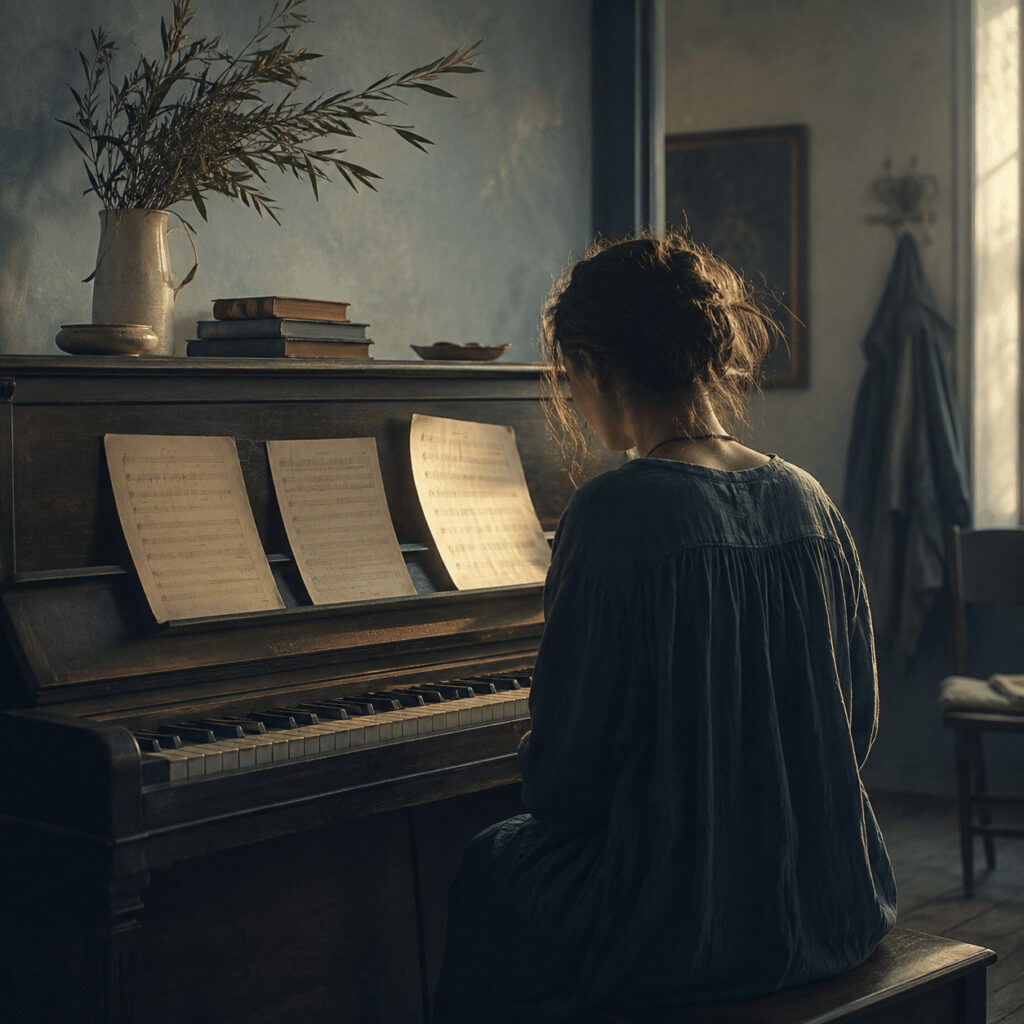
When I read a Life Path 3, I look for what the person keeps wanting to bring into the world, whether that appears as writing, humour, music, conversation, design or simply making a room feel better.
Then I look at what happens around that impulse. Does encouragement help it grow? Does criticism make it disappear? Does the person finish what matters to them, or move on once the work becomes repetitive? Can they say what they really feel, or does a joke arrive first?
I also pay attention to atmosphere. Life Path 3 can be deeply responsive to tone, beauty, ridicule, play, dullness and the emotional weather around them. Some people create almost anywhere. Many 3s need a patch of warm soil before the first shoot appears.
What I love about this number is its ability to make life more habitable. A 3 can help us laugh at what had become too tight, name what had remained shapeless or notice beauty in a place everyone else had stopped seeing. Human beings need language, story, colour and play. They help us recognise one another, carry experience and keep life responsive and alive.
This pattern may appear through cheerfulness, public creativity, private longing, blocked expression or work that has not yet found its audience. I am listening not only for the gift, but for the conditions that allow it to arrive without being distorted by fear, performance or the need for approval.
The Third Point
How Life Path 3 Creates Shared Form
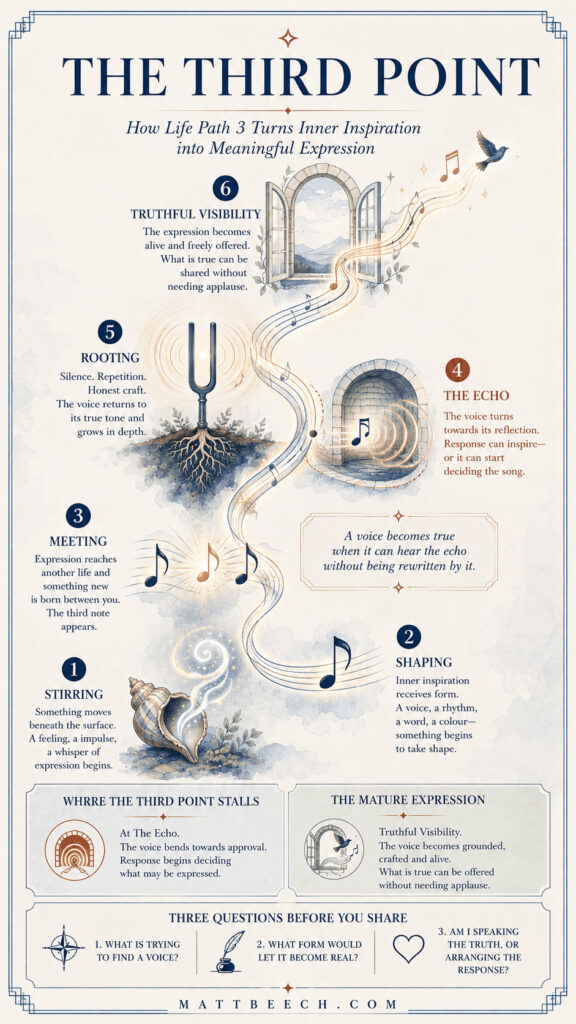
The Third Point is my name for the pattern by which Life Path 3 moves from an inner stirring into visible expression, creates shared aliveness, risks becoming trapped by response, and matures through craft and vulnerability into truthful visibility.
The name comes from the triangle. Two points can face one another across a line, but the third point creates a shape. Something appears that neither point held alone.
The same movement happens when inner experience finds expression. A feeling may be private and formless until it becomes a sentence, image, joke, song or gesture. Once expressed, it enters relationship. It becomes something that can be met.
- Stirring — A feeling, phrase, image, mood or possibility begins to gather inside you.
- Shaping — The inner movement seeks a body through words, humour, art, style, conversation, performance or creation.
- Meeting — What you have made reaches another person and creates recognition, warmth, movement or shared aliveness.
- The Echo — Attention shifts from what wants to be expressed to how it will be received. Approval, novelty or polish begins deciding what may be said.
- Rooting — Repetition, craft and emotional honesty help the first spark survive boredom, editing and uncertainty until it has enough substance to stand.
- Truthful Visibility — The expression remains alive, but it no longer exists only to secure a reaction. It becomes something genuinely offered.
The first part of this movement is easy to love. Creative inspiration arrives, you catch the phrase, see the image or suddenly understand what a piece of writing, artwork or project could become. Possibility feels abundant, and for a moment everything seems open.
The difficulty begins when inspiration asks for follow-through. An unwritten book can remain perfect in the imagination. An unfinished painting never has to reveal its weaker corner. A creative project that has not been completed can still contain every possible version of itself.
Giving it form means making choices. It brings limits, editing, repetition and the risk of criticism or misunderstanding. Yet this is also how self-expression becomes real. Creative discipline allows an idea to leave the private world, become finished work and reach another person.
Choose one idea you have been carrying and give it the smallest complete form you can: one page, one recording, one honest conversation or one finished sketch. Let completion teach you what imagination alone cannot.
The Deeper Meaning
The deeper meaning of Life Path Number 3 is the passage from private experience into shared form.
The triangle gives this movement a body. One point stands alone. Two points create relation or tension. The third creates a shape. In Pythagorean and Neoplatonic symbolism, the triad carries this sense of completion: unity moves through difference and returns as a formed whole. The harmony created by the third point is not sameness. Each point keeps its place, but together they make possible a form that none could create alone. Expression works in the same way: it allows distinct inner lives to meet without requiring either one to disappear.
The same thing happens when inner experience becomes expression. A feeling may remain private until it becomes a sentence, image, joke, melody or gesture. Once it takes shape, another person can meet it. Expression gives intimacy a form around which relationship can begin.
Jupiter, in systems that associate it with 3, points towards expansion, generosity and possibility. Expansion works by opening more space: another colour, another interpretation, another way the story might be told. Its danger follows from the same movement. If possibility keeps widening without choosing a form, attention disperses and nothing gathers enough weight to endure.
Saturn moves in the opposite direction. It gives reality through boundary, resistance and limit. A work becomes definite because some possibilities are excluded. Yet the same power can harden into sterility when the boundary protects the form so completely that no living impulse is allowed to alter it.
The Empress shows what happens when these forces are held together. A garden needs Jupiter’s abundance, but it also needs Saturn’s soil, season and pruning. Growth becomes visible because life is given room to expand and a form capable of holding it.
Humour belongs inside this balance. Laughter can loosen what has become falsely absolute and allow grief to breathe. But the joke loses its mercy when it expands away from the truth rather than opening enough space for the truth to be spoken.
The same pattern appears collectively. Cultures need artists, storytellers, musicians and comedians because shared life becomes brittle when experience has no form through which it can be recognised. Yet expression governed only by novelty and attention soon becomes weightless, while expression governed only by control becomes lifeless.
There is something quietly astonishing about an experience passing through one human life and returning to the world as a song, meal, photograph, paragraph or beautifully arranged room.
The triad is completed when inner life becomes shared form. The creator does not own the life that moved through them, but they are responsible for cultivating the shape through which it enters the world.

Traits and Strengths
Life Path Number 3 traits & strengths often include creativity, self-expression, communication, imagination, humour, storytelling and artistic sensitivity. Because this road repeatedly asks inner experience to become visible, it can develop a real ability to give ideas, emotions and messages a form that other people can understand and enjoy.
These gifts are not limited to obvious artistic talent or public confidence. They may appear through writing, conversation, performance, design, humour, hospitality, personal style or the ability to make a room feel warmer and more alive.
Common strengths that may grow through the Life Path 3 journey include:
- Creative intelligence: You may learn to see fresh combinations, images and possibilities where other people see fixed material.
- Expressive communication: This path can strengthen your ability to turn difficult feelings or complex ideas into words, stories, images or memorable examples.
- Storytelling: You may have a gift for finding the human thread inside an experience and presenting it in a way others can follow.
- Atmosphere-making: Sensitivity to tone, humour, beauty and style can become an ability to change the emotional temperature of a room.
- Imagination: Life Path 3 can keep experience open to alternatives, experiments and possibilities that have not yet taken form.
- Humour and perspective: You may know how to loosen tension, restore proportion and help people breathe inside a difficult moment.
- Aesthetic sensitivity: Colour, rhythm, language, sound, texture and arrangement may become highly developed forms of perception.
- Encouraging presence: When your expression is honest rather than performative, your enthusiasm can help other people become more hopeful, expressive or willing to try.
These strengths may appear as public talent, but they can also begin as longing, awkwardness, sensitivity or unfinished experiments. A quiet 3 may transform the atmosphere of a home, write messages people keep for years or notice the exact detail that makes a gift feel personal. Another may hold a room through performance. Another may find the words everyone else was struggling to say.
At their best, these strengths help people come back into contact with one another and with parts of life that had become difficult to name. A well-chosen phrase can express what someone has been trying to say. Humour can restore proportion. A story can make a private experience feel less lonely. Beauty can help a neglected room, idea or occasion feel worthy of attention again.

Weaknesses and Shadow Side
Life Path Number 3 weaknesses can include scattered energy, unfinished projects, emotional avoidance, sensitivity to criticism, dependence on approval and the habit of hiding behind humour, charm or performance.
These patterns often develop when self-expression begins to feel risky. The person may still be funny, imaginative, sociable or creative, but those gifts start protecting the inner life rather than revealing it. What looks like superficiality or attention-seeking may sometimes be an attempt to stay liked without becoming fully known.
Someone asks how you really are. For a moment, you consider saying that you feel hurt, lonely or overwhelmed. But the truth would change the mood and make you vulnerable.
So you make a joke.
Everyone laughs and the conversation moves on. You have made the moment easier for everyone else, but you remain unseen.
Shadow patterns that may develop along the Life Path 3 journey include:
- Performing instead of revealing: You become polished, entertaining or agreeable before saying what you actually feel.
- Scattered energy and unfinished projects: The excitement of a new idea repeatedly outruns the patience needed to complete it.
- Dependence on approval: Praise, laughter, attention or quick encouragement begins to decide whether your work or self-expression feels worthwhile.
- Emotional avoidance: Humour, storytelling, charm or constant activity diverts attention from grief, anger, fear or uncertainty.
- Sensitivity to criticism: Ridicule, dismissal or the fear of being misunderstood causes you to hide your voice, personality or creative work.
- Image over substance: Presentation, style or charisma receives more care than the craft, honesty or discipline underneath it.
- Restlessness and lack of focus: Ideas, plans, conversations and experiences keep accumulating because choosing one direction would mean letting the others go.
There is usually a private logic beneath these patterns. If I keep the room alive, perhaps no one will leave. If I make my work look casual, no one will see how much it matters to me or how much criticism could hurt. If I never finish the work, it can remain brilliant. If I speak honestly without making it polished or entertaining first, I may feel too exposed to cope with the response.
These patterns often begin when honest expression is repeatedly discouraged. Perhaps enthusiasm was mocked as childish, strong emotion was called dramatic or new ideas were dismissed before they were properly heard. The person may have learned that being cheerful, funny or easy to be around brought approval, while sadness, anger or uncertainty made other people pull away.
Over time, they begin showing the parts of themselves that keep the atmosphere pleasant and hiding the parts that might create discomfort.
The humour does not need to disappear. It simply needs to stop arriving before the truth.
Say what you actually feel first. The other person may respond awkwardly or disagree, but they now have a chance to understand you rather than only enjoy you.

Over the Course of Your Life
Life Path 3 may express itself differently as you move through childhood, work, relationships, parenthood, ageing and changing responsibilities. Creativity, communication, humour and imagination may remain important throughout, but the way you use them often becomes more deliberate with experience.
Early Years
As a child or teenager, Life Path 3 may appear through storytelling, drawing, music, humour, imitation, performance, dressing up, making things or a vivid private imagination.
Some children with this Life Path are openly expressive and enjoy being noticed. Others are quiet in public but write stories, invent characters, make up songs or spend hours building an inner world that few people see.
Encouragement can help creative confidence grow. Ridicule, harsh criticism or being told to stop showing off may lead the child to hide what they make, exaggerate their humour or only express themselves where they feel safe.
Middle Years
Adult life often asks inspiration to become skill. Work, money, relationships and family responsibilities leave less room for every idea, so the challenge becomes choosing what deserves time and following it through.
This may mean finishing a book instead of beginning another one, practising an instrument when the first excitement has faded or learning how to communicate honestly in a relationship rather than using charm to avoid conflict.
Many 3s have no shortage of ideas. The real development comes through focus, creative discipline and the willingness to complete work that cannot remain perfect once it becomes real.
Later Years
Later in life, expression may become simpler and more confident. There may be less interest in impressing people and more interest in making, saying or sharing what genuinely matters.
This can appear through teaching, mentoring, writing, storytelling, music, art, gardening, cooking, humour or renewed involvement in a creative practice that was abandoned earlier.
Experience may also bring a sharper sense of audience. You may become better at knowing which story needs telling, which joke helps and which words are worth leaving unsaid.
What Continues
The form may change, but the underlying pattern often remains recognisable. A child who invents characters may later become a writer, teacher or parent who tells unforgettable stories. Someone who once transformed a bedroom with colour and objects may later work in design, hospitality or simply create a home where people feel welcome.
Life Path Number 3 continues to ask how creativity, communication and self-expression can become part of ordinary life rather than something reserved for rare moments of inspiration.

What Pop Numerology Gets Wrong
Popular descriptions of Life Path 3 often recognise something real. The trouble begins when a living symbolic pattern is reduced to a cheerful personality type.
Life Path 3 does not always mean outgoing, artistic and confident
It is understandable that 3 is associated with sociability and the arts. Its symbolism clearly concerns imagination and visible expression.
Life Path describes a road of formation whose expression can be public, private, confident, hesitant, active or blocked. A shy writer, private illustrator, anxious speaker or person whose creativity has been buried under criticism may still be walking a distinctly 3 road.
The useful question is: “What keeps trying to find expression, and what happens when it approaches the threshold?”
Life Path 3 Contains the Full Emotional Palette
Joy belongs to the gift as one colour within a much larger emotional palette.
A 3 can be grieving, serious, angry or depressed. In fact, pressure to appear bright can make difficult feelings more lonely. When numerology describes 3 as eternally cheerful, it can reward the mask and mistake humour for proof that everything underneath it is fine.
The fuller 3 contains the whole emotional palette. Joy becomes richer when it no longer has to guard the door against sorrow.
Creativity Still Needs Craft
Popular numerology can make Life Path Number 3 sound effortlessly talented in writing, art, music or communication.
Imagination and natural ability may come easily, but finished work still requires practice, focus and repetition. A good idea is not yet a book, and a vivid image is not yet a finished painting.
Some 3s begin easily but struggle with revision or completion. The gift becomes dependable when inspiration is supported by craft and the willingness to finish.
Love & Relationships
In love, Life Path Number 3 is often affectionate, playful, expressive, romantic and highly responsive to conversation, humour and shared experience. Relationships may feel most alive when there is laughter, flirtation, curiosity, physical affection and the sense that two people are creating a life together rather than only managing responsibilities.

Many 3s want more than loyalty or practical care. They want to feel actively enjoyed. Private jokes, long conversations, thoughtful messages, beautiful meals and spontaneous plans can all become ways of keeping love warm and personal.
Yet being enjoyed is not the same as being emotionally known.
A harmonious relationship is not one in which the mood always remains light. It is one in which joy, hurt, disagreement and affection can all be spoken without threatening the bond.
A partner may ask what is wrong and receive a joke, a long explanation or a story about what happened before hearing the simple truth: “I feel hurt,” “I am afraid you are pulling away” or “I need reassurance.” Expressive skill can make someone sound open while still protecting the feeling underneath.
This can create a painful tension in relationships. The Life Path 3 partner may be very good at lifting the mood, showing affection and making the other person feel special, but struggle to ask for comfort when they are tired, sad, angry or unsure.
Love deepens when communication becomes simpler and more honest. That may mean saying what you feel before explaining it, allowing a difficult silence or trusting that your partner can remain close when you are not cheerful, entertaining or easy to reassure.
Laughter remains part of the bond. It simply stops being the only place where intimacy is allowed to happen.
Romantic Compatibility
Life Path 3 tends to thrive with people who enjoy expression, can remain present around emotional depth and offer honest feedback without shaming the gift.
Compatibility is not a ranking of good and bad numbers. The whole chart matters, as do character, maturity, communication and the actual relationship. Still, each pairing creates a recognisable kind of dance.
| Pairing | Compatibility dynamic |
|---|---|
| 3 with 1 | Expression meets initiative, but the 1 may push for action before the 3 feels ready to be directed. |
| 3 with 2 | Brightness meets sensitivity, though the 3 may overlook quieter tensions that matter deeply to the 2. |
| 3 with 3 | Laughter and ideas flow easily, but practical grounding can disappear beneath too many competing sparks. |
| 3 with 4 | Creativity gains structure and form, though the 3 may feel constrained by the 4’s need for order. |
| 3 with 5 | Shared curiosity creates excitement, but novelty can outrun commitment. |
| 3 with 6 | Expression meets affection and warmth, though the 6 may carry too much while the 3 resists heaviness. |
| 3 with 7 | Voice meets depth, but the 3 may fill silences that the 7 needs in order to open. |
| 3 with 8 | Creativity meets ambition, though the 8 may prioritise results while the 3 needs room to explore. |
| 3 with 9 | Expression meets compassion and meaning, but both may become absorbed in idealism and possibility. |
| 3 with 11 | Inspiration can feel electric and intuitive, though heightened sensitivity may create overstimulation or projection. |
| 3 with 22 | Imagination meets the power to build, but the 3 may feel burdened by scale while the 22 loses patience with unfinished ideas. |
| 3 with 33 | Expressive warmth joins care and encouragement, though the 33 may overgive while the 3 feels pressure to stay uplifting. |
The strongest relationship welcomes the brightness and remains present when expression becomes slower, quieter or less entertaining. Both people need a place at the table, and both must remain free to shape the world they are making together.
Careers & Jobs
Life Path Number 3 careers often involve creativity, communication, writing, media, marketing, design, teaching, performance or work that shapes how people experience an idea, message or event. The best jobs usually provide room for imagination and self-expression, while also giving that creativity a clear purpose, audience and deadline.
Career fields commonly associated with Life Path 3 include:
- Writing, publishing and editorial work: Author, novelist, copywriter, journalist, screenwriter, editor, proofreader, content writer, blogger, technical writer or speechwriter.
- Media, broadcasting and communications: Presenter, broadcaster, podcast host, radio host, communications officer, press officer, publicist, social media manager, content producer or video producer.
- Design and visual creativity: Graphic designer, illustrator, photographer, animator, stylist, interior designer, art director, web designer, UX writer or creative producer.
- Performance and entertainment: Actor, musician, singer, comedian, dancer, performer, host, voice actor or theatre practitioner.
- Marketing, advertising and public relations: Brand strategist, campaign creative, content marketer, advertising creative, PR specialist, social media strategist or creative director.
- Teaching, training and facilitation: Teacher, lecturer, trainer, workshop leader, tutor, course creator, community manager, creative coach or arts educator.
- Events, hospitality and experience design: Event planner, producer, curator, hospitality manager, wedding planner, cultural programmer or customer-experience specialist.
Across these careers, the Life Path 3 contribution is often the ability to make information clearer, messages more memorable and experiences more engaging. A 3 may find the story inside a complicated subject, improve the tone of a campaign or notice why a presentation, room or event feels flat.
These strengths can be especially useful in workplaces where communication has become dull, technical or impersonal. Presentation is not merely decoration. The way information is written, spoken or arranged affects whether people understand it, remember it or care enough to respond.
The main career challenge is usually not a shortage of ideas. It is deciding which ideas deserve time and continuing after the initial excitement fades. There may be five promising concepts, three domain names and a glorious mood board with no finished page.
Professional creativity eventually requires selection, revision, deadlines, feedback and completion. The most supportive work gives you enough freedom to invent and enough structure to finish. By the end, the idea has become something another person can actually read, hear, use, buy or experience.
Money & Wealth
Life Path 3 may relate to money through creativity, pleasure, freedom, presentation and self-expression. Income may come most naturally when ideas, communication or artistic ability are turned into finished work that other people can understand, use, enjoy or buy.
Money can also become tied to possibility. The new camera belongs to the photographer you might become. The course belongs to the business waiting beyond the next burst of confidence. The clothes, website theme, notebook or studio supplies seem to carry the atmosphere of a life that has not quite begun.
Beautiful things and useful tools can genuinely support this path. The question is whether a purchase strengthens work already being done or briefly creates the feeling of progress without requiring practice, visibility or completion.
Life Path Number 3 may also spend generously on gifts, meals, travel, performances and celebrations. Money becomes a way of creating warmth and memorable experiences. The difficulty comes when pleasure feels vivid and financial planning feels lifeless, so invoices, savings, pricing or routine administration are repeatedly postponed.
For many 3s, earning more is less about finding better ideas and more about finishing, sharing and repeating what already works. A creative skill becomes financially useful when it has a clear form, reaches an audience and can be offered more than once. That may involve publishing the article, pricing the service, promoting the event, sending the proposal or completing the product before beginning another.
Visibility matters too. Work cannot attract clients, readers, customers or opportunities while it remains hidden. Yet constant attention-seeking is not the answer. Sustainable income grows when honest self-expression is supported by craft, reliable delivery, clear communication and the confidence to ask for fair payment.
A little structure protects the creative life. Budgets, deadlines, simple financial routines and regular offers may feel less exciting than inspiration, but they help good work survive changes in mood and attention.
Numerology cannot tell you what financial decision to make. It can help symbolic reflection on what money has been asked to provide: beauty, freedom, recognition, hope, permission to begin or proof that your gifts matter.
The deeper financial lesson of Life Path 3 is that possibility becomes wealth only when it is given form, shown to others and allowed to create real value.
Wellbeing
The Life Path 3 road can make stimulation, expression and recovery important areas of attention. When energy is moving outward through conversation, creativity, teaching, performance or shared excitement, the body’s quieter signals may be easy to miss.
There can be a particular energy while the current is flowing. You are talking, creating, hosting or throwing ideas around, and the activity seems to generate more of itself. Hunger, tension or tiredness may remain in the wings until the conversation ends or the door closes behind the last guest.
Then the body speaks. The room feels too bright. The mind is still full of voices. Half-finished sentences and emotional fragments continue moving inside, accompanied by the strange emptiness that can follow intense connection.
A Life Path Number cannot diagnose the body or tell you what your health requires. It can, however, open a useful question: does expressive momentum sometimes carry you past the moment when your body first asks for food, sleep, quiet, movement or relief from stimulation?
For some people walking this path, recovery becomes easier through ordinary sensory rhythms: a walk without conversation, regular sleep, warm food, repetitive craft, quieter music, less screen glare or making something that no one else needs to see. Each person will need a different rhythm, but expression still needs somewhere to settle after it has moved through the room.
After the room goes quiet, the body needs somewhere for the remaining charge to settle. Warm food, dimmer light, a walk, sleep, repetitive craft or a private act of making can help the creative current return to ground.
The voice becomes clearer when the life carrying it has been allowed to recover.
Spiritual Meaning
The spiritual meaning of Life Path Number 3 concerns creativity, communication, joy and self-expression becoming forms of service rather than ways of proving personal importance. Writing, music, humour, storytelling, cooking, performance and visual art can all become spiritual practices when they are shaped with care and offered for a purpose beyond attention or praise.

Across many spiritual traditions, people have sung hymns, recited poetry, painted icons, danced in ritual, carved temples, arranged flowers and decorated sacred spaces. Beauty has often helped people slow down, notice more clearly and become receptive to meanings that ordinary language cannot always carry.
Not every creative impulse is a message from the divine, and talent proves no spiritual rank. The more useful question is what the act of expression brings into relationship.
Does it help people see something more truthfully? Does it restore proportion where fear, grief or conflict have narrowed the view? Does its beauty awaken greater care for another person, a place or life itself?
In this sense, beauty is more than decoration. A song, story, image, meal or carefully arranged room can reveal a harmony that was present only as a possibility. By giving that harmony a form, the work may help others recognise truth and feel drawn towards goodness.
Life Path 3 becomes spiritually mature when expression enters right relationship with its source, its form and the people it reaches. Inspiration must accept craft. Beauty must remain answerable to truth. Joy must not deny suffering, and the wish to be seen must not eclipse what the work is trying to serve.
This is where creativity becomes an offering. The song, page, meal, room or story is made with care and released into a world that may receive it, ignore it, misunderstand it or carry it somewhere unexpected. Its value does not rest entirely on applause. It lies partly in the quality of attention, honesty and care brought to its making.
Silence belongs to this path as well. Without periods of listening, expression can become constant output, performance or noise. Silence gives you time to notice whether something genuinely needs to be said, whether it is ready and whether you can give it a form that remains faithful to what first moved you.
Choose one small act of creation and give it a devotional purpose. Write a page for someone who needs encouragement. Cook a meal with full attention. Sing, draw, arrange a room or tell a story in a way that brings more beauty, truth and care into the day.
The spiritual lesson of Life Path 3 is not simply to express yourself. It is to create forms of beauty through which truth becomes easier to recognise, goodness easier to desire and life more capable of harmony.
FAQs
Does Life Path 3 need an audience?
No. Expression can be public, private, relational, creative or devotional. Life Path 3 concerns giving inner life a form; it does not require fame, performance or constant visibility.
What helps a blocked Life Path 3 begin expressing again?
Begin below the level of proving yourself. Write one page, make one sketch, speak honestly to one trusted person or return to a form of play that does not need to become impressive.
How can Life Path 3 finish projects without killing the original spark?
Use just enough structure to protect the idea from endless possibility. Choose a small complete form, finish that version and allow the next version to grow from something real rather than beginning again in imagination.
Closing Reflection
Life Path 3 asks you to notice what is alive, give it enough warmth and patience to become real and offer it in a form that remains faithful to what first moved you.
The first green shoot does not yet resemble the garden it may become. It simply breaks the surface because hidden life has reached the point where remaining underground is no longer enough.
Choose one true thing: a sentence, sketch, melody, conversation, arrangement, recipe or unfinished piece of work. Give it a small complete form.
Before you release it, ask what relationship you want it to create. Does it help someone see more clearly, feel less alone, recover perspective or notice beauty they had stopped seeing? Does it bring greater honesty, care or proportion into the space it enters?
Then place it into the world.
It may be welcomed, questioned, ignored, changed or loved. Another person may find meaning in it that you never intended. Once expression becomes encounter, it begins participating in a life larger than your own.
Your task is not to control every response. It is to give what is alive a truthful form and let that form serve greater beauty, goodness and harmony.

Your Life Path Is the Opening Note
Life Path 3 describes one movement within you: the impulse to turn feeling, imagination and experience into something visible, shareable and alive.
But your numerology chart is a larger composition. Other numbers reveal how you are shaped by life, what you long for beneath the surface, the gifts asking to be developed and the qualities other people meet first.
Visit the numerology calculator to discover the rest of your chart and see how these different notes combine into a pattern that is more complex, surprising and personal than any single number.
Life Path Numbers
About Matt Beech

Matt Beech is a mystic, magician and spiritual philosopher who has spent more than twenty-two years studying and practising tarot, astrology, numerology, magick and ritual. His work explores how symbols connect the visible and unseen, how spiritual forces shape human experience, and how we can participate in those patterns with greater wonder, discernment and conscious intent. Learn more about Matt here.
Leave a Reply