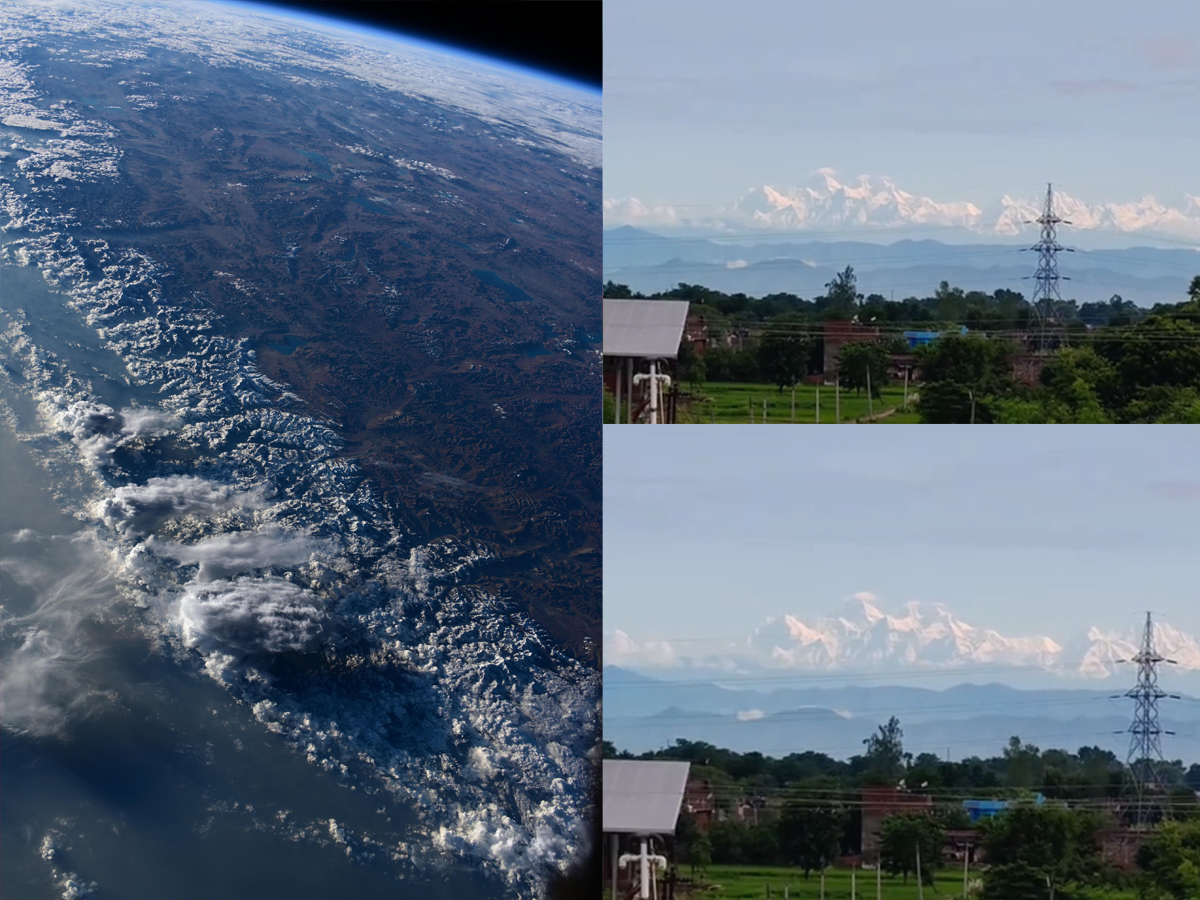
Everyone remembers when people of Bihar were amazed to see Mount Everest directly from the state after the lockdown, and all thanks to the improved air quality. The viral video showing the world’s tallest peak from Bihar took social media by storm. But imagine this — how would Mount Everest look from space?
A new image of Mount Everest, taken from the International Space Station (ISS), has amazed people across the world. The photo, shared by NASA astronaut Don Pettit, shows the world’s highest peak and much of Nepal from orbit. The picture has quickly gone viral for its rare and breathtaking view of the Himalayas.
Don Pettit, a veteran NASA astronaut, captured the photograph during his most recent six-month science mission aboard the Space Station. He shared it on social media with the note:
“Orbiting the Himalayas mountain range. Mount Everest is in this photo, with much of Nepal visible as well.”
Orbiting the Himalayas mountain range. Mount Everest is in this photo, with much of Nepal visible as well. pic.twitter.com/oXqyf9ah8m
— Don Pettit (@astro_Pettit) October 11, 2025
The image captures the vast, snow-covered peaks of the Himalayan mountain range, with Mount Everest’s summit rising sharply above its ridgeline — a sight few people on Earth get to witness from such a perspective.
Where Is Mount Everest Located?
Mount Everest, also known as Sagarmatha in Nepal and Chomolungma in Tibet, sits in the Mahalangur Himal sub-range of the Himalayas, straddling the border between Nepal and the Tibet Autonomous Region of China.
It stands at an elevation of 8,848.86 metres (29,031.7 feet), making it the tallest mountain on Earth. Everest’s exact geographical coordinates are 27.9881° N latitude and 86.9250° E longitude.
From space, its distinctive pyramid-shaped summit can be clearly seen, surrounded by glaciers and other peaks that form the Himalayan crown.
A Viral Connection on Earth
Interestingly, Pettit’s post came just as another viral moment featuring Mount Everest was trending online — a video showing the mountain visible from the Indian state of Bihar.
View of the majestic Himalayas as seen from Jainagar, Madhubani, Bihar. pic.twitter.com/nEeor4khbR
— Satyam Raj (@Satyamraj_in) October 7, 2025
The footage, shared widely on social media, claimed to show Mount Everest visible from Bihar, thanks to exceptionally clear skies and low pollution levels. Though such visibility is extremely rare, experts say specific weather conditions can occasionally make the world’s highest peak faintly visible from certain elevated regions.
The timing of Pettit’s photograph and the viral Bihar video reignited global fascination with the mountain and its enduring symbolism.
Global Reaction to the Astronaut’s Post
Astronaut Don Pettit’s spaceborne view received thousands of reactions and shares from users around the world. People praised both the beauty of the Himalayas and the perspective that space imagery provides.
For people across South Asia — especially Nepal and India — the image served as a source of pride, showing Everest’s majestic presence from orbit. Many users commented on how such photographs remind humanity of the planet’s beauty and fragility.
A Reminder of Earth’s Natural Wonder
As Pettit’s post continues to circulate online, it highlights more than just scientific achievement. Photos like this show how space exploration can inspire awe, connecting people across countries and cultures.
The Himalayas, and Mount Everest in particular, continue to symbolize not just nature’s grandeur, but also the shared wonder of Earth seen from above — where borders fade, and beauty unites all who gaze upon it.