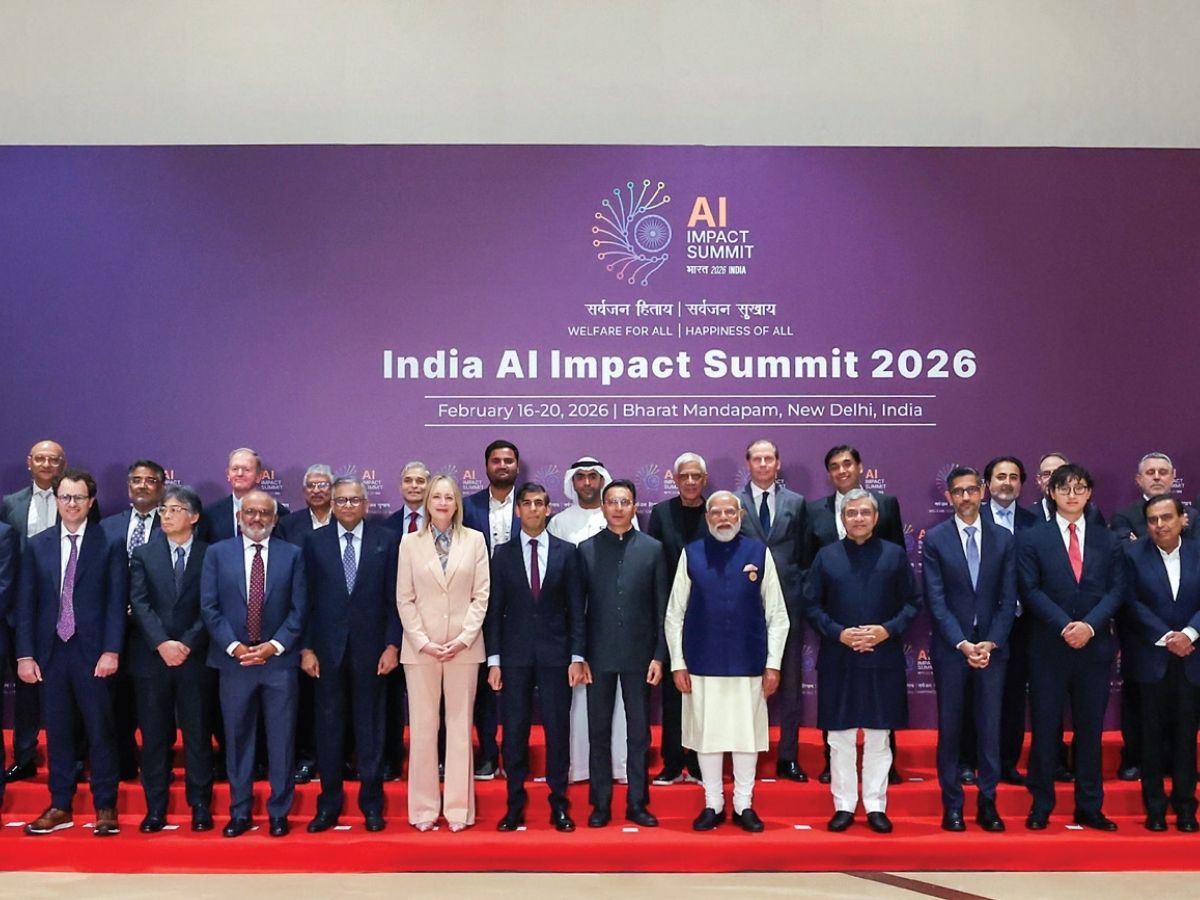
The AI Impact Summit that India hosted from February 16-20 carries weight beyond its diplomatic guest list. French President Emmanuel Macron’s attendance, alongside world leaders, delegates and industry leaders signals something more consequential than protocol. This is the first global AI summit convened in the Global South, and it arrives at a moment when the question of who controls artificial intelligence has become inseparable from questions of sovereignty, development, and strategic autonomy.
Previous AI summits in the UK, South Korea, and France focused on safety frameworks and innovation principles. India’s approach is different. The shift is toward deployment, measurable impact, and what New Delhi terms “AI for Humanity”. This vision integrates applications in agriculture, healthcare, education, the judiciary, and weather forecasting. The aim is to take AI governance out of the countries that build frontier models and includes deploying it to solve problems that impact billions.
This framing however while compelling, sidesteps a harder reality. The AI landscape has already consolidated around two powers, the United States and China. This constrains what middle powers like India can achieve. They continue to remain consumers than creator of AI tech.
The Duopoly
These are the numbers to be considered. Nvidia, a leading American technology company, controls 92 per cent of the data-center GPU market. Controlling access to cloud resources and services is a crucial way firms like Google, Microsoft, and Amazon are advantaged in the AI market. These companies are overwhelmingly American and Chinese and will host 60-65 percent of AI workloads by 2030. According to reports they have spent more than $300 billion on AI infrastructure in 2025 alone. Building a single advanced chip fabrication facility requires upward of $10 billion. This effectively closes the semiconductor layer to everyone else.
The United States dominates through chip design and software. China is racing to localize its semiconductor supply chain with domestic tools accounting for 35 per cent of chipmaking equipment. It still remains generations behind in advanced nodes. Semiconductor chips are designed, fabricated in foundries, and then assembled and packaged for commercial use. The US leads in chip design, Taiwan in fabrication, and China, increasingly, in packaging. For India, recent US tariffs targeting Indian goods underscore dependency risks. Export controls on high-end GPUs can throttle India’s AI ambitions overnight. China’s grip on critical minerals creates different vulnerabilities. Both US and China can determine who advances and who falls behind through policy shifts. Countries that control advanced compute shape standards, norms, and trajectories; those without it adapt.
India’s Complementary Innovation Bet
India’s AI journey has been connected with the country’s development journey. It is strengthening governance, improving public service delivery, and enabling solutions that can reach citizens at scale. India’s aim is to democratise AI enabling participation by startups, researchers, public institutions and innovators across regions.
The evidence is tangible. BHASHINI supports over 36 text languages and 22 voice languages with 350+ AI models. The Kisan e-Mitra chatbot has fielded over 9.5 million farmer queries in 11 regional languages. These are not glamorous compared to GPT-5, but they solve real access problems at scale.
More striking is work on resource-efficient AI. Kompact AI, developed by IIT Madras with Ziroh Labs, enables foundational models to run on CPUs instead of GPUs—transformative for under-resourced settings. It proves that India can do frugal innovation at cutting edge technology. Initiatives such as the IndiaAI Mission and the Centres of Excellence for AI are at the heart of this transformation. India has around 1.8 lakh startups, and nearly 89% of new startups launched in 2024 used AI in their products or services. Rankings such as the Stanford AI Index place India among the top four countries in AI skills, capabilities, and policies. The country is also the secondlargest contributor to AI projects on GitHub, highlighting the strength of its developer community. This reflects the arenas in which middle powers can exert leverage.
The Multipolar Proposition
The Summit’s seven thematic “Chakras”—covering human capital, inclusion, safety, science, resilience, democratization of resources, and economic development—reflect this strategic calculus. Over 100 countries have engaged through these working groups. Middle powers have been developing their AI capabilities and are contributing towards global AI innovations. Saudi Arabia and the UAE have invested more than $1trillion sovereign wealth funding on AI and automation. France offers open models like Mistral and have been investing in data centres outside the country. Switzerland has launched fully open-source multilingual LLM Apertus last year. Japan, South Korea and Singapore are leading Asia AI’s adoption by focusing heavily on hardware ecosystems., and Japan aiming to be the most AI friendly country in the world.
These countries still lack individually in scale but they want to compensate for through coordination. The summit is wagering that integration capacity will shape long term advantage than frontier tech leadership. The summit tests whether tech companies, government agencies, researchers, civil society, and funders can work together to become solution providers, creating resilience against concentrated supply chains.
Challenges prevail. The five eyes alliance of the US, UK, Canada, New Zealand and Australia reached an agreement that Chinese company Huawei was a threat and needed to be contained. Since then there has been a systematic campaign and lobbying effort to highlight the risks associated with working with the Chinese company. China on the other side has leveraged control over critical minerals. Global AI power thus continues to be dominated by the US and China.
In this scenario, Singapore offers an instructive model. It recently announced the launch of model AI governance framework guiding companies as to how to deploy AI agents responsibly and emphasises human accountability. Singapore’s AI strategy strategically involves both US and Chinese technologies to build a neutral, diverse and robust AI ecosystem. Google, Meta, Alibaba, and Huawei all operate research centers. Over 200 AI deployments now operate across healthcare, transport, and urban planning.
India follows a similar logic but the scale is much larger. The upcoming summit will see Chinese participation along with that of the US and focused plenary sessions will revolve around governance, application, and inclusion—areas where influence does not require owning the compute layer.
Conclusion
Is this an attempt to reshape the global AI order? Yes and No. The event will not break the duopoly of China and the US, nor democratise access. But, it is a step at establishing norms, create alternative pathways, and build coalitions that have the potential to make AI landscape multipolar in future. India’s middle power status brings it at a position of emphasising measurable impact in the areas of public good, and take it outside Silicon valley or Shenzhen. The tricky part is the execution. Can we build an AI world where countries outside the duopoly have any say. India says they do. The next week will show if the argument has teeth. India hopes to make inroads in to the big boy’s club in AI by leading the dialog on making AI work for the public good. However, India faces several challenges like AI literacy, digital infrastructure, digital access in rural areas, lack of talent pool for innovation and research and regulatory mechanisms. The AI summit has been a motivation for the government and several companies to focus on these challenges and try to find solutions. The summit will hopefully give the right push for India to embrace the AI revolution.