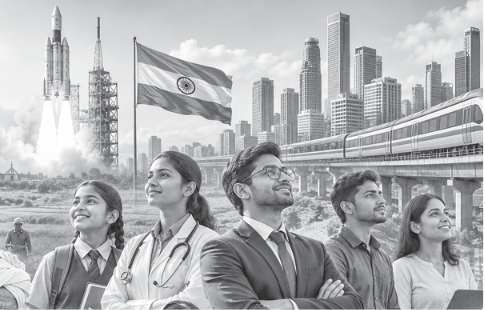
India is aspiring to be Viksit Bharat by 2047. The idea is moving and the country must attain this cuttingedge milestone at any rate. This requires an inclusive Soch and effective approach. Among other drivers, the participation of public at large cannot be ruled out. In fact, the development is supposed to be attained by inclusion of women, poor, farmers, private entrepreneurs, managerial personnel and professionals alike. This appears apt because these lots have contributed to productivity and benefited from social interventions. Its initiation is evident by lifting considerable number of people from abject poverty. The formalization of informal sectors by implementation of new labor laws has also pushed the social security up. For reality check, rural poverty has declined from 69% to 32.5% while urban poverty dropped from 43.5% to 17.2% in recent years. However, the achievement made looks little narrow, as substantial drop in the percentage of poverty is expected.
The aspirational goal of Viksit Bharat @ 2047 requires more galvanization and mainstreaming of the people into more productive ventures to accelerate the pace of growth. Also, stability in democracy and integration of the hoi-polloi to development outfit would be a misnomer unless public at large are encapsulated into middle class. Enrolment to middle class is a realistic dream for Indian citizenry. Conventionally, middle class is characterized by three cornerstones viz. disposable income, conspicuous consumption and leisure. Side by side, emulating the lifestyle, tastes, and consumption patterns of the wealthy inspires the class to passionately engage with productive ventures. The fact that economic development would change the structure of social stratification from the pyramid-shaped to a diamond-shaped where majority of the people land onto the middle class.
According to many estimates, underdeveloped countries have around 19% of middle class whereas developed, over 40%. In the medium developed countries, the share of our country has improved to some extent. However, the placement is more informal, low-paying and sectors where social security is minimal. Though social security exists in the financial markets, the affordability is too taxing. middle is around 30%. In the core of it, access to financial resources is unequivocal. Financial resources are supposed to empower the middle class in such a way that they become autonomous actors free from any shackles to take independent decisions. The decision with independence would empower and boost public thereby improving quality of life. The development in the world countries has happened through increasing the share of middle class in the population. For example, American democracy marched with the rich being weak that pushed poor into the middle class. The middle class burnt with desire for democratic and unlawful government and made the heroic success possible. In England, the gentry were all powerful and in France, poor swelled to vast proportions and could gain upward mobility.
Though the idea of ‘citizen first’ is a powered doctrine of New Public Management Systems, it has not helped the middle class share to be larger. It is worth mentioning that countries like Australia and New Zealand have taking greater interest in measuring citizen satisfaction and finding ways to work with citizens and communities to design services so that they the share of middle class can be improved. The middle class in India has been accounted for 31% by its own definition. The figure by income and expenditure pattern does not necessarily make the percentage claimed viably realistic. The fact that middle class largely deals with created by economic pressure are so acute that one becomes completely dependent on others. Even in the case of job search, dependence on others becomes unequivocally unavoidable. Despite the digital space being powerful, the placement at the workplaces requires connection and a hold on social networks. The desire intensified by global lifestyle has increased the ambitions and expectations. Even if the income rises, the items to be quenched become more constraining. how one relates with one another in a manner that turns out be independent agencies or actors.
It provides interchangeability in role-sets and role relations. The interchangeability in lifestyle unlocks the possibility of respecting eachothers’ space in meaningful manner. Merely illustrating on consumption pattern and income level for middle class creates an optical illusion. The freedom for the citizens to take decisions is expedited through access to fundamental requirements viz. education, health and social security. In the absence of which every step to be followed by middle-class actors would be compromised. In fact, education, health, medical care, water supply, sanitation, economic opportunities and housing conditions are the enablers of middle-class population. The value system of economy, freedom, gender equality, decentralization, democratic federalism, inter-regional equalities, and nationalism are promoted by emergence of middleclass society. It really sounds very constructive. In Thailand, from expansion of basic facilities, integrating social policy in national development, mobilizing people participation in social development, and then, human and social development of the people have led to effective transformation, leading to up-share in the middle class. Why middle class is not taking off First, the middle class in India is not taking off because real income growth for a large section of households is modest.
The stringencies Second, the large portion of income is spent on housing, health care and education. When cost rises of these items, disposable income shrinks, making it difficult to get into the middle class. It does exert unavoidable and unbearable pressure. Third, the job market in Fourth, low female workforce, urban concentration and rural lag, limited social security cushion education employment mismatch, and K shaped growth are some of the reasons that do not let middle class take off in India. Ways to improve In order to improve the share of middle-class citizen in India, we require to push labor intensive manufacturing, align curricula with industry specific demands through skill gap studies by opening special skill centres. Besides, the expansion of insurance, public health capacity, quality of public schooling, quality housing for all need to be ascertained. The fact that most people prefer to send their children to private schools, as they consider government schools to be engaged in shoaling exercise.
Government educational institutions need to be transformed scholastically so that they become magnets of opportunity providers. The female participation into work needs to be mainstreamed. The misnomer is females are non-serious role players in the organisations. They need to be provided with focused educational training that they turns out to be smart performers. The government health care centres should be transformed in such a way that they become equitably accessible and best service providers. The focused social security coverage to be extended to all citizens so that they tend to take independent decisions. The eye opener to expand the middle class in India sincerely desires all interventions to be targeted for all. It should not be for poor or specific class. Ultimately, targeting to all would scale up the size that would fit into a catalyzer, fast transforming our country into Viksit Bhart. All we need is to channelize the scheme of thought through some policy interventions. We are going in the right direction, but tweaks can always give pathbreaking results. Let the ball spin unless it lands inside the boundary line! The author is Associate Professor at IIPA, New Delhi.