After devastating floods in Nepal, serious questions are once again being raised over the threat posed by Chinese dams.
I express my deepest condolences to those who lost their lives in the disaster in Nepal and to the families whose lives have been devastated. My heart is heavy with sorrow and weeps for them. It is difficult to imagine how long it will take to overcome the consequences of this catastrophe. Even now, we do not have a clear picture of what exactly happened amid the high mountains of Tibet that resulted in the destruction of an entire region of Nepal. It is being said that glaciers broke apart, causing an enormous amount of water to accumulate in a glacial lake. Natural dams then gave way, unleashing devastation in Nepal. There was also information suggesting that earthquake tremors caused the lake’s dams to collapse. But the US Geological Survey has clearly stated that there was no indication of an earthquake in that part of Tibet before the flash flood in Nepal. In other words, there was no earthquake. So did all of this happen simply because of a glacial collapse?
The most serious question, however, is that whatever natural events took place, they occurred in Tibet, which is under Chinese control. China is an extremely technologically advanced country. It knows that this highly inaccessible region of the Himalayas is constantly subject to natural upheavals. There is certainly no reason to believe that it does not keep a close watch on the entire area. When a natural lake is about to breach, warning signs generally begin appearing beforehand. One would, therefore, expect China to have received some indication as well. Yet Nepal was not informed about any impending disaster. This is precisely the point that has raised questions about China’s intentions: Why did it not alert Nepal to the possibility of a catastrophe? When these questions were raised, China denied the allegation. But China did not clarify whether its satellites had detected anything unusual or not. Nepal has not spoken openly on the matter either, but its officials have certainly said that had the source of the disaster been within Nepal, they would have been monitoring it.
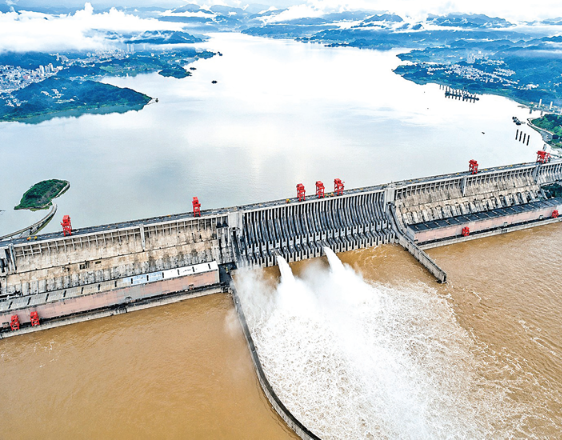
Since the source of the disaster was in Tibet, they had no advance information before the devastation struck. Against the backdrop of this entire episode, one concern has begun troubling me: What would happen if the world’s largest dam, being built in Medog in Tibet, were to ever collapse? I had written about this issue last year as well, when news of the dam project first emerged. Now that same question has once again become highly relevant. The dam is only about 30 to 40 kilometres from the Indian border. It is being built on the same river that we call the Brahmaputra in India. China has so far not disclosed how much water the reservoir will hold, but experts believe that several crore cubic feet of water could be stored there at any given time. Suppose, for a moment, that the dam were to ever burst. What would happen then? And what if China We Indians are such benign people that we can never even imagine China using a ‘water bomb’ against us. But what if a dam were to burst due to natural causes? What would happen then? were ever to deliberately release water into Indian territory? But we Indians are such benign people that we would perhaps not give much importance to such a possibility.
Our concern is primarily about natural causes. This dam is located in an extremely sensitive Himalayan region, where geological activity is frequent. As recently as January 2025, the area was hit by an earthquake measuring 7.1 on the Richter scale. If an earthquake of such magnitude were ever to cause the dam to give way under the pressure of crores of cubic feet of water, the resulting devastation would not be confined to Arunachal Pradesh. It could wreak havoc across Assam and other states of the North-Eeast, and could even extend as far as Bangladesh. Bangladesh has also expressed its concerns about the project to China. It has written to Beijing seeking more information about the dam. But China is the undisputed emperor of silence! The river plunges down thousands of feet as it enters Indian territory after flowing through the area where this dam is being built. The biggest worrying aspect is that China has so far kept the details of this dam secret. No country in the world knows what the design of the dam is or exactly how India and Bangladesh are going to be affected by it. That is why there is concern. There is also concern beviSiT To ruSSia and dovaL’S arrivaL in China Is it merely a coincidence that last week External Affairs Minister S Jaishankar was in Russia on a two-day visit, while National Security Adviser Ajit Doval travelled to China for two days? There were several different programmes associated with both visits, but in reality, the purpose of both journeys was the BRICS summit being held in New Delhi on September 12 and 13. cause there is no treaty between China and India for sharing real-time information regarding river flows or the dangers that could arise from them. China will not give us information. But there is one reassuring piece of news:
To manage the water coming from China, India is constructing the 11,000 Megawatt Upper Siang Project in Arunachal Pradesh. But there is another concern as well: What if China stops the water? China can do anything! India will have to remain completely alert. I believe that in the world in which we are living, there can be no alternative to friendship. No matter how powerful a country may be, it cannot suppress even a small country. We are seeing this in the case of the US-Iran war. China has made itself extremely powerful and has made the world dependent on it. There are hundreds of things that, if we did not receive them from China, would bring trade to a standstill. It keeps trying to entangle us; sometimes in Arunachal Pradesh, sometimes in Doklam, and sometimes in Ladakh. But merely cursing China will achieve nothing. We must make full use of the knowledge and abilities of our youth and make ourselves so capable that no one dare cause us any harm.
Jai Shankar’S Jaishankar met President Vladimir Putin directly and also handed him a personal message from Prime Minister Narendra Modi. In diplomatic circles, it is considered almost certain that Putin may come to New Delhi for the BRICS summit. There is also every expectation that Chinese President Xi Jinping will attend. The last time Xi Jinping visited India was in October 2019. You will remember that last September, a photograph of Narendra Modi, Putin and Xi Jinping that emerged from Tianjin, China, during the Shanghai Cooperation Organisation meeting, had made America extremely uncomfortable. Will a similar photograph emerge from New Delhi as well, causing another heartburn? One can certainly hope so!
*The author is the chairman, Editorial Board of Lokmat Media and former member of Rajya Sabha. [email protected]