New Delhi:
The Congress on Sunday trained its guns at Prime Minister Narendra Modi over his approach to India-China ties, accusing him of pursuing a policy of “calibrated capitulation” towards Beijing.
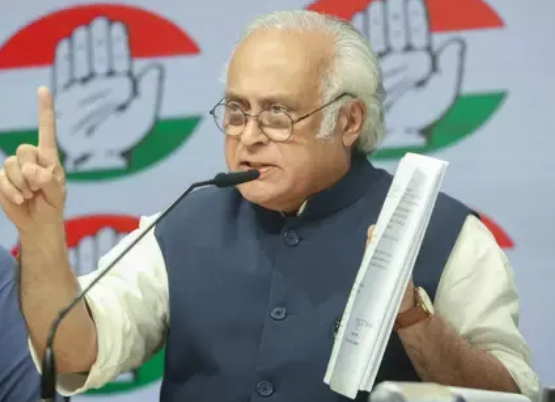
Congress general secretary in-charge communications Jairam Ramesh asked whether Modi’s “infamous clean chit” to China on June 19, 2020, has weakened India and why his government has “allowed China’s territorial advances in Ladakh and now Arunachal Pradesh”.
The Congress leader remarks came a day after Modi conveyed to Chinese President Xi Jinping that peace and tranquillity along the frontier remain an “essential” basis for development of India-China relations, even as the two leaders welcomed “steady progress” in the bilateral ties.
Ramesh posted a statement on X, and said, “Now that his bilateral summit with President Xi Jinping is over, here are four questions for Prime Minister Narendra Modi to which the nation continues to seek answers. Did not your infamous clean chit to China on June 19, 2020 weaken India?”
He pointed out that on the night of June 15-16, 2020, “twenty of our soldiers made the supreme sacrifice in hand-to-hand combat with Chinese troops in the Galwan valley”, the first such loss of life on the border in 45 years.
“Just four days later, on June 19, 2020, you inexplicably told an all-party meeting ‘Na koi humari seema mein ghus aaya hai, na hi koi ghusa hua hai.’ That statement has never been retracted. Has this not greatly weakened our subsequent negotiating position?” Ramesh said.
He also asked why has the PM “allowed China’s territorial advances in Ladakh and now Arunachal Pradesh”.
He also highlighted that “our traditional patrolling and grazing rights across large stretches of Eastern Ladakh have been quietly but definitely “surrendered”.
“Meanwhile, there have been reports of Chinese encroachment in Arunachal Pradesh, including loss of India’s access to patrolling points and fresh standoffs,” Ramesh claimed.
“China’s posture on Arunachal Pradesh has only hardened: renaming towns, reasserting claims to what it calls ‘South Tibet’, and pushing ahead with its 60,000-MW Medog mega-dam on the Brahmaputra’s Great Bend, a project that gives it a stranglehold over the water security of our entire northeast,” he said in his statement.
“Why has the PM allowed softening of India’s position on China’s role in support of Pakistan during Operation Sindoor, Ramesh asked.
“On July 4, 2025, Lt. General Rahul Singh, the Deputy Chief of Army Staff, had publicly spoken of the military establishment’s assessment of the deep and pivotal role of China in assisting Pakistan during Operation Sindoor. But all of a sudden, on August 25, 2026, the former Chief of Defence Staff Gen. Anil Chauhan took a completely different position in a lecture at the VIF with which the National Security Adviser has himself been closely associated. Was this part of a strategy to change the atmospherics leading up to yesterday’s meeting?” the Congress leader said.
Why has the PM allowed the trade deficit with China to reach record levels, Ramesh asked.
He also noted that India’s trade deficit with China hit a record USD 112.6 billion in 2025-26, destroying large sections of our industry, especially MSMEs.
“The dependence on China for critical raw materials, manufacturing components and intermediates has reached dangerous levels. ‘Make in India’ and ‘Import from China’ have become two sides of the same coin. Where is the roadmap for changing this unacceptable situation?” the Congress leader said.
“Prime Minister, normalisation of India’s relations with China is one thing, but what has been in evidence on your part is calibrated capitulation,” Ramesh said.
According to the Ministry of External Affairs, in their talks on the sidelines of the BRICS summit, Moi and Xi Jinping reaffirmed that both the countries should take a strategic and long-term perspective of their ties and differences should not become disputes.
The MEA also said that on the economic front, Modi and Xi underlined the need to address each other’s concerns, including structural trade imbalance and supply chain issues, and facilitation of meaningful and predictable market access.
The two leaders expressed commitment to a “fair, reasonable, and mutually acceptable” resolution of the boundary question proceeding from the political perspective of their overall bilateral relations and the long-term interests of the two sides, it said.
Xi Jinping had arrived in India after seven years to attend the 18th edition of Brics Summit.