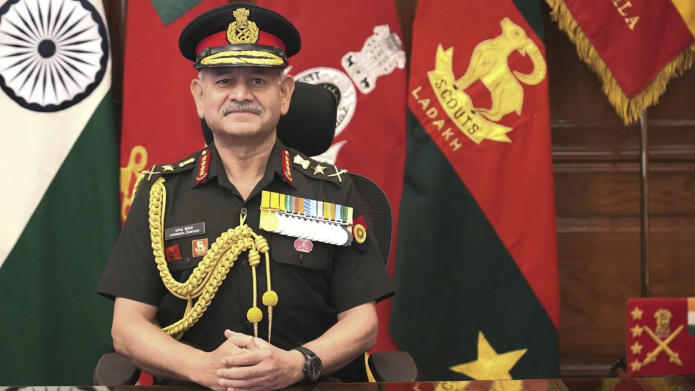
For the first time, Army Chief General Upendra Dwivedi has openly shared how Operation Sindoor was planned and carried out. He described the mission earlier this week while inaugurating Agnishodh, the Indian Army’s new research cell at IIT Madras.
A Mission in the ‘Grey Zone’
General Dwivedi compared Operation Sindoor to a strategic chess match, explaining that it unfolded in a “grey zone” — unpredictable and just short of a full-scale war.
“In Op Sindoor, what we did, we played chess… What does it mean! It means that we did not know what step the enemy was going to take and what we were going to do. It was a gray zone. The gray zone is that we are not going for the conventional operations but we are doing something which is just short of the conventional operations,” he said.
Planning Kicked Off in Late April
The operation’s planning began on April 23, when Defence Minister Rajnath Singh met with all three service chiefs. According to Dwivedi, they unanimously agreed that decisive action was needed.
“This is the time when Defence Minister Rajnath Singh had also said, I think enough is enough. And all the three chiefs were very clear, something had to be done. And the free hand was given, of course, that you decide what is to be done,” he recalled.
By April 25, the Northern Command had struck seven out of nine high-value targets, killing multiple terrorists.
Different From Uri and Balakot
General Dwivedi stressed that Operation Sindoor was unlike past missions such as Uri and Balakot. Uri targeted launch pads near the border as a warning, while Balakot in 2019 aimed at training camps deep inside Pakistan.
Sindoor, however, struck “wide and deep” into the enemy’s “heartland,” focusing on high-priority assets codenamed “Nursery” and “Masters.”
“This was the first time we hit the heartland. And our targets were Nursery and the Masters. And that’s what came as a shocker to them,” he said.
The nine total targets included five in Jammu and Kashmir and four in Punjab. Two operations were jointly executed with the Indian Air Force. Dwivedi described it as an unfinished battle: “This test match stopped on the fourth day and it could have continued for fourteen days also, one forty days also, fourteen hundred days also, we don’t know. So we have to be prepared for those kinds of things.”
Air Force Confirms Biggest-Ever Aerial Kills
In a separate statement, Air Chief Marshal Amar Preet Singh revealed that India’s air defence forces destroyed five Pakistani fighter jets and one AEW&C/ELINT surveillance aircraft during Operation Sindoor — the largest surface-to-air combat kills in India’s history.
Speaking at the 16th Air Chief Marshal LM Katre Memorial Lecture, he said the 7 May strikes targeted terrorist facilities both near the border and deep inside Pakistan.