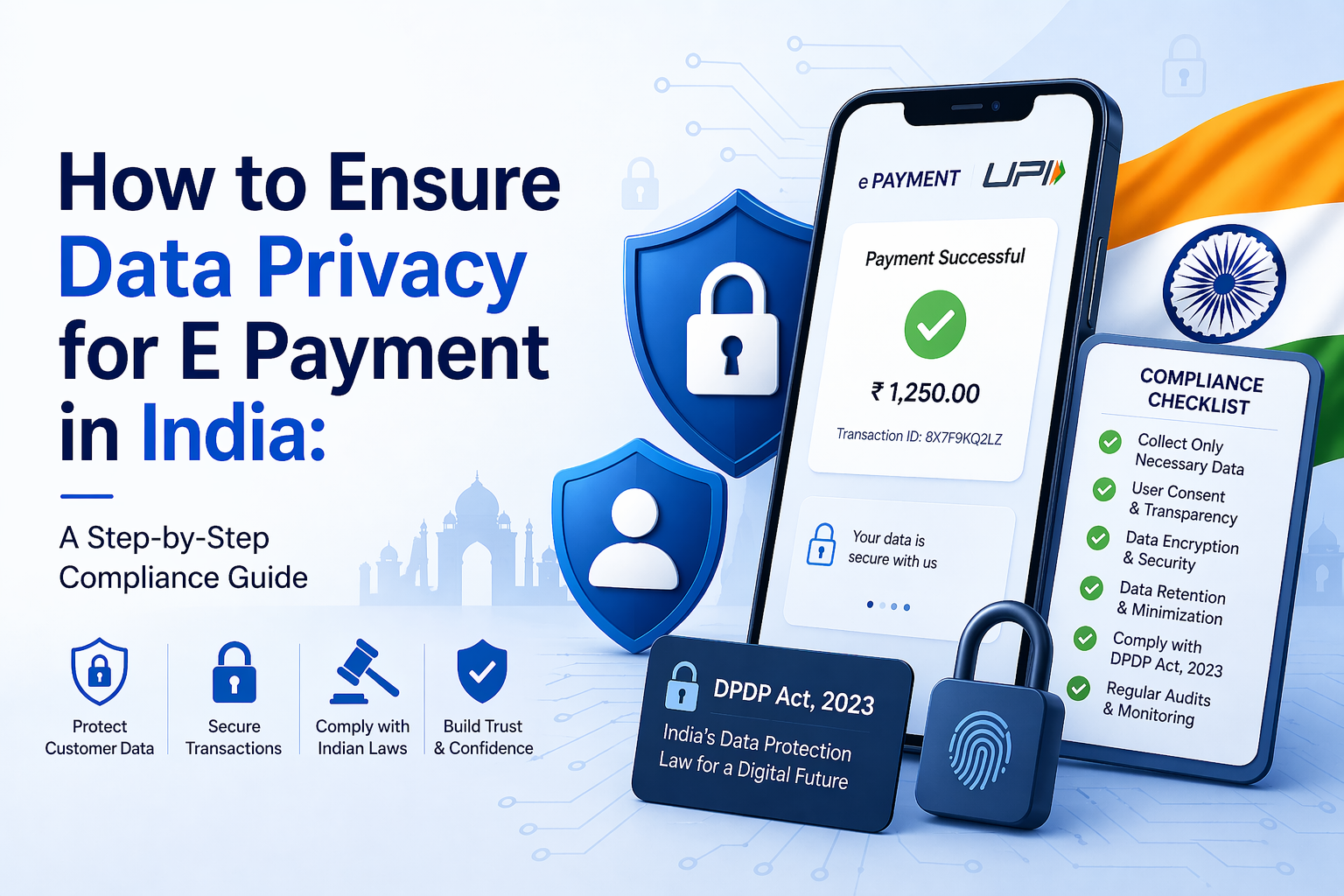
E payment in India has exploded in recent years, transforming how businesses and consumers handle transactions. With this growth comes a critical challenge: protecting customer data from breaches and ensuring regulatory compliance.
Indeed, digital payment security isn’t optional anymore. Businesses must navigate multiple regulations, including the DPDP Act 2023, RBI guidelines, and GDPR and payment gateways compliance requirements.
This step-by-step guide walks you through building a robust data privacy framework for your payment systems, from assessing your current setup to establishing ongoing monitoring processes.
Understanding Data Privacy Laws for Digital Payments in India
Multiple regulatory frameworks govern digital payment security and data protection requirements for businesses operating in India. Understanding these overlapping laws helps you build a compliant payment infrastructure.
The Digital Personal Data Protection Act (DPDP), 2023
The DPDP Act 2023 marks India’s first standalone data protection legislation, enacted on August 11, 2023. This law applies to any entity processing digital personal data of individuals within India, regardless of where the business operates. Payment service providers, banks, NBFCs, and fintech companies fall directly under this framework.
The Act operates on seven core principles: lawful and fair processing, purpose limitation, data minimization, accuracy, storage limitation, security safeguards, and accountability. These principles shape how you must handle customer information during payment transactions.
Consent requirements demand that you obtain permission that is free, specific, informed, unconditional, and unambiguous with clear affirmative action. Click-wrap consent mechanisms no longer satisfy these standards. Additionally, you must provide privacy notices in English or any of the 22 languages listed in the Eighth Schedule of the Constitution.
The Act introduces significant penalties. Non-compliance can result in fines up to INR 250 crore. The compliance deadline falls on May 13, 2027, giving businesses time to align their systems with consent management, security safeguards, data erasure, and breach notification requirements.
Payment and Settlement Systems Act, 2007
The PSS Act 2007 provides the legal foundation for regulating payment systems in India. The Reserve Bank of India holds sole authority to authorize and supervise payment systems, including UPI, NEFT, RTGS, IMPS, and card networks.
No entity can operate a payment system without RBI authorization. Foreign entities may operate payment systems in India under the same conditions as domestic entities. The Act legally recognizes settlement finality, stating that settlements become final and irrevocable once determined, protecting against systemic risks.
Section 15 mandates confidentiality for documents and information obtained by RBI. However, disclosure is permitted when necessary to protect payment system integrity, banking policy, or public interest.
RBI Guidelines and Circulars
RBI mandates that all payment system data be stored exclusively in India. For cross-border transactions, only the domestic component may be stored abroad temporarily. All data must return to India within 24 hours of processing. This applies regardless of whether you use global cloud providers or translation APIs.
The RBI’s framework enforces interoperability across platforms and introduces compliance norms for cross-border transactions. Issuers must compensate customers if transactions fail to meet authentication standards. Using contextual data for risk assessment falls under the DPDP Act, potentially raising compliance challenges for foreign merchants.
Grievance redressal mechanisms must evolve to protect users from wrongful denial. Safeguards against misuse of consumer data in risk profiling remain critical.
Information Technology Act, 2000
The IT Act 2000 established India’s foundational digital framework. Sections 4 and 5 grant legal recognition to electronic records and digital signatures, making electronic payment instructions and online banking logs legally enforceable.
Section 43A imposes liability on businesses for failing to implement reasonable security practices while handling sensitive personal data. Negligence resulting in wrongful loss entitles affected users to monetary compensation.
Section 72A penalizes unauthorized disclosure of personal information in breach of lawful contracts. In digital payment contexts where users share bank details, OTPs, and biometric identifiers, this provision deters data misuse and internal breaches.
Step 1: Assess Your Current Data Privacy Framework
Building a compliant payment infrastructure starts with understanding what data flows through your systems and where vulnerabilities exist. Most businesses discover gaps only after incidents occur, but proactive assessment prevents costly breaches and regulatory penalties.
Identify What Personal Data You Collect
Payment transactions generate multiple data categories. Customer identification data includes names, email addresses, phone numbers, and billing addresses. Financial information encompasses bank account details, credit or debit card numbers, CVV codes, and transaction histories. Authentication data covers passwords, PINs, OTPs, and biometric identifiers like fingerprints or facial recognition patterns.
Your e payment in India systems also collect device information such as IP addresses, browser types, and mobile device identifiers. Transaction metadata includes timestamps, merchant details, payment amounts, and geolocation data. Communication privacy during transmission and information privacy after storage both require protection.
Create a comprehensive inventory documenting each data element. Specify whether the information qualifies as sensitive personal data under IT Act Section 43A and Rule 3 of SPDI. Financial information, passwords, and biometric data fall under this category, triggering stricter handling requirements.
Map Your Data Storage and Processing Systems
Data mapping tracks where information enters, moves through, and exits your environment. This process involves documenting data sources like payment forms and mobile apps, identifying storage locations such as databases and cloud servers, and recording all third-party integrations including payments gateway and fraud detection services.
Build a cardholder data flow diagram showing the complete lifecycle. Map internal systems handling payments alongside external vendors accessing customer information. A comprehensive data map reveals which systems hold collected data and how everything connects.
Document processing activities as required by GDPR Article 30. Record the purpose for each data collection, retention timelines, and parties with whom information is shared. For example, if you collect email addresses for transaction confirmations, specify this purpose, note that data syncs to your CRM, and define a six-month deletion period for non-purchasing customers.
Review Existing Security Measures
Audit your current digital payment security infrastructure. PCI-DSS compliance requires maintaining firewalls to protect against security threats and avoiding default credentials like manufacturer-provided PINs or passwords. Verify that customers can change their credentials whenever necessary.
Check whether all data receives encryption during transmission. Cardholder information must be encrypted before online transfer. Review your infrastructure security by staying aware of new PCI-DSS mandates, using updated software and spyware protection, and running regular system scans.
Access controls determine who can view sensitive information. Restrict cardholder data access to authorized personnel only. Physical and electronic protections must safeguard confidential information at all times.
Conduct a Privacy Risk Assessment
Payment frauds involving credit cards and digital wallets constituted 92% of all customer frauds reported in India in 2022. Leakage of personal data ranks as the highest risk concern for mobile payment system users. Financial loss, confidential data loss, and personal data leakage emerge as top-priority consequences according to expert analysis.
Evaluate risks from an attacker’s perspective. Identify vulnerabilities in software and potential security flaws. Review third-party app integrations to ensure they maintain adequate safeguards for sensitive data. Use data classification to understand exactly where customer data lives, who has access, and how it’s processed.
Assess threats specific to mobile payments, including device loss or theft, phishing attempts, spoofing, malware, and unauthorized physical access. An astronomical Rs. 5,574 crore was lost to online frauds in 2023 alone.
Step 2: Implement Consent Management Systems
Consent management forms the backbone of GDPR and payment gateways compliance under the DPDP Act. Organizations must obtain legal permission to collect and use personal data, with users exercising rights to opt in or out for specific purposes. Consequently, implementing robust consent systems protects against penalties reaching ₹250 crore while building customer trust.
Design Clear Consent Request Forms
Consent requests must be freely given, specific, informed, and unambiguous. Explicit consent requires clear affirmative action from users, not pre-checked boxes or assumed agreement through inactivity. Your consent forms should explain what data gets collected, how it will be used, and who accesses it in plain language across all 22 scheduled languages as mandated by DPDP.
Design consent banners that remain clear and concise. Avoid pre-checked boxes entirely, as they violate most privacy laws. Users need granular choices, allowing them to accept or reject different permissions independently. For e payment in India systems, this means separating transaction processing consent from marketing communications consent.
Besides transparency, maintain comprehensive records of user consents. These records must be securely stored and easily retrievable for auditing purposes. Section 6(10) of the DPDP Act places the burden of proof on you to demonstrate valid consent was obtained.
Set Up Multi-Factor Authentication
Multi-factor authentication enhances digital payment security by requiring users to verify identity through multiple methods such as passwords, biometrics, or one-time passcodes. Implementing MFA reduces account takeover fraud risk by more than 90%. This extra security layer prevents unauthorized access even when passwords become compromised.
Enable Real-Time Consent Tracking
The DPDP Rules 2025 require maintaining detailed consent ledgers with interconnected logs. Your consent ledger must capture timestamps, privacy notice versions, purpose logs, and identity tokens linking consent to user accounts.
Real-time tracking ensures consent decisions update instantly across systems. Immutable consent records with cryptographic signatures satisfy compliance requirements.
Provide Easy Consent Withdrawal Options
Withdrawing consent must be as easy as giving it. Users should be able to revoke permissions through the same interface used to grant them. Backend systems must stop all data flows immediately upon withdrawal.
Step 3: Establish Data Security and Protection Measures
Security measures protect payment data from unauthorized access, breaches, and regulatory penalties.
Implement End-to-End Encryption
Encryption transforms sensitive data into unreadable code. SSL and TLS protocols secure transmission, while end-to-end encryption ensures data remains protected throughout its lifecycle.
Set Up Firewalls and Access Controls
Firewalls and network segmentation limit exposure. Role-based access and least privilege principles ensure only authorized users access sensitive systems.
Deploy Fraud Detection Systems
AI-driven fraud detection analyzes transaction patterns and flags suspicious activity in real time, minimizing financial losses.
Plan for Data Breach Response
Define breach response teams, containment strategies, evidence preservation, and notification procedures for regulators and affected users.
Ensure Data Localization Compliance
RBI mandates storing payment data within India, with strict rules for cross-border processing and data return timelines.
Step 4: Build Ongoing Compliance and Monitoring Processes
Compliance requires continuous monitoring and improvement.
Conduct Regular Security Audits
Run vulnerability scans and test systems against common threats to identify risks early.
Train Your Team on Data Privacy
Educate employees on data protection laws, phishing risks, and secure data handling practices.
Document Your Privacy Policies
Maintain updated, transparent privacy policies that reflect current practices.
Set Up Customer Grievance Redressal Mechanism
Provide multiple complaint channels and comply with RBI’s dispute resolution requirements.
Conclusion
You now have a complete roadmap for protecting customer data in your payment systems. From understanding the DPDP Act and RBI guidelines to implementing consent management, security measures, and ongoing monitoring, each step builds a compliant framework.
Certainly, data privacy compliance takes effort, but the alternative carries penalties up to ₹250 crore and damages customer trust. Start by assessing your current systems, then systematically address gaps in consent mechanisms, encryption, and fraud detection.
Keep monitoring, training your team, and updating your policies as regulations evolve. Your commitment to digital payment security will protect both your customers and your business for years to come.