
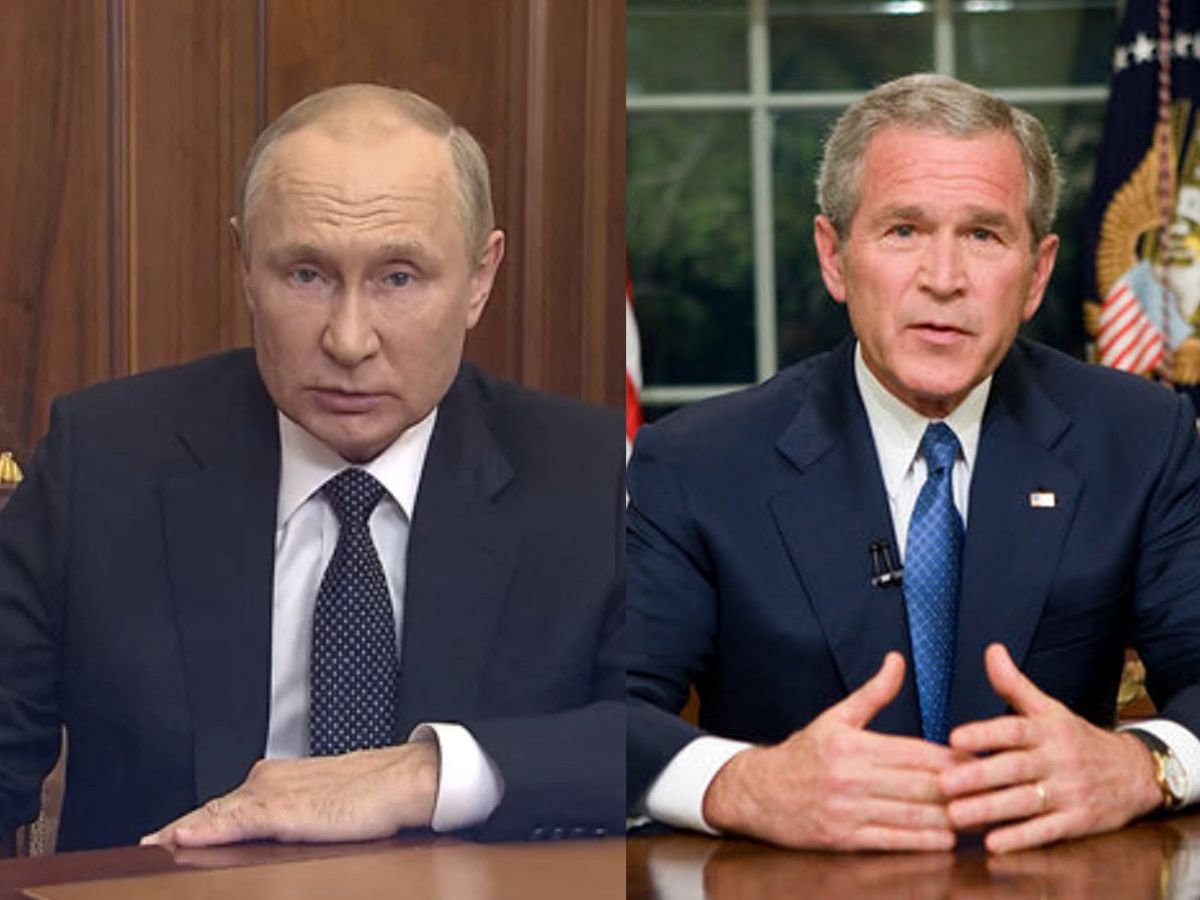
The National Security Archive has released a large set of declassified word-for-word transcripts that reveal the private conversations between Russian President Vladimir Putin and US President George W Bush from 2001 to 2008. These documents show that both leaders shared deep concerns about Pakistan’s nuclear safety. During their first face-to-face meeting in Slovenia in June 2001, Putin openly described Pakistan as “just a junta with nuclear weapons”, reflecting his fear about how unstable the country’s nuclear system was.
Fears over Pakistan’s nuclear control
The records show that even though the United States publicly worked closely with President Pervez Musharraf after the 9/11 attacks, both Putin and Bush privately believed his military-led government was a serious risk when it came to nuclear weapons. Putin criticised Western countries for not pushing Pakistan hard enough on democratic reforms. A major worry was the role of AQ Khan, the architect of Pakistan’s nuclear programme. In 2004, Khan admitted he had run a secret global network that sold nuclear centrifuge designs and materials to Iran, Libya, and North Korea. This shocking confession caused tension between Washington and Moscow.
What Putin and Bush said about Iran and Pakistan
One of the most striking exchanges in the transcripts came during a discussion about Iran’s secret nuclear sites and their connection to Pakistani technology.
President Putin said, “But it’s not clear what the labs (Iran) have, where they are… Cooperation with Pakistan still exists.”
President Bush replied, “I talked to Musharraf about that. I told him we’re worried about transfers to Iran and North Korea. They put AQ Khan in jail, and some of his buddies. Under house arrest. We want to know what they said. I keep reminding Musharraf of that. Either he’s getting nothing, or he’s not being forthcoming.”
Putin then added, “As far as I understand, they found uranium of Pakistani origin in the centrifuges.”
Bush said, “Yes, the stuff the Iranians forgot to tell the IAEA about. That’s a violation.”
Putin responded, “It was of Pakistani origin. That makes me nervous.”
Bush agreed, “It makes us nervous, too.”
Putin continued, “Think about us.”
Bush concluded, “We don’t need a lot of religious nuts with nuclear weapons. That’s what Iran has running the country.”
Why these revelations matter to India
Indian intelligence officials told CNN-News18 that these newly released records simply confirm what India has long believed—that Pakistan’s nuclear system is a serious global security risk. They said the problem is not limited to the “rogue” AQ Khan but is rooted in the wider system, where nuclear weapons are controlled by the military with very little civilian oversight.
From India’s point of view, the US decision to focus more on counter-terror cooperation with Pakistan instead of holding it accountable for nuclear leaks allowed Islamabad to avoid punishment. This, Indian officials believe, set a dangerous example and increased the risk of nuclear or radioactive material falling into the wrong hands during future conflicts. They also warned that the close links between Pakistan’s military leadership and extremist groups remain one of the biggest threats to stability in the region.