
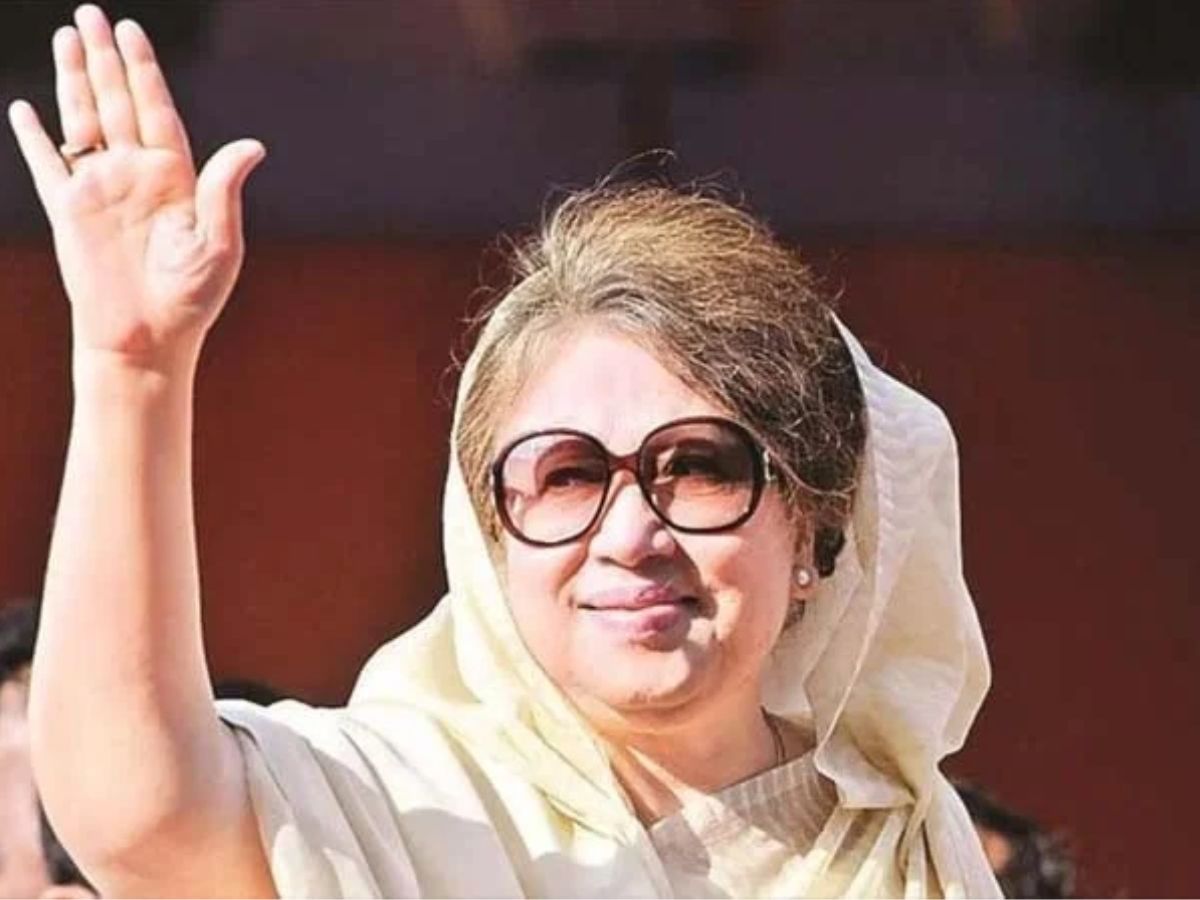
Khaleda Zia passed away early on Tuesday morning while receiving medical treatment at Evercare Hospital in Dhaka. She was 80 years old. As chairperson of the Bangladesh Nationalist Party (BNP), she remained one of the most powerful and influential figures in the country’s politics until her final days.
The death of Begum Khaleda Zia, a two-time former Prime Minister of Bangladesh, has come at a very important moment in the country’s democratic journey. Her passing comes just as Bangladesh prepares for national elections in February 2026.
Her elder son Tarique Rahman, who has been widely seen as the leading contender to become the next prime minister, had returned to Bangladesh recently after spending 17 years in exile. His return had already raised political excitement ahead of the upcoming elections.
Khaleda Zia Early Life and Family Background
Khaleda Zia was born on August 15, 1945, in Dinajpur, which was then part of East Bengal. Her father had moved to what was then West Pakistan after the Partition of India, leaving behind a tea business in Jalpaiguri, India.
She studied at Dinajpur Government Girls High School and later attended Surendranath College. In 1960, she married Ziaur Rahman, an army officer who later became President of Bangladesh and a national hero of the independence war.
Her life changed dramatically in 1981 when Ziaur Rahman was assassinated, leaving her a widow. The couple had two sons Tarique Rahman, who is now active in politics, and Arafat Rahman “Koko”, who died of a heart attack in 2015.
How Did Khaleda Zia political power Rise?
After the death of her husband, Khaleda Zia slowly entered public life. Ziaur Rahman had founded the BNP in 1978, and Khaleda later became its leader.
After Ziaur Rahman’s killing, Justice Abdus Sattar took over as acting president and BNP chief. However, in 1982, General Hussain Muhammad Ershad overthrew him and imposed martial law.
Khaleda Zia became BNP chairperson in 1984 and soon became the face of the nationwide movement against Ershad’s military rule. She openly rejected the 1986 election, calling it unfair, while other political parties chose to participate.
Between 1983 and 1990, she was arrested seven times. During this period, she built a strong student movement through the BNP’s student wing, Jatiotabadi Chatra Dal (JCD), which won 270 out of 321 student unions. These students played a major role in the protests that finally led to Ershad’s fall in 1990.
Khalida Zia As Bangladesh First Woman Prime Minister
In 1991, after the BNP won the national election, Khaleda Zia became the first woman Prime Minister of Bangladesh and the second woman in the Muslim world to hold such a position after Pakistan’s Benazir Bhutto.
Her first term from 1991 to 1996 was historic because it restored parliamentary democracy after years of military rule.
She returned to power again after the BNP won a large victory in 1996. However, her second term was short-lived. She resigned within a month due to allegations of corruption, political violence, Islamist militancy, and strained relations between the government and the military. Fresh elections were held in June 1996, which the BNP lost.
Later, in 1999, she formed a four-party alliance with the Jatiya Party, Jamaat-e-Islami, and Islami Oikya Jote to oppose the ruling Awami League.
Khaleda Zia was elected from five different parliamentary constituencies during the elections of 1991, 1996, and 2001. In 2008, she again won all three seats from which she contested.
Khalida Zia Political Career Shaped by Rivalry
For more than three decades, Bangladeshi politics was dominated by the intense rivalry between Khaleda Zia and Sheikh Hasina, the leader of the Awami League and daughter of Bangladesh’s founding leader Sheikh Mujibur Rahman.
Their bitter political battle deeply divided the country. It often led to street protests, government shutdowns, election boycotts, and long periods of political instability, shaping the nation’s modern political history.
Also Read: Khaleda Zia, Bangladesh’s First Female Prime Minister, Dies at 80