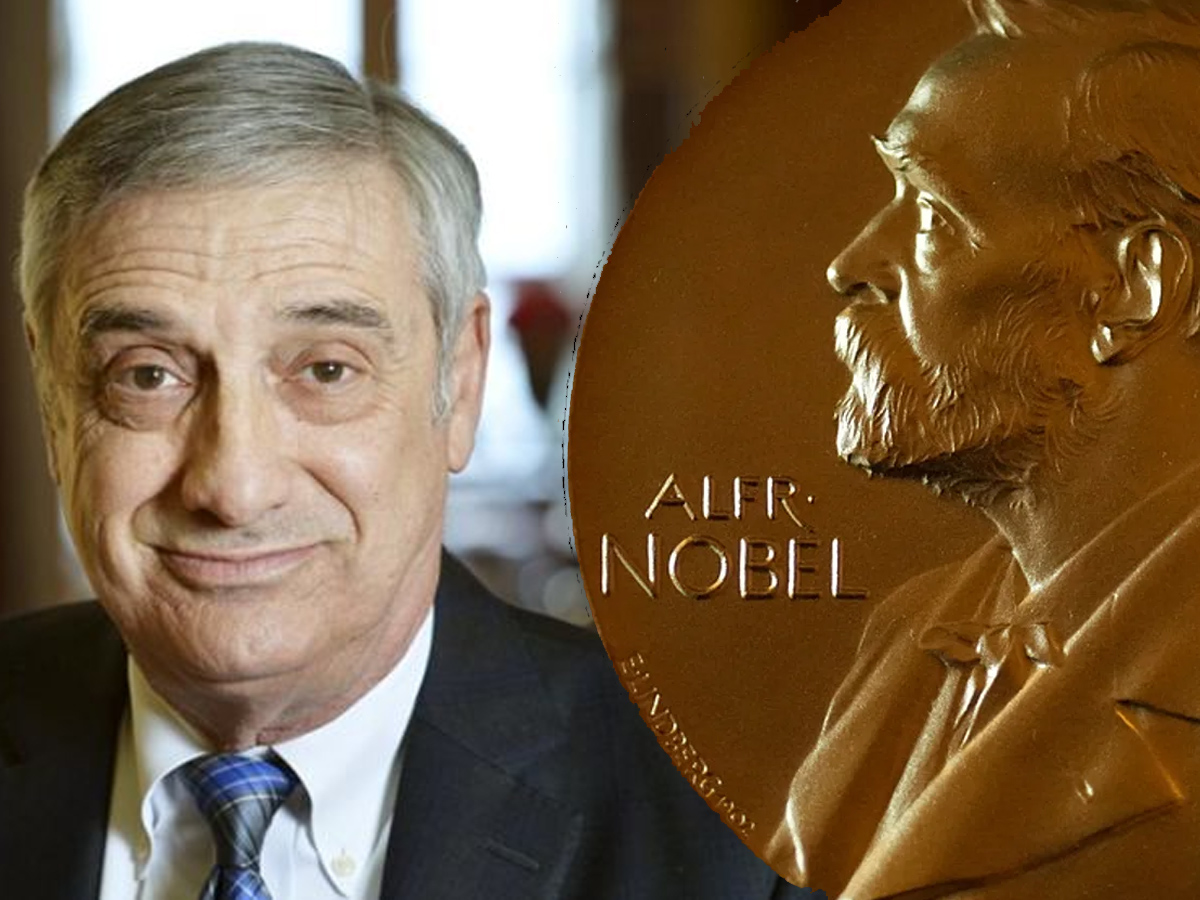
Joel Mokyr, a Dutch-Israeli-American economic historian, has won the 2025 Nobel Memorial Prize in Economic Sciences for his groundbreaking research on how societies achieve long-term economic growth through innovation and knowledge.
The Royal Swedish Academy of Sciences announced the award on October 13, calling his work key to understanding why technological progress becomes continuous in some societies but not others.
Mokyr shared the Nobel Prize with economists Philippe Aghion and Peter Howitt, who were honoured for their theory of creative destruction. The committee said Mokyr’s work “identified the prerequisites for sustained growth through technological progress.”
BREAKING NEWS
The Royal Swedish Academy of Sciences has decided to award the 2025 Sveriges Riksbank Prize in Economic Sciences in Memory of Alfred Nobel to Joel Mokyr, Philippe Aghion and Peter Howitt “for having explained innovation-driven economic growth” with one half to Mokyr… pic.twitter.com/ZRKq0Nz4g7— The Nobel Prize (@NobelPrize) October 13, 2025
Joel Mokyr: The Mind Behind the “Industrial Enlightenment”
Born in Leiden, the Netherlands, Joel Mokyr has spent much of his academic life uncovering how cultural values, curiosity, and openness to new ideas helped spark the Industrial Revolution.
Mokyr earned his PhD from Yale University in 1974 and has been a professor of economics and history at Northwestern University in Illinois since then. He currently holds the title of Robert H. Strotz Professor of Arts and Sciences.
He introduced the term “Industrial Enlightenment” to describe the cultural and intellectual transformation that encouraged innovation and technological progress in 18th-century Europe. His research suggests that societies grow not only because of economic incentives but also because of ideas, trust in science, and respect for knowledge.
Career Dedicated to Understanding Progress
Over five decades, Mokyr’s research has reshaped how economists and historians view development. His work combines historical analysis with modern economic theory to show that innovation is not just about inventions but also about social attitudes and institutions that promote learning.
His influential book, A Culture of Growth: The Origins of the Modern Economy (2016), argues that Europe’s cultural embrace of experimentation and evidence-based thinking was central to the modern economy’s rise.
Mokyr’s research continues to guide policymakers and economists as they look for ways to sustain innovation-driven growth in today’s world.
Global Recognition and Awards
Joel Mokyr’s contributions have earned him numerous awards and global recognition:
- 2025 Nobel Memorial Prize in Economic Sciences (shared)
- Balzan Prize for Economic History (2015)
- Heineken Prize for History (2006)
He is also a fellow of the American Academy of Arts and Sciences and the British Academy.
Mokyr has served as a visiting professor at Harvard, Stanford, and the University of Chicago, and was also a fellow at the Center for Advanced Studies in the Behavioral Sciences at Stanford.
Enduring Legacy of Joel Mokyr
The Nobel Committee noted that Mokyr’s work helps explain why some societies embrace technological change while others resist it. His insights continue to shape global discussions about innovation, growth, and the future of economies.
By connecting history, culture, and economics, Joel Mokyr has shown that progress is not just about invention — it’s about mindset.