
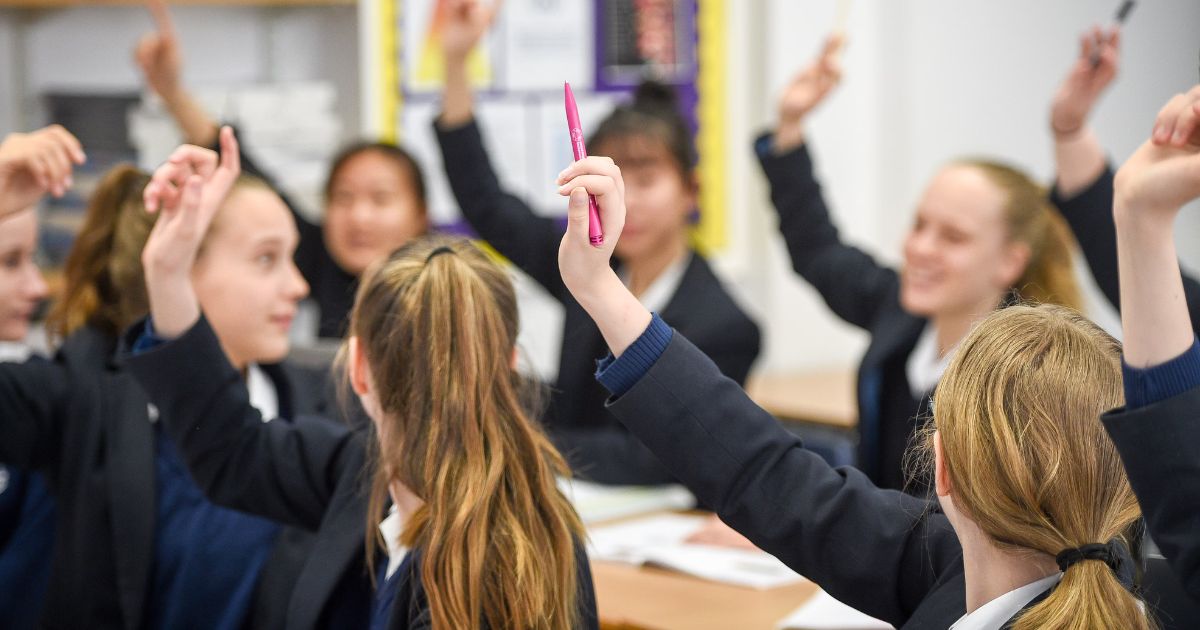
A recent demographic revelation has stirred sharp cultural and political introspection across Britain: White British children are now a minority in nearly one in four state schools across England. In major urban regions like London, Birmingham, and Leicester, the shift is not just demographic—it’s cultural, educational, and deeply political.
Decades in the making, this transformation has occurred in tandem with demographic dynamics, long-term immigration, and a growingly divided sense of national identity. What happens when immigration outpaces integration is a much more complicated social question than the story’s apparent statistical update.
A Shift Decades in the Making
According to an analysis of school census data gathered from over 21,500 primary and secondary schools in January, the majority of the cohort in 25% of them is listed as white non-British or an ethnic minority.
White British students make up less than 2% of the student body in 454 schools, and there are no reported white British students in 72 schools.
Many of the nation’s major cities, including London, Birmingham, Manchester, Bradford, and Leicester, have noticeable demographic shifts.
For example, only 12 out of 2,779 students at Loxford School, in the London district of Redbridge, were White British, while none of the 1,084 students at Rockwood Academy, in Birmingham, were listed as “White British” in the census.
The Quiet Segregation
The Buckingham University study predicts that within the next 25 years, the percentage of the UK population that is made up of foreign-born and second-generation immigrants will climb significantly, from less than 20% to 33.5%.
By the end of the century, one in five individuals in the UK will be Muslim, and six out of ten will either not have been born in the UK or have at least one immigrant parent, according to a paper by Professor Matt Goodwin.
“Profound doubts about the capacity of the UK state to both absorb and manage this degree of demographic change” are raised by the drastic population change, he said. An increase in support for reform is being driven by worries about the levels of legal and illegal immigration and their long-term effects.
A Divided Classroom, A Fragmented Future
The lived realities of British pupils are at the core of the issue, not just the numbers. Many schools have turned into microcosms of various communities in spite of legislative initiatives to promote inclusion. In areas where families live next to each other, children from diverse ethnic or religious origins often do not attend the same schools.
This quiet segregation—borne of catchment areas, parental choice, language comfort zones, and sometimes fear—has created parallel educational worlds. In many schools where White British children are in the minority, assimilation isn’t failing—it was never meaningfully attempted. That failure is as much systemic as it is social.
Integration Without a Map
The UK has always taken pride in its mixed culture. However, detractors claim that multiculturalism evolved from a reciprocal exchange of values to a disconnected cohabitation.
The uncomfortable truth is that integration, for many communities, has become a hollow term. Over time, linguistic and cultural barriers have become more rigid in some places rather than more pliable. A common thread that unites pupils from all origins into a unified national narrative, the ideal of shared civic identity, seems to be shattered.
Cultural Nationalism and the Radical Fringe
This fragmentation has not gone unnoticed by political forces that thrive on discontent. Across parts of Britain, cultural nationalism has found fertile ground—not just among the traditional far-right, but among sections of working-class populations who feel ignored, displaced, and misunderstood.
Official counter-extremism frameworks have increasingly flagged narratives of “cultural replacement” and “mass immigration” as breeding grounds for radicalization. But this only highlights the deeper problem: when genuine anxieties are dismissed outright as extremist, they are driven underground, where they can metastasize unchecked.
The consequence? A volatile political climate where cultural identity becomes a weapon, not a conversation.
Left Behind in Their Own Country
Nowhere is this rupture more visible than in education outcomes. Disadvantaged White British children—especially boys—are falling behind their peers across almost every key indicator: reading, mathematics, and school attendance. Some schools report GCSE pass rates for this group as low as 36 percent.
The irony is bitter. In a country that once built global empires through education and language, a growing number of its native children now struggle to find their place within their own national institutions.
Many of these children belong to communities where traditional industries have vanished, social mobility has stalled, and cultural confidence has eroded. They are not simply underperforming—they are disappearing from national concern.
A Deeper Reckoning
This is not just about numbers or school rosters. It’s about the soul of Britain—what it means to belong, to assimilate, to be heard.
If integration is to be real, it cannot be limited to symbolic gestures or token festivals. It requires active policies that bring communities into genuine dialogue, that invest in shared spaces, and that acknowledge cultural discomfort without judgment.
Otherwise, Britain risks becoming a nation of adjacent tribes—sharing the same land, but not the same future.