
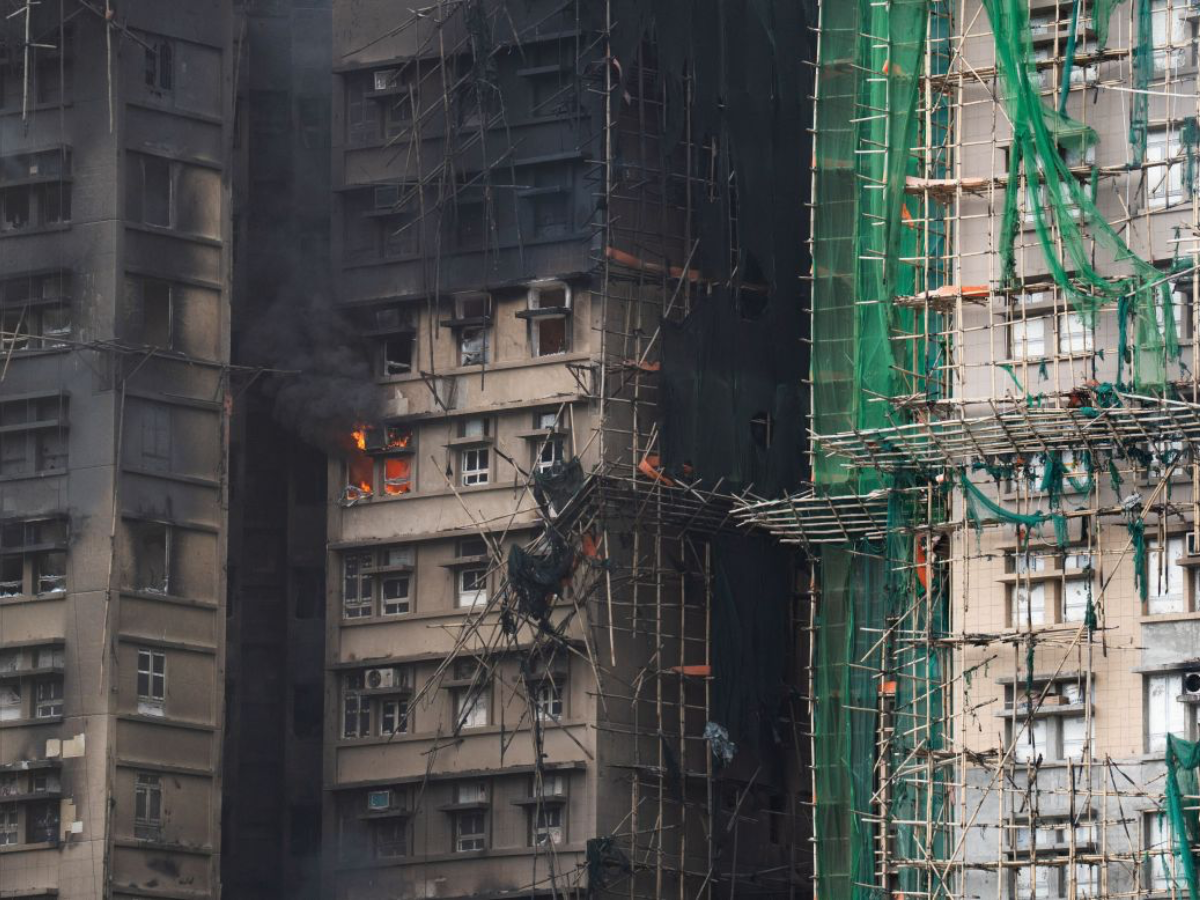
The fire that ripped through the Wang Fuk Court complex in Tai Po has sent shockwaves to the core of Hong Kong. Dozens are dead, many injured and hundreds remain unaccounted for and the search for answers is on.
But few questions are as prominent as this one how did a renovation tool as familiar to residents here as bamboo scaffolding become a contributor to the city’s worst blaze in decades?
What is Bamboo Scaffolding?
Bamboo scaffolding is a construction method with its roots in centuries of craft. Builders tie long bamboo poles together with nylon cords to create lightweight, flexible frames that wrap around whole buildings.
The technique originated in mainland China and has survived well into the modern era because it is cheap, adaptable and surprisingly strong for its weight. While metal scaffolding has replaced bamboo in most regions, Hong Kong continues to rely on it most notably in older, tightly packed districts.
How is Bamboo Scaffolding Used?
In Hong Kong, bamboo remains ubiquitous on large renovation projects. Skilled workers known locally as spider scale buildings, assembling dense grids of poles by hand. They do not use cranes, cutting poles on site and bending them around narrow passages and irregular facades.
ALSO READ: Hong Kong fire: What Caused Deadly Tai Po apartment Blaze & What is its Impact?
Once complete, the structure is wrapped in mesh to stop debris from falling onto pedestrians. Because bamboo is light and quick to erect, entire housing blocks can remain enclosed for months, sometimes longer.
Is Bamboo Scaffolding Dangerous?
Safety concerns existed before the Tai Po disaster happened. According to records from the government, fatal accidents involving bamboo scaffolding happened repeatedly in recent years, mostly during construction or maintenance work.
ALSO READ: Negligence or Accident? Questions Rise After Deadly Hong Kong Apartment Fire
Beyond just the risks to workers who work on them, bamboo itself is a combustible material and lacks the stability of metal frames. Fire engineers have argued that, although bamboo may still suit small household tasks, it is too hazardous to cover entire high-rise towers.
What role did Bamboo Scaffolding play in the Tai Po fire?
Investigators say that the fire began on a segment of scaffolding during renovation work. It then swiftly spread across the mesh and poles, creating a vertical path for the fire to spread quickly.
Those experts say this probably contributed to the collapse of sections in the fire and made containing the disaster much harder. For many, though, the disaster now raises urgent debate about whether this long-standing practice still has any place in a city of towering concrete blocks.
ALSO READ: Who is Bruna Caroline & What Led to the ICE Action Against Leavitt’s Family Member?
Disclaimer: This article has general analysis and should not be taken as technical, legal or safety advice.