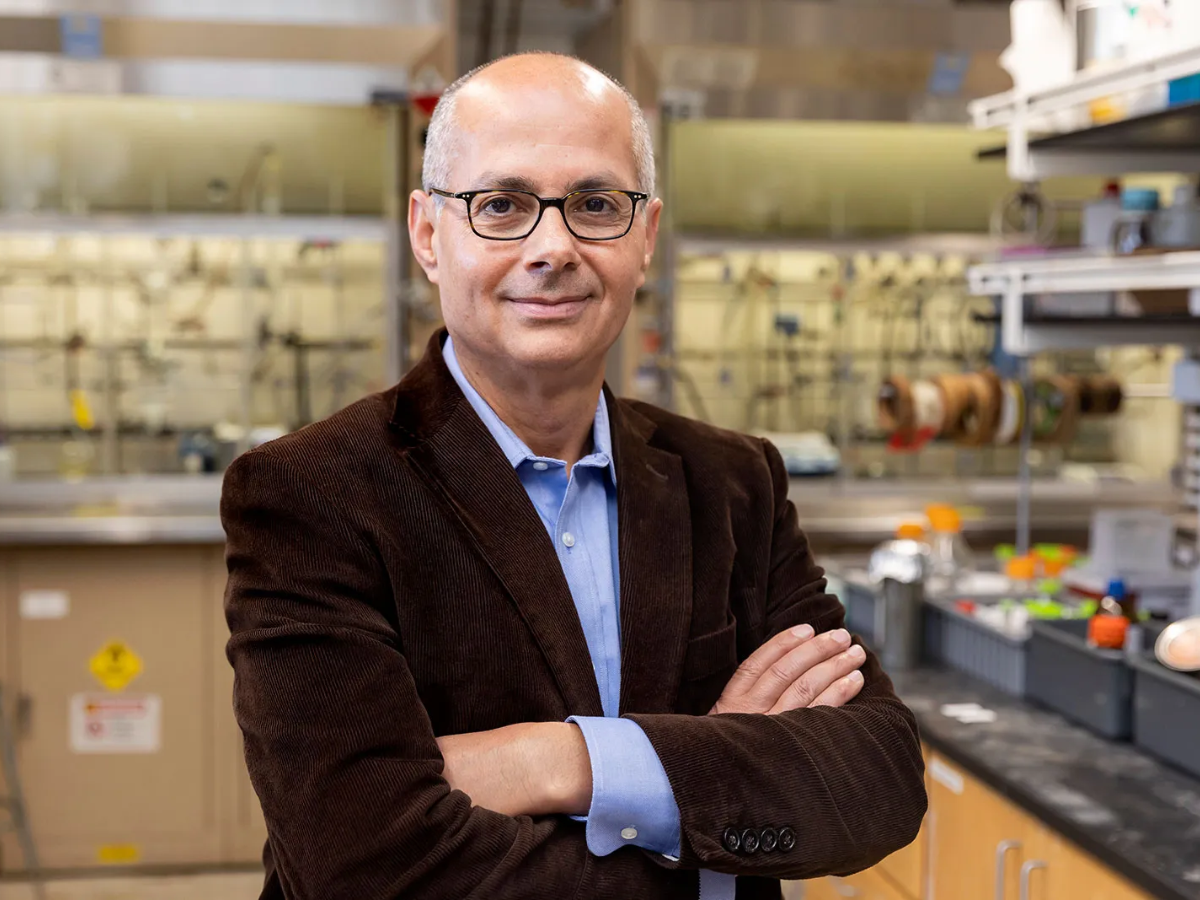
The Nobel Prize in Chemistry of 2025 has made the entire world take notice of Omar M. Yaghi, a Palestinian-American researcher whose groundbreaking work has transformed our understanding of materials, sustainability, and the environment.
Awarded alongside Richard Robson and Susumu Kitagawa, Yaghi received the Nobel for his groundbreaking development of metal–organic frameworks (MOFs) materials capable of capturing gases, storing energy, and even pulling water from desert air. But who exactly is Omar Yaghi, and how did he rise from humble beginnings to become one of the most influential chemists of the century?
Omar Yaghi’s Journey
He was born in Amman, Jordan, in 1965 to a Palestinian refugee family from the Occupied Palestinian Territories. His early life was one of poverty. He lived in a small crowded house, with no electricity or access to clean water conditions that would influence his later vision of science driven by sustainability.
He left Jordan for the United States at the age of 15, prompted by a strong interest and prodded by his father. Beginning at Hudson Valley Community College, he moved on to SUNY Albany, where his interest in chemistry started to take shape. He completed a PhD at the University of Illinois Urbana-Champaign, then postdoctoral work at Harvard University under Richard H. Holm a mentor who assisted him in sharpening the principles that would ultimately culminate in his Nobel-prize-winning discovery.
What Is Reticular Chemistry and Why Did It Receive a Nobel Prize?
In the early 1990s, Yaghi posed a revolutionary question: Can we build new materials by linking molecules like Lego bricks?
This gave rise to Reticular Chemistry, a science centered on sewing molecular constituents together to form immense, crystalline structures via strong chemical linkages. The outcome metal–organic frameworks (MOFs) and covalent organic frameworks (COFs) are materials of very high porosity and tunable functionality.
These materials are capable of capturing carbon dioxide, holding hydrogen and methane, and even extracting water from the air, and they play a critical role in addressing global challenges such as climate change, energy shortages, and water shortages.
It was precisely this innovation that earned Yaghi, Kitagawa, and Robson the 2025 Nobel Prize in Chemistry awarding not only a discovery, but the birth of an entire new discipline of science.
How Did Omar Yaghi’s Academic Career Shape Global Science?
Yaghi’s academic path mirrors his vision one rooted in excellence and accessibility. He has taught at Arizona State University, University of Michigan, UCLA, and finally, UC Berkeley, where he currently serves as the James and Neeltje Tretter Chair in Chemistry.
At Berkeley, he also established the Global Science Institute, which facilitates the creation of advanced research facilities in developing nations, empowering scientists worldwide to engage in high-impact research. His mentorship and leadership have encouraged an entire generation of chemists to conceptualize research as collaboration rather than isolation.
In a testament to his remarkable impact, the University of California appointed him University Professor in 2025 the highest academic honor.
What Makes Omar Yaghi’s Work So Impactful ?
The global implications of Yaghi’s discoveries go far beyond the lab. His MOF technologies are now being adapted for carbon capture, clean fuel storage, and water generation in arid regions.
Through his ventures Atoco (focusing on atmospheric water and carbon solutions) and H2MOF (dedicated to hydrogen storage), Yaghi is proving that science can directly drive sustainable innovation.
These successes evidence a unique combination of intellectual acumen and business vision — a congruence that makes his Nobel Prize not only a vindication of previous discoveries, but also the opening to new influence.
What Awards Did Omar Yaghi’s Receive Prior to the Nobel Prize?
Prior to his 2025 Nobel award, Yaghi had already collected a succession of significant global accolades — the Wolf Prize (2018), the Tang Prize (2024), and the Von Hippel Award (2025).
Each award marked a milestone in his journey, acknowledging the global reach and practical significance of his work. The Nobel, however, crowns a lifetime of discovery cementing his legacy as a scientist whose innovations are as visionary as they are vital.
What Is Omar Yaghi’s Legacy Beyond the Nobel Prize?
More than a laureate, Omar Yaghi is an embodiment of the power of science to change lives. His life from refugee boyhood in Jordan to Nobel laureate in America reflects the resilience and intellect that are the best of human potential.
His own philosophy is straightforward but deep: chemistry must not only make, but care. Through designing materials that can literally draw water from the air, Yaghi has demonstrated that scientific brilliance can be coupled with moral intent.
As the planet confronts increasing environmental challenges, his Nobel Prize-winning breakthroughs hold out the promise that answers might already be at hand constructed, molecule by molecule, by those with the courage to dream differently.