
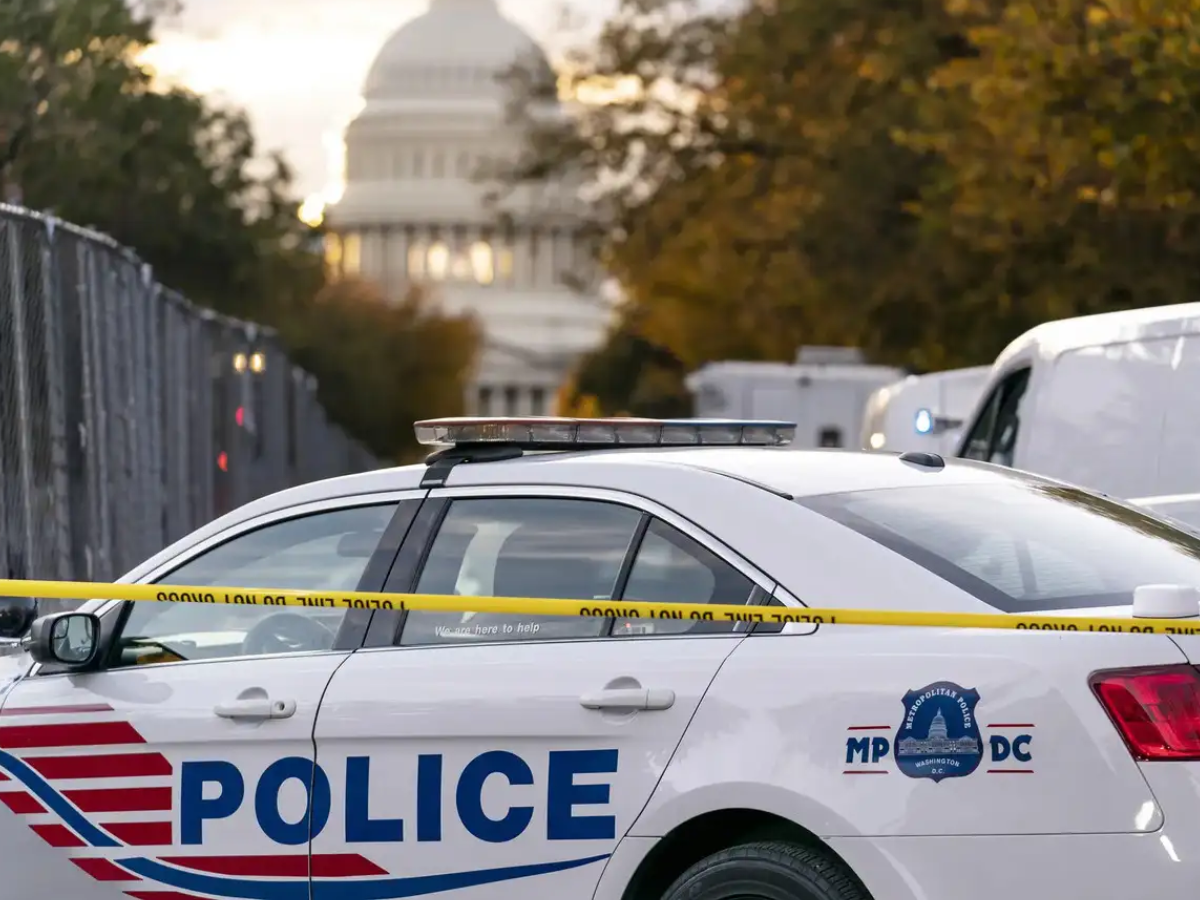
The District of Columbia sued U.S. President Donald Trump for his unprecedented move to take over the city’s police force, escalating a political and legal showdown over the capital’s administration.
D.C. Attorney General Brian Schwalb sued Trump in federal court on Friday in a challenge to Trump’s action, which he called an “illegal takeover” of the Metropolitan Police Department. The suit was brought only hours after the Trump administration appointed Drug Enforcement Administration chief Terry Cole as “emergency police commissioner” with the full authority of a police chief.
A hearing in the matter is set for 2 p.m. EDT.
White House Cites ‘Emergency’
White House spokeswoman Abigail Jackson brushed aside the move, asserting the administration has “lawful authority” to seize control of the D.C. Police because of “the emergency that has arisen in our Nation’s Capital as a result of failed leadership.”
The move came after a late Thursday order from U.S. Attorney General Pam Bondi, removing authority from the city and assigning it to Cole and overturning several earlier directives, including one that restricted the department’s role in cooperating with federal immigration enforcement.
Trump Deploys Troops, Federal Agencies
Trump declared earlier this week that he was sending hundreds of National Guard soldiers and taking the D.C. police force temporarily into his control to deal with what he termed a crime emergency — even though violent crime statistics are on the decline. Washington, where approximately 700,000 people live, has also had additional patrols by federal agencies such as the FBI, DEA, and Customs and Border Protection.
Trump has threatened to do the same in other Democratic-controlled cities like New York and Chicago. This is part of a larger campaign by the president to extend his reach into local politics, from big banks to universities, mostly getting political and financial concessions.
Home Rule Act at Center of Dispute
The constitutional conflict centers on the 1973 D.C. Home Rule Act, which gives the president the power to govern the D.C. Police during “special conditions of an emergency nature” for a 30-day period. To extend this period, Congress must pass a joint resolution something Trump has suggested he may seek.
Some lawyers contend that Trump’s broad seizure goes beyond the parameters of the law. “DC’s attorney general has very good arguments,” said William Banks, a national security law professor at Syracuse University, although he added that there is no precedent for such an action. Courts in the past have been deferential to presidential emergency declarations, says law professor Jill Hasday.
Political Stakes for Mayor Bowser
The suit also exacerbates tensions between D.C. Mayor Muriel Bowser and Bondi. Bowser has worked with Trump on occasion on some law-and-order matters because the city is so dependent on federal money, but she has vocally opposed troop deployment and the federalization of the police.
Schwalb labeled the move “the gravest threat to Home Rule D.C. has ever faced,” a signal of a struggle not simply over policing, but over who actually runs the nation’s capital.