
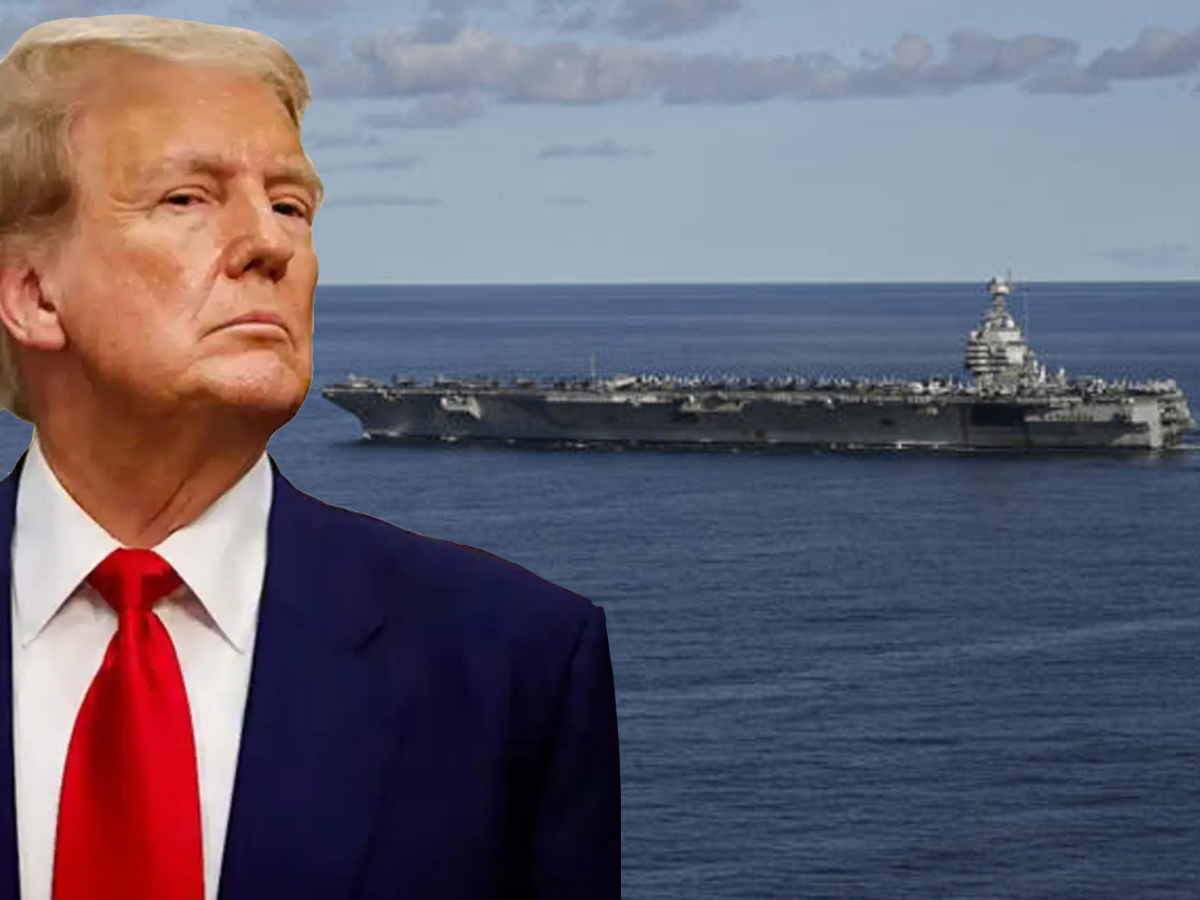
In a major shift that could reshape tensions in Latin America, US President Donald Trump said on Sunday (November 16, 2025) that Washington “may be having some discussions” with Venezuelan President Nicolás Maduro. His comments came at a time when the United States had deployed its largest military force in the region in decades, including the arrival of the advanced aircraft carrier USS Gerald R Ford.
Mr. Trump did not explain what kind of talks might happen. But he said, “Venezuela would like to talk.” The statement came as the US Navy continues its operations targeting vessels suspected of carrying drugs, a campaign that has drawn both international concern and regional support.
Massive US Naval Build-Up Near Venezuela
The US Navy confirmed on Sunday that the USS Gerald R Ford and several other warships had reached the Caribbean region as part of “Operation Southern Spear.” The deployment marks the strongest American military presence near Venezuela in generations.
The carrier strike group includes fighter jet squadrons, guided-missile destroyers, and around 12,000 sailors and Marines. The Navy said the strike group traveled through the Anegada Passage near the British Virgin Islands on Sunday morning.
Rear Admiral Paul Lanzilotta said the group would strengthen US efforts to “protect our nation’s security and prosperity against narco-terrorism in the Western Hemisphere.”
Admiral Alvin Holsey, who oversees the Caribbean and Latin America, also called the move “a critical step in reinforcing our resolve to protect the security of the Western Hemisphere and the safety of the American Homeland.”
Trump Says He Is Open to Talking
When asked about Maduro’s alleged interest in talks, Mr. Trump responded casually, “What does it mean? You tell me, I don’t know.” A moment later, he added, “I’ll talk to anybody. We’ll see what happens.”
For months, the Trump administration has insisted its military actions target drug cartels. However, the scale and intensity of the operations have left observers wondering whether Washington is using them to pressure Maduro’s government.
US Strikes Have Killed at Least 83 People
The US military also released new information on its latest strike. Southern Command posted a video on X showing a small boat exploding after being hit on Saturday in international waters in the eastern Pacific Ocean. Three men were killed.
Since early September, similar US strikes in the Caribbean and eastern Pacific have killed at least 83 people across 21 attacks. The US has so far offered no evidence that the boats were operated by “narcoterrorists,” as claimed by Mr. Trump.
Caribbean Nations Begin Joint Training With U.S. Forces
In Trinidad and Tobago, just seven miles from Venezuela, officials confirmed that troops have begun a week-long training exercise with US forces. It is the second such exercise in a month.
Foreign Affairs Minister Sean Sobers said the operations target violent crime and drug trafficking, as the island is a route for narcotics headed to North America and Europe.
The training includes Marines from the 22nd Expeditionary Unit stationed offshore for months. Venezuela’s government described the exercises as an act of aggression but did not comment on the aircraft carrier’s arrival.
US Strengthens Presence in Panama
Army Secretary Dan Driscoll said on Sunday that American troops have also been training in Panama. He added, “We’re reactivating our jungle school in Panama. We would be ready to act on whatever” President Trump and Defense Secretary Pete Hegseth needed.
The comment further highlights Washington’s growing military focus on Latin America.
Critics Question Legal Basis for the Attacks
The Trump administration has repeatedly said it is fighting drug cartels. But it has faced criticism from UN human rights officials, regional leaders, and even US lawmakers — including some Republicans — who want clarity on who is being targeted and under what legal authority.
Senate Republicans recently rejected a proposal that would have required Trump to seek congressional approval before launching any attack on Venezuela.
State Department to Label “Cartel of the Suns” a Terror Group
Secretary of State Marco Rubio said the administration will designate the Venezuelan organization “Cartel de los Soles,” or Cartel of the Suns, as a foreign terrorist organization. He claimed the cartel is led by Maduro and senior officials.
Rubio said the group is responsible for “terrorist violence” and moving drugs into the US and Europe. The designation takes effect on November 24, making it a crime to provide any support to the cartel.
Maduro has rejected all accusations, saying the US is “fabricating a war” against him.
Maduro Mobilizes Troops as Tensions Rise
On Facebook, Maduro wrote that “the Venezuelan people are ready to defend their homeland against any criminal aggression.”
Venezuela has announced a “massive” mobilization of troops and civilians to defend the country. Maduro and other socialist party leaders have held rallies to push for new neighborhood committees that promote party policies and increase membership.
Experts say the US deployment may be aimed at intimidating Maduro.
Elizabeth Dickinson from the International Crisis Group said, “This is the anchor of what it means to have U.S. military power once again in Latin America… everyone is watching with bated breath to see how willing the U.S. is to really use military force.”