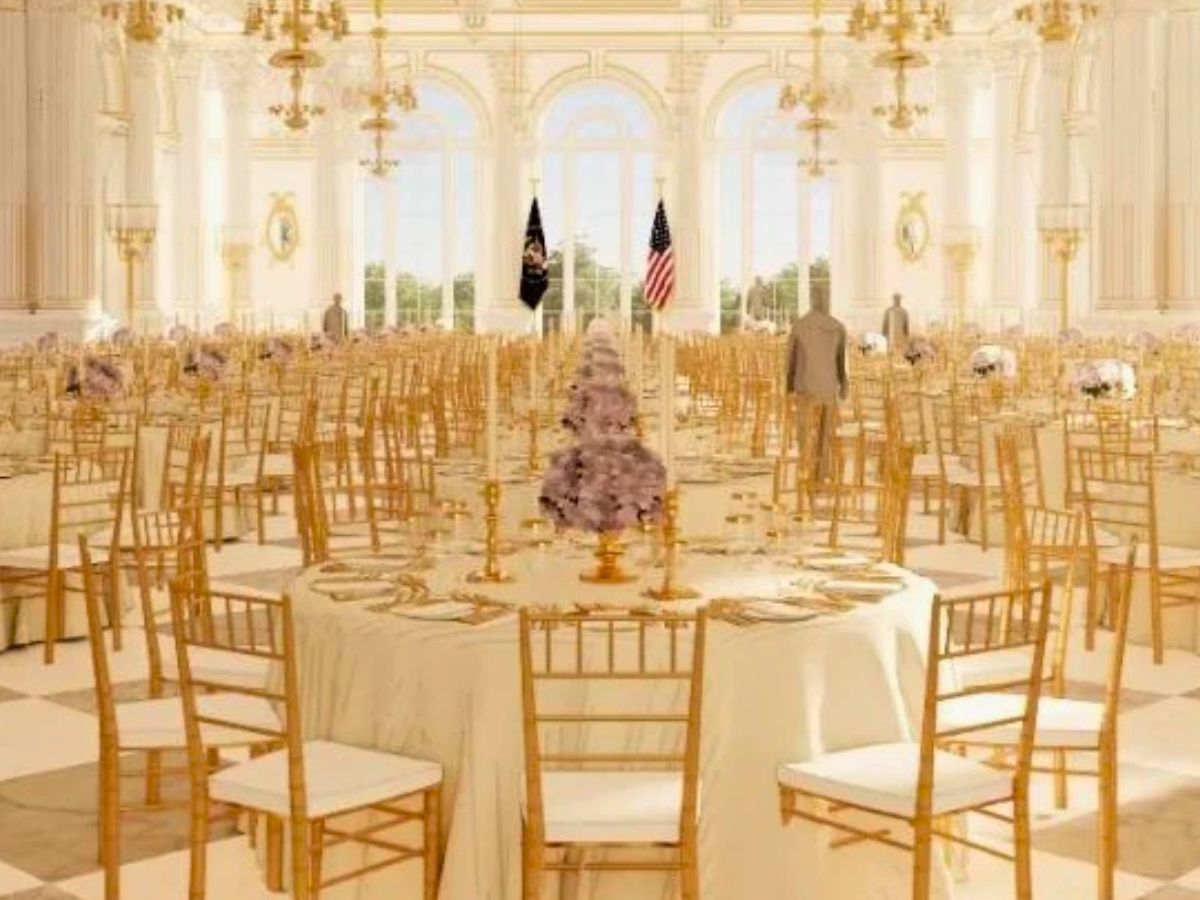
US President Donald Trump has begun transforming the White House with a new golden-hued ballroom. Bulldozers tore down the East Wing, a structure standing since 1942, to make way for the 90,000-square-foot venue.
The project is a lavish replica of Trump’s Mar-a-Lago style. It will host up to 999 people, possibly for political fundraisers. But the construction’s pace, skipped approvals, and cost escalation have raised eyebrows, drawing comparisons with infrastructure projects in India.
Skipped Approvals and Controversy
The East Wing demolition started without clearance from the National Capital Planning Commission (NCPC), the body that usually oversees major federal construction. Critics note this mirrors “typical Indian construction practices,” where projects often proceed before formal permissions are granted.
A commission official said, “The commission didn’t have jurisdiction over demolition or site preparation on federal property.” Trump has a history of bypassing conventional approval processes, as seen with the US-Mexico border wall construction.
Cost Escalation: A Familiar Pattern
Originally estimated at $100 million, the ballroom’s cost quickly rose to $200 million, then $300 million. Trump claimed on October 15 that the project was “on budget and on time.” A week later, he acknowledged the 50% cost escalation.
Private donors, including Amazon, Google, and Meta, are funding portions of the construction. Trump also pledged to contribute personally. The funding approach has drawn parallels with Indian mega-projects, where budgets often balloon over time.
Vanity, Legacy, and Politics
Trump’s ballroom is more than a luxury addition. It is a legacy project, a statement of personal brand, and a political tool. Its scale — double the size of the White House — is designed to leave a mark on history.
Politicians worldwide often pursue symbolic constructions, from monuments to stadiums. Trump’s golden ballroom fits into this tradition, merging vanity with influence.
A Cultural Exchange of Construction Practices
The project demonstrates a global diffusion of construction culture. Bulldozers, unilateral decisions, cost escalation, and donor influence are hallmarks often associated with Indian infrastructure projects. Now, similar patterns appear at one of America’s most iconic buildings.
It raises questions about how project management styles, not just architecture or technology, are shared or mirrored internationally. Trump’s approach may inspire debate on governance, oversight, and the blending of cultural construction norms.
Symbol of Ambition and Controversy
From demolishing historic structures to bypassing formal approvals and doubling budgets, Trump’s White House ballroom echoes the characteristics of large-scale Indian projects. While it is a personal and political statement, it also highlights the spread of construction culture across borders, leaving both critics and observers astonished.