
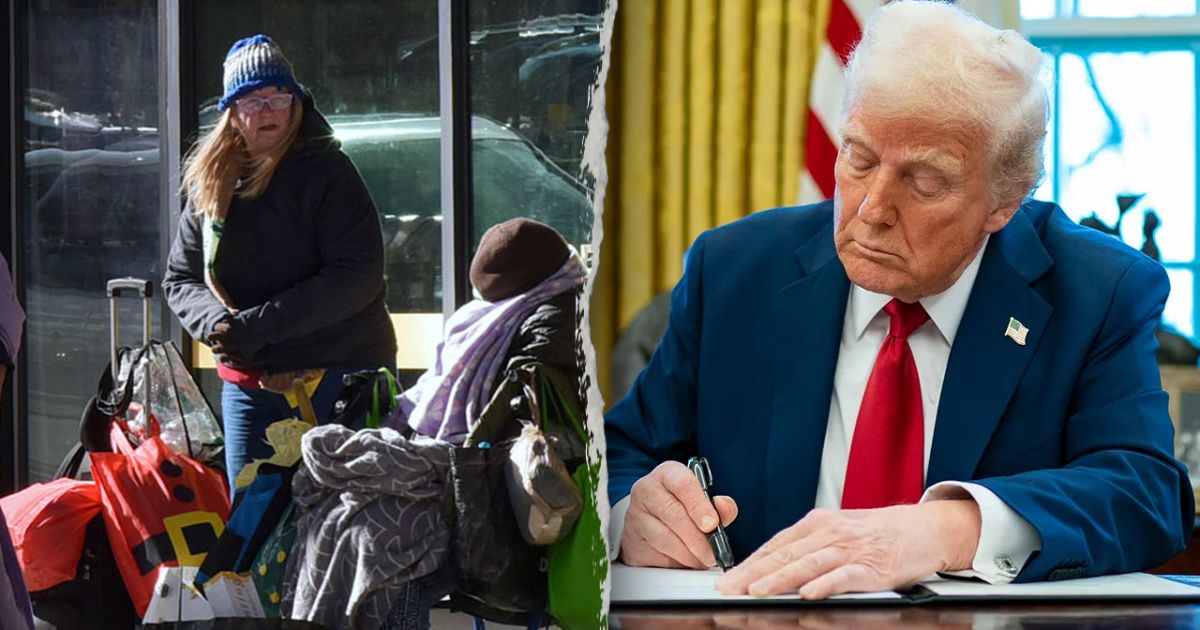
US President Donald Trump ignited outrage Sunday by demanding the homeless residents of Washington, DC, be removed from the city or face eviction. Posting on his Truth Social platform, Trump demanded homeless individuals relocate “IMMEDIATELY,” promising to move them away from the capital far. He also threatened to send federal officers there to fight crime, even with violent crime levels in the city at historic lows.
Trump’s Daring Assertions and Incendiary Photographs
Trump posted four pictures, seemingly during his motorcade ride from the White House to his golf club in Virginia. Two of them revealed about 10 tents camped out on grassy spots near a highway ramp less than a mile from the White House. A picture of a person napping on the stairs of a downtown building and one of roadside trash filled out the quartet.
Along with these photographs, Trump teased a Monday news conference announcing plans that he said would “essentially, stop violent crime” in DC, without elaborating on specifics. Later, he included that the event would also touch on “Cleanliness,” connecting crime and homelessness as areas requiring immediate focus.
The Free DC movement responded by quickly organizing a protest to coincide with Trump’s press event in favor of self-determination and resisting federal intervention.
Crime in DC: Declining Trend Defies Trump’s Assertion
Unlike Trump’s threats, statistics from the Metropolitan Police Department and government reports indicate that violent crime in Washington, DC, is decreasing. As of January, violent crime was down 35% compared to last year and reached a record low point of over 30 years. The mayor of the city, Muriel Bowser, reminded this Sunday on MSNBC of a further 26% drop in violent crime during 2024 to date.
We are not seeing a crime surge,” Bowser stated, attributing the decrease to local police work. She also explained that federal law enforcement is continuously present in the city and works in tandem with DC police. She reminded that the DC National Guard, threatened by Trump for use, is still under the president’s control but is not being mobilized at this time.
The Complex Politics of Homelessness and Federal Authority
On homelessness, numbers indicate that about 800 homeless individuals spend nights outdoors in DC, with additional thousands residing in shelters or transitional housing. Trump’s call to drive them out and send them “far from the Capital” was condemned, particularly because there was no articulation of how or where this would occur.
The White House has not yet clarified the legal grounds for the eviction of homeless people or if Trump can do so. Although he owns federal property, governance and day-to-day public services in DC are in the hands of local officials, as conferred by the 1973 DC Home Rule Act.
Trump also threatened to pass a bill stripping away DC’s local control, a measure that would place the city under direct federal rule a development strongly opposed by city residents and government officials.
Congresswoman Eleanor Holmes Norton, a representative of DC in Congress without voting rights, denounced Trump’s remarks as “misguided and offensive.” She pointed out that DC’s majority-Black and Brown electorate should be free to rule themselves free of interference from the outside world. Norton also urged again for DC statehood as the final solution to provide local self-determination.
Political Struggles and Public Safety Ahead
Trump’s comments arrive at a time when there has been increased political war over DC’s future and whether to question how to most effectively combat homelessness and crime. As the former president paints the city as unsafe and in crisis, official statistics paint another picture.
As residents of Washington gear up for the protest of federal overreach, the controversy over control, safety, and compassion in the nation’s capital will only grow more heated in the days ahead.
ALSO READ: US to End Dropbox Visa Interview Waivers from September 2025, Affecting Most Renewals