
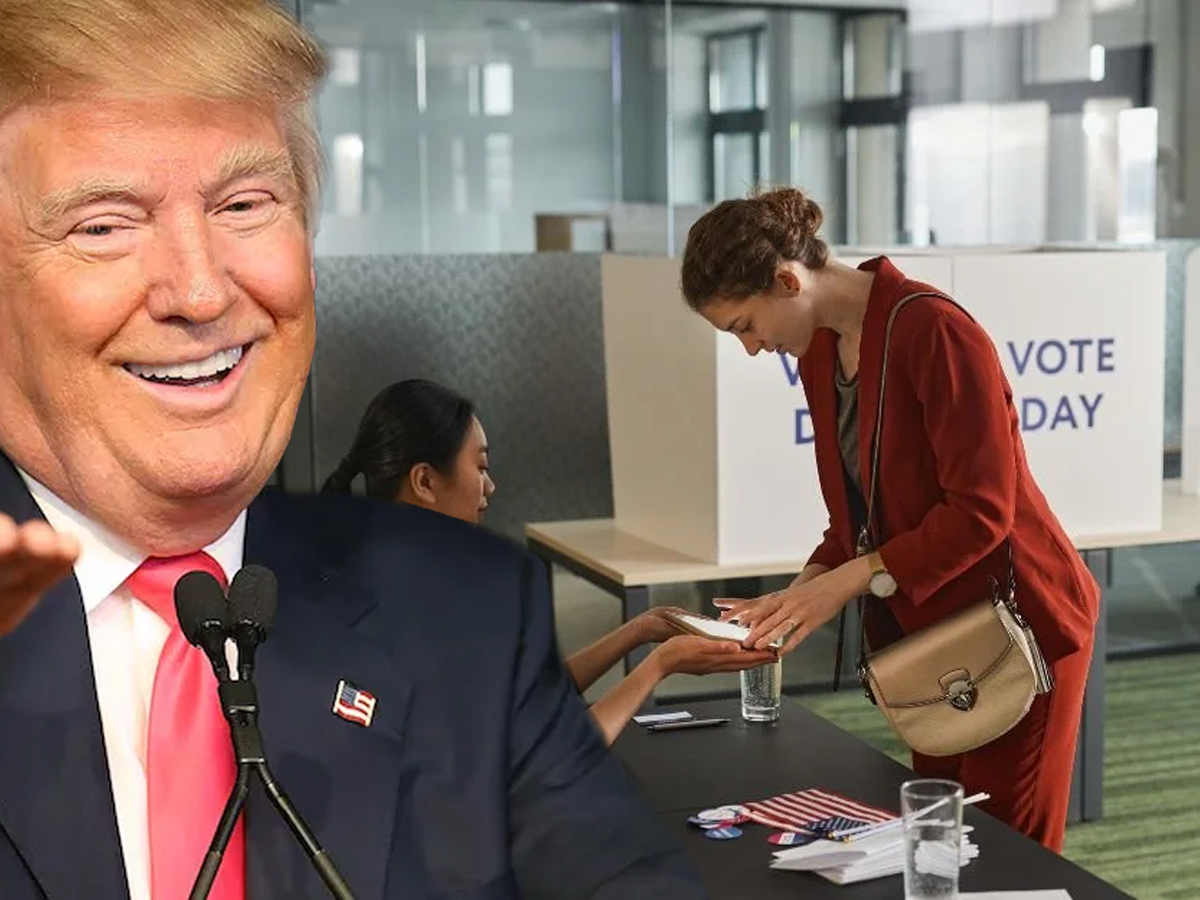
US President Donald Trump has once again launched a sharp attack on the American electoral system. After winning the 2025 elections, Trump has revived his old demand to scrap Electronic Voting Machines (EVMs) and postal ballots. He has announced a national movement before the 2026 midterm elections to eliminate both systems.
Trump has promised that he will sign an executive order to replace voting machines with traditional paper ballots. He wants these ballots to carry a special watermark to prevent fraud. According to him, paper ballots are “more reliable, faster to count, and harder to manipulate.”
In his post, Trump wrote, “Now we are the only country in the world still using postal voting. Every other nation has abandoned it due to widespread voter fraud.”
He urged Americans to support a transparent and fraud-free voting process.
Connection with India’s Debate on EVMs
Trump’s remarks are mainly aimed at US reforms, but they could also impact debates in other countries like India. In India, opposition or civil society groups have repeatedly questioned the reliability of EVMs and the accuracy of the voter list, which is a major concern in India.
ALSO READ: Navarro Criticises India’s Energy and Defence Ties with Russia
Bihar’s opposition parties are currently vehemently objecting to purported anomalies in voter lists. Additionally, they want the EVM-VVPAT (Voter Verified Paper Audit Trail) matching procedure to be more transparent.
Trump’s comments are expected to give fresh energy to critics of India’s electoral process.
Elon Musk and the Global EVM Debate
The debate over electronic voting systems is not new. On June 15, tech billionaire Elon Musk also called for the elimination of EVMs. He made this statement in response to a post by US presidential hopeful Robert F. Kennedy Jr. about irregularities in Puerto Rico’s primary elections.
Musk’s comment created a storm in India. Former Union Minister Rajeev Chandrasekhar defended India’s EVMs, while opposition leaders Rahul Gandhi and Akhilesh Yadav criticized their use.
This shows that the debate over voting machines is not limited to America. It is now influencing political conversations worldwide.
Voting System in the US: A Brief History
The US was using paper ballots and punch-card machines until 2000, but in the 2000 election, which was too controversial between George W. Bush and Al Gore. This election highlighted flaws in this system. The Help America Vote Act (HAVA) of 2002 was passed to fix these issues. This bill led to the adoption of EVMs, which also include Direct Recording Electronic machines (DREs).
But by the 2022 midterm elections, most Americans (about 70%) had returned to hand-marked paper ballots, and only 7% used DREs without a paper record.
Concerns about hacking, foreign interference, and private companies controlling voting machines deepened the distrust. Even though VVPAT systems were introduced to improve security, suspicion remains high.
Why the Distrust Remains Strong
Voting machines, according to experts, depend on intricate software that is susceptible to hacking, at least in theory. According to a 2007 Congress investigation, votes could be added, subtracted, or altered using secret codes.
ALSO READ: Trump Pushes for Zelenskyy-Putin Meeting, Calls It ‘Early Step’ Toward Peace
Another problem is that only three companies, including Dominion Voting, which was the focus of conspiracy claims following the 202 elections, manufacture 90% of the voting equipment in the US.
Aging machines also create problems, as many counties continue to use devices beyond their 10-year lifespan.
Paper Ballots vs EVMs: The Growing Divide
The US government has invested heavily to secure elections. Nearly $1 billion was spent to upgrade election systems before the 2020 elections. Some states are even testing open-source software-based EVMs to improve transparency.
Still, conservatives led by Trump continue to push for a complete return to paper ballots. The federal government has already classified the voting system as part of America’s critical infrastructure, but the debate is far from over.
Impact on Global Politics
Trump’s renewed attack on EVMs will not only shape America’s election process but also spark fresh debates in other democracies. In India, where opposition parties often allege tampering in EVMs, Trump’s remarks may strengthen calls for reform.
With the 2026 US midterms and India’s upcoming state elections, the question of technology vs tradition in voting will remain a hot topic.
MUST READ: U.S. Air Force Chief of Staff General David Allvin to Retire