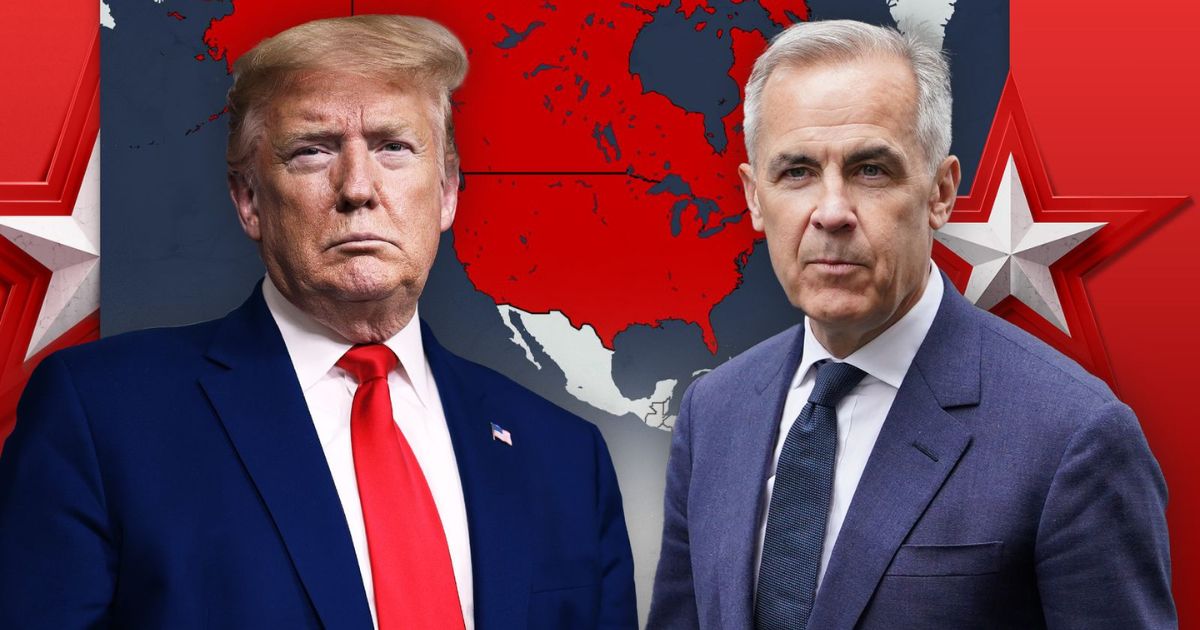
Canada’s move to acknowledge Palestine at the next United Nations General Assembly has drawn adamant criticism from US President Donald Trump. In a scathing statement on Truth Social, Trump cautioned that Canada’s action risks compromising future trade agreements. Trump also threatened a fresh round of tariffs on Canadian exports, heightening tensions within the G7 bloc.
Canada’s declaration is being followed by France’s and the United Kingdom’s similar promises. All three countries now intend to officially support a two-state solution by acknowledging Palestine in September. With Malta on the list now, and Belgium likely next, the diplomatic current seems to be turning around the West.
Trump Threatens More Tariffs on Canada
Trump responded quickly and forcefully. He stated that the US could pull the plug on any hope for a trade agreement with Canada under PM Mark Carney. Trump has already imposed tariffs on various Canadian products this year. In March, he imposed a 25% tariff on Canadian steel and aluminium. Later, weeks apart, he imposed the same on automobiles. In June, he doubled tariffs on steel and aluminium.
Now, Trump announced a 50% tariff on Canadian copper effective Aug. 1. If negotiations with Carney collapse, Trump threatened to impose a 35% tariff on all Canadian imports.
Carney Justifies Palestine Recognition
Canadian PM Mark Carney justified the move, saying it was in line with Canada’s historic support for a two-state solution. He stated that Canada would formally recognise Palestine at the United Nations in September based on the recent commitments by the Palestinian Authority to undertake reforms.
Canada has long been committed to a two-state solution — an independent, viable, and sovereign Palestinian state living side by side with the State of Israel in peace and security.
My statement on Canada’s recognition of a Palestinian state: pic.twitter.com/VHW1ziQ9s0
— Mark Carney (@MarkJCarney) July 30, 2025
“Canada has long been committed to a two-state solution,” Carney explained. “A sustainable, sovereign Palestinian state coexisting side by side with Israel in peace and security.” Carney was accompanied by Foreign Minister Anita Anand to the news conference where the announcement was made.
France, UK, Malta Join Diplomatic Push
France was the initial major power to change its position. President Emmanuel Macron stated in a personal letter to Palestinian Authority President Mahmoud Abbas that France would recognize Palestine in September. He demanded an end to the Gaza war and called for immediate humanitarian assistance, the release of hostages, and the disarmament of Hamas.
Consistent with its historic commitment to a just and lasting peace in the Middle East, I have decided that France will recognize the State of Palestine.
I will make this solemn announcement before the United Nations General Assembly this coming September.… pic.twitter.com/VTSVGVH41I
— Emmanuel Macron (@EmmanuelMacron) July 24, 2025
Soon afterwards, UK Prime Minister Keir Starmer followed suit. He threatened that unless Israel ends the humanitarian crisis and moves towards peace, Britain will recognize Palestine. Malta also joined the list, stating its intention to endorse statehood at the July 29 UN session.
G7 Rift Over Israel?
Canada’s move would signal the start of a greater political rift among the G7. Historically aligned in favour of Israel, the grouping is now under internal divergence. To date, no G7 nation has recognized Palestine. But with France, the UK, and Canada going alone, the previous consensus is cracking.
This may alter not only diplomatic ties with Israel but also the West’s overall strategy for Middle East peace initiatives. Trump’s ultimatums indicate intensifying intolerance for opposition among allies, but other leaders are less inclined to follow Washington’s hard line.
Global Recognition of Palestine Grows
Since Yasser Arafat’s 1988 Palestinian declaration of statehood, more than 130 nations have provided recognition, principally from Africa, Asia, Latin America, and the Middle East. In 2012, the United Nations General Assembly gave Palestine non-member observer status in a 138–9 vote.
Sweden was the first Western European country to recognize Palestine in 2014. Ireland, Spain, and Norway also followed suit in May 2024. Slovenia joined in June, with Belgium and Malta sitting on the fence. The Vatican has also acknowledged Palestine.
Trump’s bluster can coerce allies, but Canada won’t turn back. As civilian fatalities mount in Gaza and public opinion shifts, Western powers are refocusing. G7 recognition of Palestine marks not merely a diplomatic change—but also a rebuke of Trump’s transactional approach.