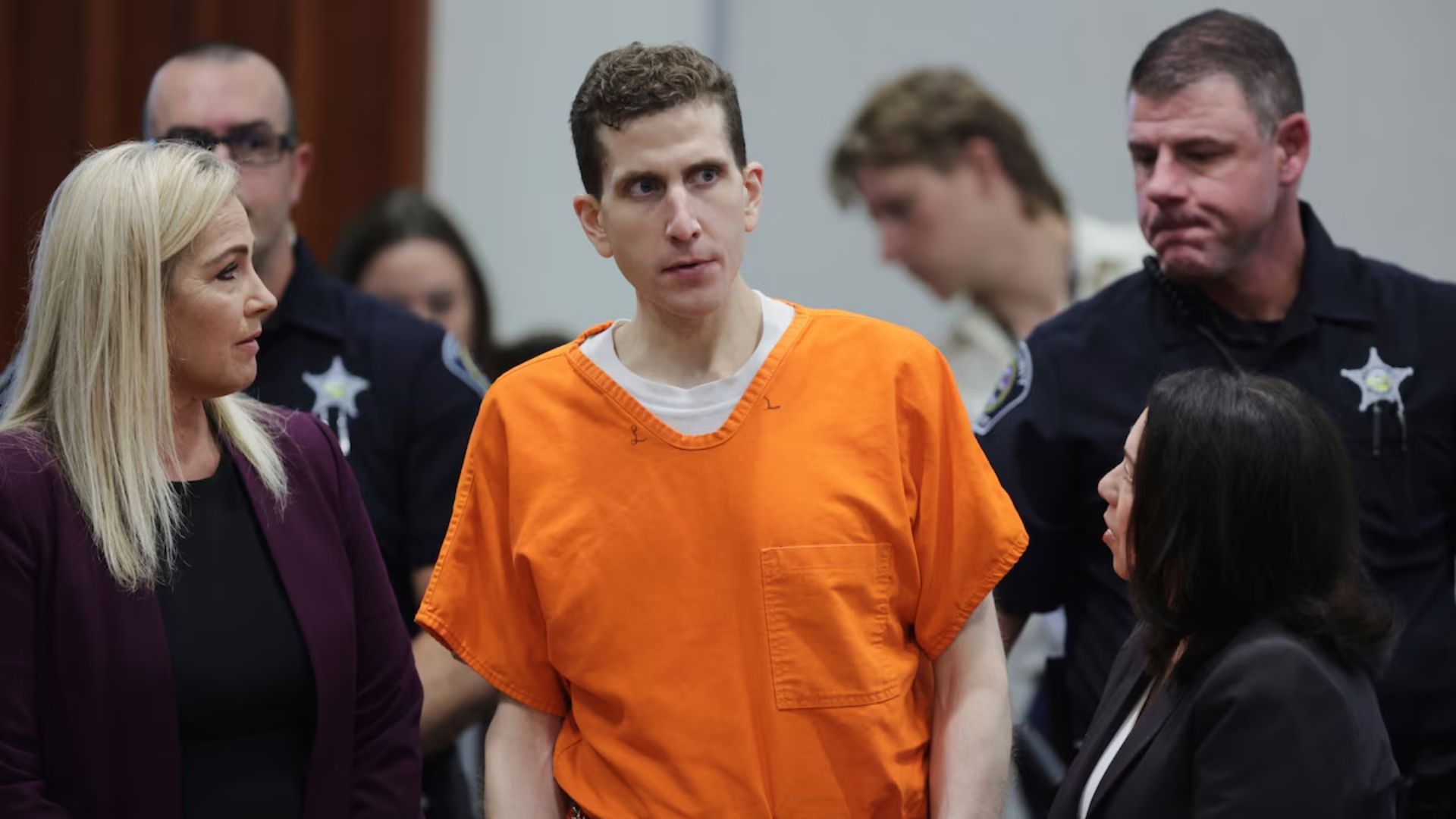
Bryan Kohberger, the 30-year-old ex-student of criminology who pleaded guilty to murdering four University of Idaho students in 2022, was sentenced on Wednesday to four life terms without parole.
Kohberger remained silent in an orange jumpsuit while listening to tearful testimonials from families of the victims.
While delivering the sentence, Judge Steven Hippler said, “I’m unable to find anything redeemable about Mr Kohberger. His actions have made him the worst of the worst.”
Details of the Crime
The horrific murders took place on November 13, 2022, in the quaint college town of Moscow, Idaho, and rocked the country. Kohberger broke into the off-campus residence of three of the victims and stabbed Kaylee Goncalves, Madison Mogen, Xana Kernodle, and Ethan Chapin to death.
Police reports made public for the first time at sentencing revealed the bloody brutality of the crime scene. Goncalves was stabbed 34 times, injuries so bad she was said to be ‘unrecognizable as her facial structure was extremely damaged’.
Kernodle, thought to have fought physically with the killer, had over 50 stab wounds, according to official reports.
“That’s done by a person who is cold, who is enraged,” said retired police chief James Fry. “Mad, extremely mad.”
Survivors and Investigation
Two of her roommates made it through the attack. One of them, Dylan Mortensen, reported to police she saw an intruder with ‘bushy eyebrows’ wearing a mask in the house that evening. Fry was asked why she might have been left alive. Fry said there are several possibilities. ‘He could’ve felt he’d been in the house too long. I don’t know, only he has that answer’, Fry said.
Kernodle is thought to have may have met Kohberger in the kitchen shortly after the delivery of her food, and that the attack may have started then. “I think it was a fight for their life,” Fry said.
Unanswered Questions
Despite the conviction and sentencing, the motive behind Kohberger’s violent rampage remains elusive. Fry, who led the investigation, admitted in an interview with ABC News, “You’re always wanting to get the families the why,” but added, “Sometimes they don’t get to have the why.”
“There’s always cases that, you know, 10 years down the line, somebody says something,” Fry said, leaving open the possibility of more coming forward in the future. Police haven’t been able to determine a connection between Kohberger and the victims or a main target.
Fry also unveiled the personal cost the manhunt imposed on him and his department. Throughout the almost seven-week pursuit of the suspect, Fry testified that he was receiving death threats, sleeping beside a loaded shotgun, and covering the windows of his office with butcher paper to safeguard the safety of his team.
Justice and Closure
On July 2, merely weeks before the trial was set to proceed, Kohberger pleaded guilty to four charges of first-degree murder and one burglary charge, for which he was handed the maximum penalty of 10 years.
During the sentencing, Fry saw Kohberger face-to-face for the first time as he sat across from him in the jury box.
Looking back at the destruction wrought, Fry stated, “He should be ashamed of what he did. He destroyed lives, families, communities. Changed everybody that ever worked that case, changed my university.” He further added, “It’s not human what happened.”
Nevertheless, Fry felt a sense of vindication, elated that he kept his word to the families of the victims that the case would not be left cold. “In the end, we got him,” was the unstated but emphatic culmination of an effort spanning years to bring justice to the shattered Moscow community.