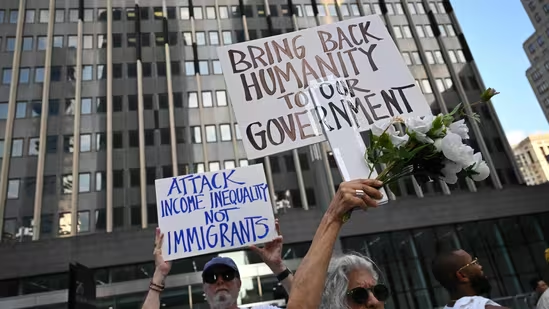
A renewed wave of nationwide civil dissent, branded under the label “Good Trouble Lives On”, surged across all 50 states this week as millions took to the streets to again condemn the policies of former president Donald Trump.
To protest what civil liberties some believe has eroded under the legacy of his administration at the center of which lies a high-impact sit-in demonstrator directly outside the Immigration and Customs Enforcement (ICE) facility at federal plaza from Manhattan in New York, where protestors physically blocked access routes, bringing demanded punitive immigration structures to their knees.
Over 366 protest sites activated in the course of an hour, one of the largest mobilization efforts since 2020 as protest actions erupted across join actions under the centralized focus on immigration enforcement but in addition addressed issues such as cuts in public health, anti-democratic governance and what organizers call a creeping second wave of authoritarian manifestations within American political life.
What is the Good Trouble movement?
In remembrance of the late congressman and civil rights activist John Lewis, protests were held in 1,600 places throughout the United States. The youngest and final surviving member of the Big Six civil rights campaigners, who were led by Martin Luther King Jr., was John Lewis.
Employers and workers have already been mobilizing in major protests in Atlanta, in Georgia, St. Louis, in Missouri, Oakland, in California and Annapolis, in Maryland-all those historically sites that bear all association with grassroots resistance.
Legacy of Civil Rights Leader John Lewis Inspires Movement The movement draws its moral and rhetorical foundation from the late Congressman John Lewis, a veteran of the civil rights movement of the 1960s.
The youngest among the “Big Six” under Dr. Martin Luther King Jr. For many, the protests have a commemorative tribute aspect to Lewis as well as caution against political complacency. Before his death in 2020, Lewis was known to have said-good trouble, necessary trouble-as part of asserting that rights are needed to reclaim democracy.
Increasing Tension with the Federal Response The protests occur within a smoldering environment since the day earlier this year on Los Angeles, California, where federal agents clashed with immigrant rights activists that protested the expansion of ICE raids. Any tensions raised regarding the movement by the deployment of some 2,000 National Guard troops into the city in June saw their return earlier this week, but interpreters of events among protestors saw this as a retreat, not a reversal of policy.
This was followed by symbolic protests across the country under the banner of “No Kings March”, which appeared to draw upon anti-monarchical imagery as a denunciation against executive overreach. Such events led millions to march from New York to San Francisco to contribute to the growing national opposition to what organizers deem as a “retreat” from democratic reality under the steam of Trump-flavored governance.
Response of Civil Society and Democratic Imperatives: Lisa Gilbert, co-president at Public Citizen, one of the premier non-profit watchdog organizations in this country, went even deeper in speaking about the life-and-death stakes these protests carry: “We are in one of the scariest moments in our nation’s history, as rights and freedoms and expectations of our democracy are challenged.” Gilbert’s comments reflect a consensus within civil society actors, warning of a dangerously eroding framework of democracy in the face of executive impunity, systemic inequality, and targeted suppression of vulnerable communities.
Struggle Continues into a Democratic Redeeming Transformation Good Trouble, as it unfolds, both memorializes carry on with unfinished business mattered unfinished business of civil rights heroes like John Lewis and establishes civic resistance again as fundamental to the preservation of democracy. The protests, through their sheer geographical scale and symbolic messaging, reflect a deep state of unease with American governance and a serious commitment to counter it in organized principled systems.