
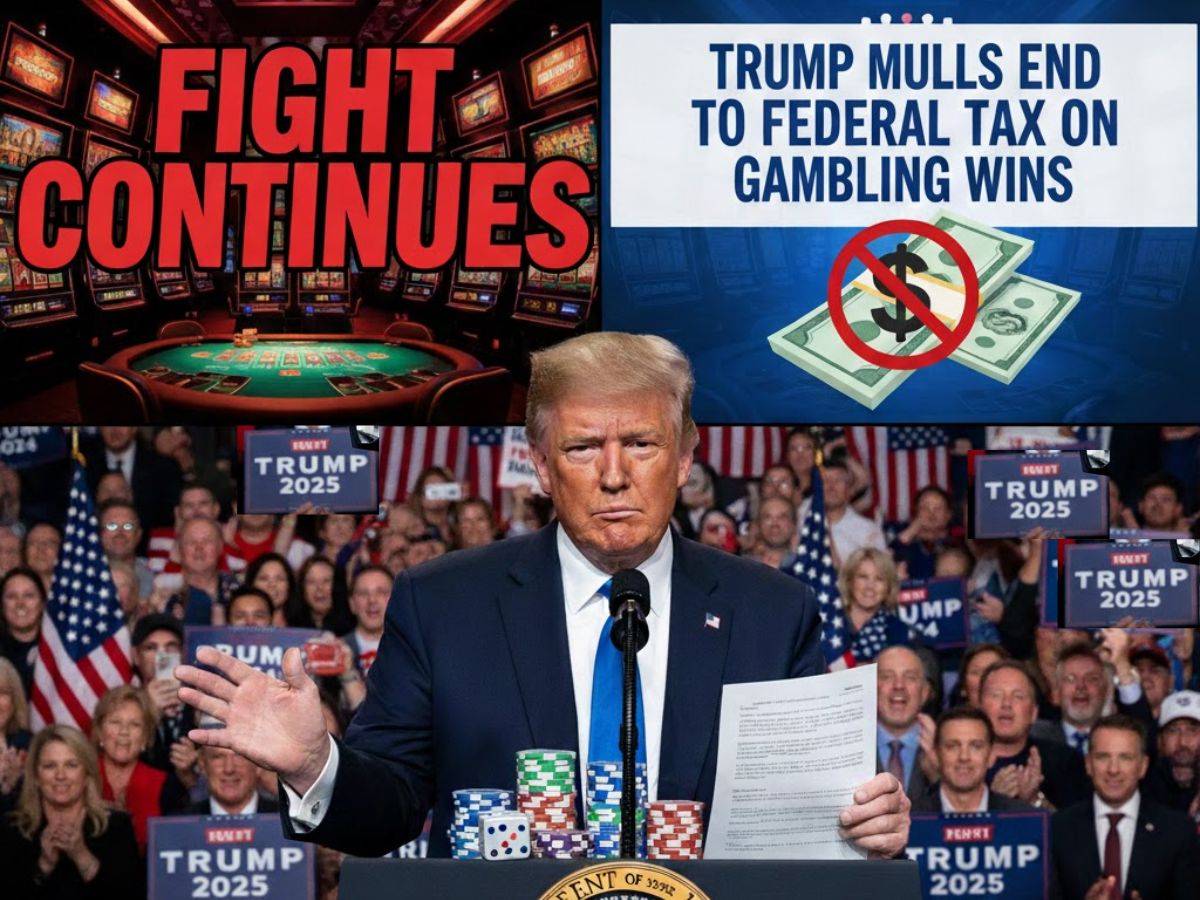
President Donald Trump has said he is thinking about a plan to remove federal taxes on gambling winnings, affecting millions of Americans who bet on sports, play the lottery, or go to casinos. However, in brief remarks to reporters, the President provided no details, timeline, or legislative strategy, stating only that he would “have to think about” the policy change.
What Exactly Did Trump Say?
When asked about taxes on gambling wins aboard Air Force One, Trump pointed to his administration’s previous tax cuts before hinting at a potential future move.
His exact comment was: “We have no tax on tips, we have no tax on Social Security, and we have no tax on overtime,” he said. “No tax on gambling winnings? I don’t know. I’m going to have to think about that.” This places the idea in the realm of consideration rather than an announced policy initiative. He made no mention of how such a change would be enacted or paid for.
Also Read: US Embassy Warns Against ‘Birth Tourism,’ Expands Social Media Checks for H-1B Visas
How Are Gambling Winnings Currently Taxed?
Under longstanding U.S. tax law, all gambling winnings—from lotteries, casinos, horse racing, and sports betting—are considered taxable income and must be reported to the IRS.
The current system includes:
- Reporting: Winnings over $600 typically trigger an IRS W-2G form.
- Withholding: Larger payouts can face automatic federal withholding of 24% or more at the time of winning.
- The Phantom Income Problem: The OBBBA, Trump’s 2025 tax bill, starts in 2026 capping gambling loss deductions at 90% of winnings. Bettors might then owe tax on net “income” they never had, creating what critics call “phantom income.”
What Are the Legislative Realities?
Despite Trump’s speculative comments, eliminating the federal tax on gambling winnings would face significant hurdles.
Key factors include:
Congressional Action Required: An Act of Congress, not only a presidential executive order or preference, is necessary for such a significant modification to the Internal Revenue Code.
Existing Pushback in Congress: There is a bipartisan push to reverse the OBBBA limit on gambling loss deductions. Nevada lawmakers, such as Senator Catherine Cortez Masto, have proposed restoring the 100% deduction, but the bills remain stalled.
Revenue Impact: A complete elimination of the tax would result in a significant loss of federal revenue, necessitating new levies or compensating cuts elsewhere—a difficult political task.
Your Questions Answered: Gambling Tax Policy FAQs
Q: If passed, would this mean all gambling wins are tax-free?
A: Only the federal income tax on winners would be removed. Particularly in places like Nevada and New Jersey that depend on this revenue, state and municipal taxes on gambling revenues would most likely continue to exist.
Q: What is the “phantom income” issue?
A: Under the OBBBA rules starting 2026, if you win $10,000 but lose $9,500 gambling, your real gain is $500. But since you can only deduct 90% of losses ($8,550), you’d owe tax on $1,450 ($10,000 − $8,550) of “phantom income,” not just your $500 profit.
Q: Why are lawmakers from Nevada leading the charge?
A: Nevada’s economy relies heavily on casinos and hospitality. Tax rules that discourage gambling or impose heavy taxes on visitors—like taxing “phantom income”—are viewed as directly hurting the state’s main businesses and jobs.
Q: Is this a campaign promise for the 2026 elections?
A: Although not an official promise, mentioning the idea has strong political appeal in states with big gambling industries. It lets Trump show support for an important economic sector and its workers ahead of the election.
Q: What is the most likely outcome?
A: The most immediate and likely legislative action is a bipartisan fix to the 90% deduction cap to eliminate “phantom income.” A full elimination of the federal tax on winnings is a much heavier lift and faces steeper fiscal and political obstacles, making it a longer-term, more uncertain prospect.
Also Read: Ranveer Singh’s Dhurandhar Sparks Online Harassment Campaign Against Critics, Says Guild