
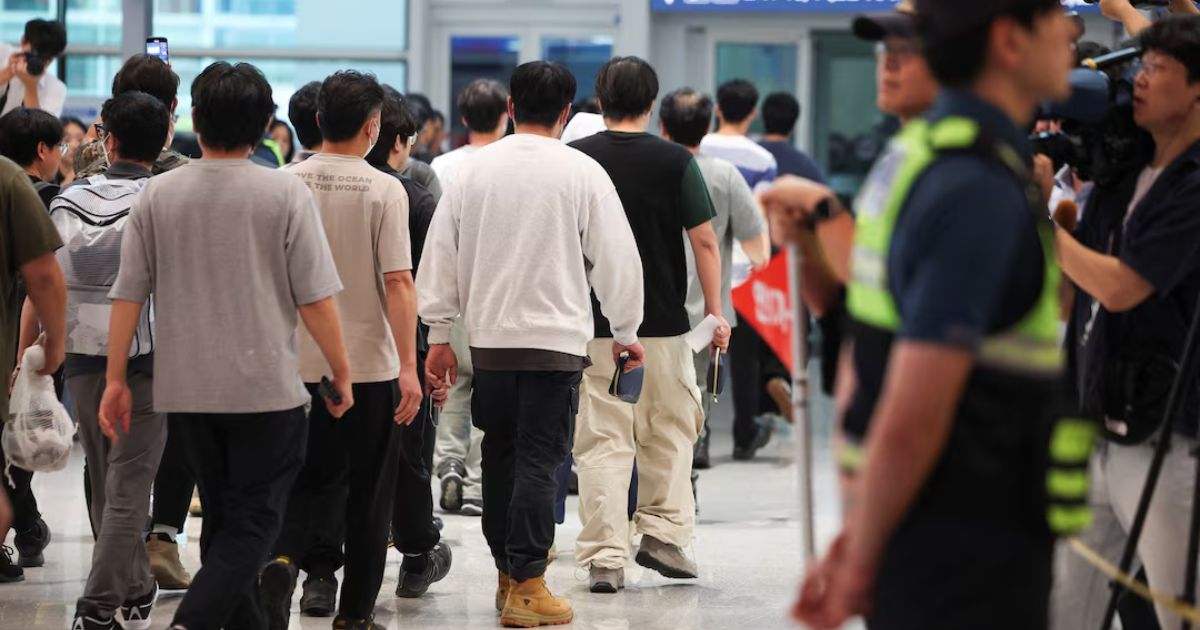
South Korean Workers Return After ICE Raid
Over 300 South Korean labourers returned to Incheon International Airport on Friday afternoon, putting an end to an eight-day ordeal that has shaken Seoul’s confidence in its closest ally, the United States. The group of 316 Koreans and 14 other foreign nationals had been held since 4 September after the US Department of Homeland Security’s biggest single-site raid, conducted by Immigration and Customs Enforcement (ICE) at a Hyundai-LG battery factory construction project in Georgia.
Escorted home on a chartered Korean Air flight, the workers looked visibly fatigued, many masked and toting small suitcases. Their quiet return contrasted with the storm brewing in South Korea, where public outrage has broken out over what many see as humiliating treatment.
Visa Dispute Sparks Diplomatic Strain
At the core of the dispute is a pre-existing visa grey area. Employees had been taking advantage of B1 business visas and the ESTA 90-day waiver program to temporarily work on assignments, something past US administrations accepted. But ICE considered their work in Georgia outside the allowed activities of training or meetings.
Seoul has maintained that the US does not have the expert technicians to carry out such factory installations and needs to let in temporary skilled labour. President Lee Jae Myung issued a stern warning that Korean companies would “hold back from making investments” in the US unless the matter is quickly settled. “This is not long-term employment but urgent technical aid,” he emphasized.
ALSO READ: ICE Raid On Hyundai Plant In Georgia Detains 475 Workers, Sparking US-South Korea Tensions
Public Outrage and a Breach of Trust
South Korean citizens and media have responded with outrage. The right-wing Chosun Ilbo attacked the arrests as a “merciless operation” and violation of trust, while the left-wing Hankyoreh blamed Washington for “backstabbing” Seoul despite recent high-level talks. Photos of Korean workers taken away in chains fuelled outrage even further, and many likened it to historical humiliations by foreign powers.
A poll by television broadcaster MBC found that 68% of South Koreans feel the US “failed to show consideration” to its ally. Protesters expressed their anger at the airport. “This was a national humiliation,” declared 75-year-old Hong Jung-sik, terming the incident “evil behaviour.
While South Korea’s foreign minister secured assurances that workers would not be restrained in transport, the incident has left lasting scars. Chief of staff Kang Hoon-sik summed up the unease, “We’re in an age of new normal with the United States. The standard changes every time.”