
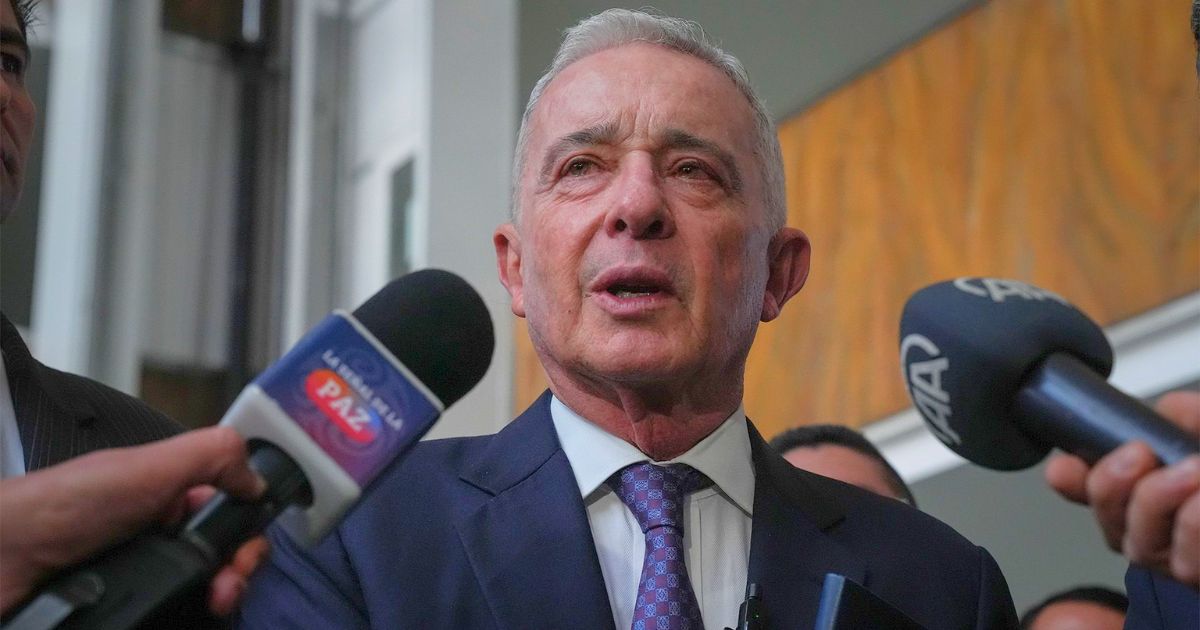
In a landmark verdict, a Colombian court convicted ex-President Álvaro Uribe of abuse of process and bribery of a public servant. He is the first former president in Colombia to be convicted at trial. The conviction comes barely months ahead of the country’s 2026 presidential election, in which Uribe’s political cohorts are vying for the presidency.
A judge read the verdict over almost ten hours, dismissing his defence while causing bitter arguments throughout the country. The verdict has fanned long-running divisions about Uribe’s connections to paramilitary forces and elicited scathing reactions from the US.
President on Trial: The Charges and the Verdict
Judge Sandra Liliana Heredia delivered the lengthy verdict in court on Monday. She convicted Uribe, 73, of abusing legal procedures and bribing a public official in a long-standing witness tampering case. However, she found him not guilty on a separate bribery charge. The ruling closes a 13-year-long legal saga that has polarized Colombians.
Every count has a sentence of 6 to 12 years. His sentence will be read by the judge on Friday. Uribe’s attorneys confirmed they will appeal and asked that he be spared during the process. Due to his advanced age, Uribe might receive a sentence under house arrest.
Bitter Fight Over Paramilitary Links
The case originated in 2012, when Uribe accused leftist Senator Iván Cepeda of conspiring to implicate him with right-wing paramilitary units. But in 2018, the Supreme Court ruled Cepeda had acted in line with the law. Rather, it concluded Uribe and his allies coerced former paramilitary combatants into altering their testimonies.
The court twice denied prosecution motions to dismiss the case. Cepeda, who was present at the hearing, described the verdict as justice long overdue. The verdict also sheds new light on Uribe’s presidency, when he commanded a hardline military campaign against rebel groups and brokered the demobilization of paramilitaries. Colombia’s truth commission asserts that those groups killed more than 205,000 people in the armed conflict.
Rubio and Washington Respond
The decision was condemned by United States Republican Senator Marco Rubio, an old Uribe friend. He accused Colombia’s courts of being “weaponized by extreme judges” and cautioned that the ruling created a dangerous precedent. Uribe was aligned with Washington during his presidency and extradited paramilitary bosses to the US.
A warning from Banco de Bogotá indicated the conviction would impact bilateral relations. US legislator Mario Díaz-Balart has called for cutting non-military assistance to Colombia next year, in part because of the alleged due process flaws in the case.
Political Earthquake: 2026 Election Risks
Uribe leads the influential Democratic Centre party and wields great sway over Colombia’s right wing. A few of his supporters are tipped to stand in 2026. His conviction thus comes as a political earthquake. Critics call it long-overdue accountability. Its defenders describe it as persecution.
Both camps stood outside the court throughout the hearing, with Uribe’s supporters donning masks of his face. His lawyers claim he’s innocent and intends to demonstrate this on appeal.
Judge’s Message to the Nation
As she opened proceedings, Judge Heredia asserted, “Justice does not kneel before power. It is at the service of the Colombian people.” Her written judgment is 1,000 pages long. Her words now resound across a bitterly polarized Colombia.
This verdict doesn’t only convict a former president. It compels—and compels a country to face uncomfortable truths about war, politics, and accountability, just as it nears a decisive election.