
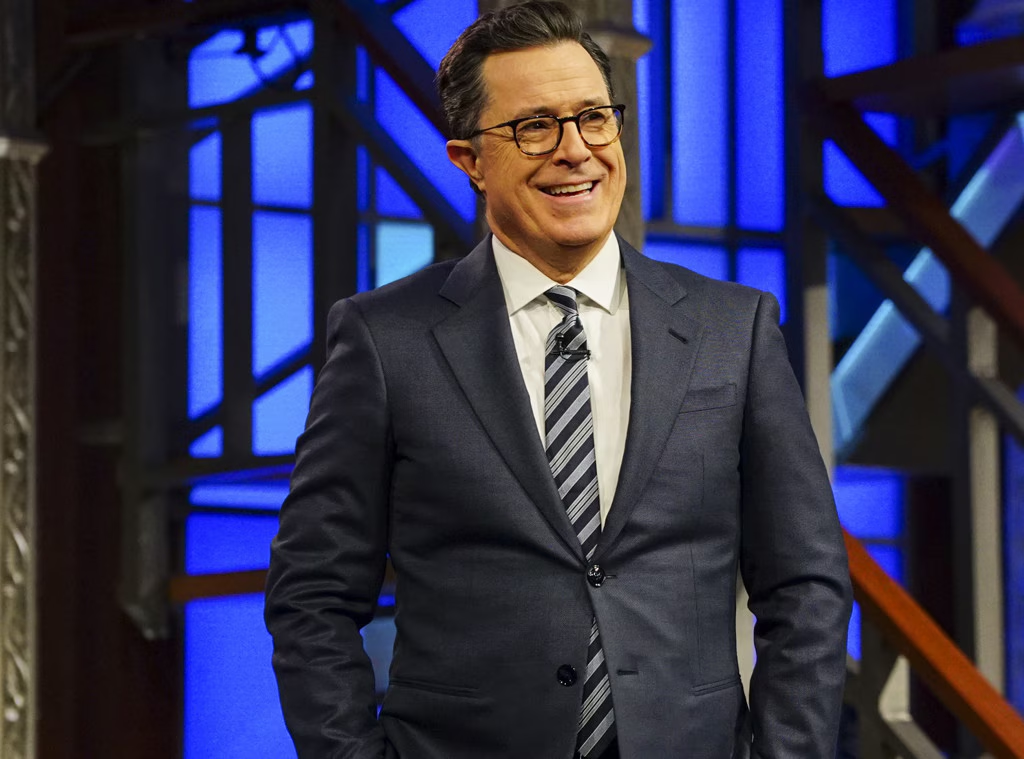
A growing political controversy has emerged following CBS’s announcement that The Late Show with Stephen Colbert will conclude its broadcast run in May 2026. While the network cited standard programming adjustments, U.S. Senator Elizabeth Warren has publicly questioned whether the decision to end the program was politically motivated particularly in light of a recent multimillion-dollar settlement between CBS’s parent company, Paramount Global and former President Donald Trump.
Allegations of Political Retaliation Surface After Colbert’s Criticism
Senator Warren is one of the members of the progressive deal, who suggested Colbert’s condemnation of the $16 million settlement might have provoked CBS’s sudden action. This she said in her social media statement:
“Just three days after Colbert publicly excoriated CBS parent company Paramount for its $16M settlement with Trump-a deal that looks like bribery. The American public deserves to know whether his show was canceled for political reasons.”
Her statements are, therefore, rekindling concerns about media independence, the corporate-political entanglement, and the possible suffocation of dissenting voices in mainstream broadcasting.
Paramount-Trump Settlement Raises Eyebrows
At the heart of the controversy is a $16 million legal settlement made between Paramount Global and Donald Trump. The settlement was the result of a lawsuit filed by Trump regarding the editing and presenting of a 60 Minutes interview with Democratic presidential candidate Kamala Harris late in 2024.
Trump alleged that the segment distorted his views and took legal action against the network for defamation. Paramount chose to settle the case quietly and on July 1, 2025, made a brief announcement of the settlement.
Colbert Responds On-Air: ‘$16 million Would Help’
Upon returning from a production hiatus, Stephen Colbert addressed the issue head-on in his monologue, expressing his disillusionment with his employer.
“I am offended,” he said, pausing before adding, “I don’t know if anything anything will repair my trust in this company. But just taking a stab at it, I’d say $16 million would help.”
His remarks, laced with satire, alluded to the financial scale of the settlement and implicitly suggested that the agreement undermined journalistic integrity. Colbert characterized the deal as a “big fat bribe,” directly challenging the editorial credibility of CBS’s leadership.
Industry Reactions: Jon Stewart Labels Deal ‘Shameful’
Able veteran satirist and Daily Show host Jon Stewart, also under the Paramount corporate umbrella, expanded the criticisms. On the air and via social media, Stewart questioned what the settlement meant for journalistic ethics within the network ecosystem: “I would assume internally this is devastating to the people who work in a place that pride themselves on contextual, good journalism.”
For decades, Colbert and Stewart have been openly harsh critics of authoritarianism, media censorship, and political corruption, leaving them often at odds with elements of the corporate and political establishment. The fact that both personalities remain in Paramount-owned entities, CBS and Comedy Central, has only served to amplify public scrutiny of the company’s internal decision-making.
Media Freedom or Corporate Compliance? Broader Implications for Democracy
As this controversy unfolded, it opened up a larger debate on the state of press freedom in the United States. Media establishment once thought to be safer from commercial pressure and political entanglements, say critics, is fast losing that immunity, meaning journalistic integrity is being compromised. The timing of the Colbert cancellation, a mere few days after the comedian criticized the corporate settlement over an important political issue, raises enormous questions concerning the independence of satirical journalism held in existence by profit-based media networks.
The Colbert case also reveals tensions between public interest and corporate interests when politicians directly engage in private settlements with media companies. Although CBS famously never offered telling reasons for Colbert’s ousting, the confluence of events has engendered increasing demands from both viewers and lawmakers for more transparency on an issue where no media company appears eager to share.
Whether The Late Show with Stephen Colbert was shut down for internal restructuring reasons or because of political pressure is far from clear. Nevertheless, the affair has provocatively opened the public to questions regarding the neutrality of media, the limits of political satire, and the impact that financial settlements may have on editorial independence.
This scandal may also act as a bellwether for how media institutions negotiate dissenting journalistic practices against corporate interests and public confidence in a progressively polarized environment, where political tensions mount before the 2026 presidential election.