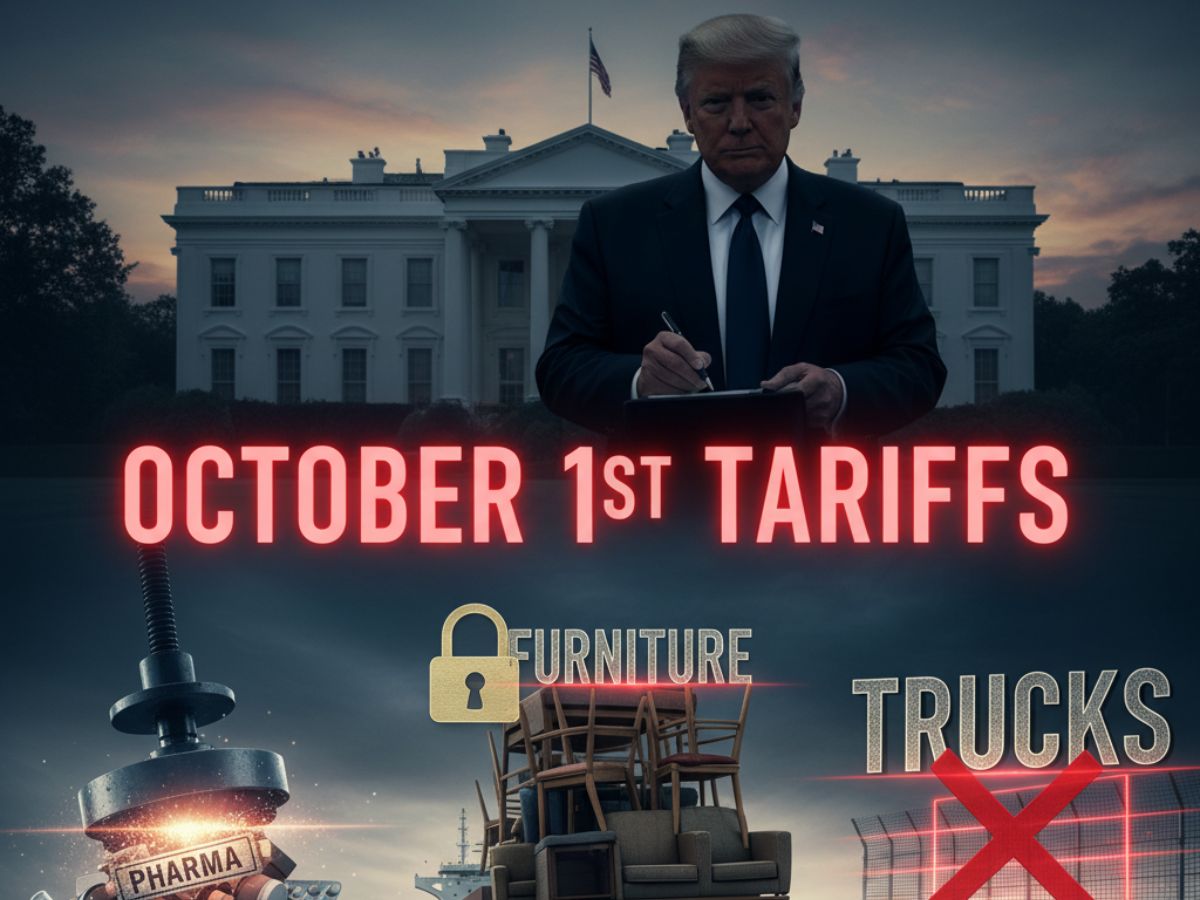
In a move that has jolted global markets and industries, U.S. President Donald Trump unveiled a new wave of import tariffs, targeting everything from life-saving medicines to heavy-duty trucks. After a period of relative calm, the news on Truth Social signifies a dramatic return to trade confrontation and could potentially rekindle the very worries that have clouded the global economy.
What Exactly Are the New Tariffs?
The new duties are sweeping and targeted, set to take effect from October 1. The most eye-catching is a 100% tariff on branded pharmaceutical drugs. This means the cost of many prescription medicines imported into the U.S. could double. Additionally, Trump announced:
- A 25% tariff on imported heavy-duty trucks.
- A 50% tariff on imported kitchen cabinets and bathroom vanities.
- A 30% tariff on upholstered furniture.
The stated goal, according to Trump, is to protect the U.S. manufacturing industry and national security. However, the move has immediately drawn criticism from trading partners and industry groups who fear it will disrupt supply chains, raise costs for American consumers, and unfairly target allies.
Why Now?
This latest salvo follows a summer where Trump reached trade deals with key partners like Japan and the European Union. So, why restart the trade war now? Analysts suggest it’s a strategic shift. With a key case on the legality of his earlier global tariffs pending before the Supreme Court, the administration is now using more established legal authorities for its trade actions.
The announcement shatters a period of stability, returning to the pattern of uncertainty that defined the spring. As Federal Reserve Bank of Richmond President Tom Barkin noted, “If there is a particular sector where you see a new announcement, of course, that’s going to set you back. There’s sectors with a lot more clarity, and sectors with a lot less clarity.”
Also Read: Amid Global Recognition, Palestine Knocks on BRICS’ Door: What Does It Mean for the World Order?
How Are Markets and Investors Reacting?
The immediate reaction was mixed, reflecting confusion over how widely the tariffs will apply. Asian stock markets fell, with pharmaceutical companies taking a hit. European shares, however, recovered from early losses.
Interestingly, U.S. investors seemed initially hesitant to panic. A note from BMO Economics suggested that “Until the U.S. economy shows more signs of stress from the trade war, investors seem content to keep calm and carry on.” This phrase, “keep calm and carry on,” summarizes a wait-and-see approach, but the underlying anxiety is palpable.
The 100% Drug Tariff and Its Loophole
The tariff on branded drugs sent shockwaves through the global pharmaceutical industry. However, Trump included a significant caveat: the 100% duty would only apply to producers that had not already broken ground on U.S. manufacturing plants.
This has triggered a rush to demonstrate compliance. A spokesperson for Swiss giant Roche underlined that one of its U.S. units recently started work on a new facility. Rival Novartis, which has also pledged major U.S. investment, remained quiet. The move appears designed to force drugmakers to physically move production to the United States, a goal Trump has long pursued.
Ireland, a hub for pharmaceutical production, has already been preparing. Exports of medicinal and pharmaceutical products from Ireland to the U.S. leapt a staggering 536% in the first seven months of 2025, indicating a rush to frontload shipments before new tariffs could hit.
The Furniture and Trucking Industries Brace for Impact
The tariffs on furniture are a direct attempt to fulfill Trump’s pledge to “bring back” America’s furniture business. The decision has caused alarm in major exporting nations. “Many of our members were shocked when we heard the news. I think the decision on the additional tariff is unfair,” said Nguyen Thi Thu Hoai from a Vietnamese wood and handicraft association. This is significant because over 60% of the $25.5 billion in U.S. furniture imports in 2024 came from Vietnam and China.
The tariff on heavy-duty trucks, meanwhile, is aimed at benefiting U.S. manufacturers like Peterbilt and Kenworth. However, the U.S. Chamber of Commerce had previously argued against such a move, pointing out that the top import sources—Mexico, Canada, Japan, Germany, and Finland—pose “no threat to U.S. national security.” Higher trucking costs could also increase transportation fees for all goods, potentially fueling the very inflation Trump has vowed to reduce.