Florida [US], May 27 (ANI): In a significant escalation of maritime tensions in West Asia, the United States armed forces have intensified enforcement operations to choke off maritime traffic bound for or originating from Iranian territories.
Detailing the scale of the ongoing naval operations in a post on X, the US military said it “redirected” 109 commercial vessels in the Arabian Sea on Wednesday to enforce President Trump’s blockade of ships travelling to and from Iranian ports via the Strait of Hormuz.
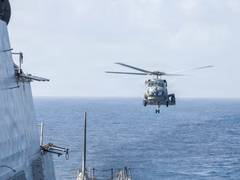
An MH-60R Sea Hawk helicopter approaches USS Delbert D. Black (DDG 119) after patrolling the Arabian Sea in support of the U.S. blockade against Iran. As of May 27, 109 commercial vessels have been redirected to ensure compliance. pic.twitter.com/Ic6btTvrpz
— U.S. Central Command (@CENTCOM) May 27, 2026
The naval restrictions from Iran and the US across the contested waters have drastically disrupted international trade. The blockade of the Strait and Gulf of Oman began on April 13 and has provoked an energy crisis with severe global economic consequences.
To maintain a watertight perimeter and ensure absolute compliance with the economic sanctions against Iran, American naval assets are executing continuous aerial surveillance and active interdiction missions. Several US Sea Hawk helicopters are currently patrolling the Arabian Sea to make sure the blockade continues.
Against the backdrop of this aggressive naval enforcement, the White House has delivered a sharp, high-stakes rebuttal to Tehran, completely dismantling claims broadcast by state-backed networks regarding an imminent diplomatic breakthrough over these crucial maritime trade corridors.
The US administration issued a definitive denial of assertions that Washington and Tehran were on the verge of finalising a preliminary blueprint aimed at restoring maritime commerce through one of the world’s most critical energy transit choke points.
Calling the report a “complete fabrication”, the White House denied claims aired by Iranian state television that the United States had proposed a draft Memorandum of Understanding involving the lifting of the naval blockade on Iran and the withdrawal of American forces from the Gulf region.
This aggressive pushback underscores the intense information warfare currently playing out alongside kinetic tensions in the region. In a severe public correction aimed not just at foreign state broadcasters but also at domestic newsrooms that carried the unverified narrative, Washington chose to issue a direct public takedown on social media.
“This report from Iranian-controlled media is not true and the MOU they ‘released’ is a complete fabrication. Nobody should believe what Iranian state media is putting out. FACTS MATTER,” the White House said on X as it lashed out at US media for reporting the Iranian claims.
The underlying controversy traces back to details propagated earlier on Wednesday by Iranian state television and the Mizan news agency. Their accounts indicated that an outlined framework proposed a sequential withdrawal of US military forces from areas surrounding Iran, alongside the cessation of the maritime blockade enforced by Washington.
In exchange for these concessions, the reports claimed that Tehran would pledge to normalise commercial vessel transit through the channel, aiming to return traffic to pre-conflict volumes within a tight one-month timeframe.
Crucially, Iranian media outlets specified that naval warships are excluded from the provisions of the draft agreement, meaning the diplomatic relief focuses strictly on civilian supply lines. Furthermore, the reports outlined that maritime traffic through the channel would be overseen by Tehran in close coordination with Muscat, keeping regional navigation firmly under local management.
Despite the optimistic tone of the broadcast text, the Iranian media coverage itself emphasised that the framework is strictly tentative and unauthenticated. Regional officials are reportedly underscoring that further intense discussions and “tangible verification” are mandatory before Tehran commits to a definitive pact.
The timeline for these verifications is already structured under the purported terms. Iranian sources noted that, should a conclusive accord be finalised within a 60-day window, the arrangement could eventually be codified through a legally binding United Nations Security Council resolution.
The global stakes of these negotiations cannot be understated, given that the Strait of Hormuz facilitates the movement of a massive percentage of global crude supplies as one of the world’s most pivotal energy transit corridors.
Consequently, the unverified reports of the potential diplomatic breakthrough immediately impacted global energy markets. The news initially drove US crude futures lower to trade below USD 89 per barrel as traders anticipated a swift reduction in supply vulnerabilities and a de-escalation of geopolitical friction in West Asia.
These fast-moving diplomatic movements directly coincide with a wider international push by US President Donald Trump to orchestrate a comprehensive regional peace framework encompassing Iran and multiple Middle Eastern nations, a grand strategy aimed at fundamentally reshaping the geopolitical landscape of the entire region. (ANI)
The article has been published through a syndicated feed. Except for the headline, the content has been published verbatim. Liability lies with original publisher.