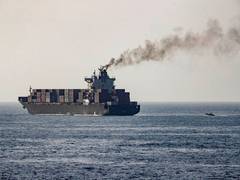
Florida [US], May 31 (ANI): The United States Central Command (CENTCOM) has announced that its military forces have neutralised a Gambia-flagged merchant vessel that was attempting to navigate towards an Iranian maritime facility.
In a public dispatch shared on X, CENTCOM revealed that American forces had “observed M/V Lian Star transiting international waters toward an Iranian port on the Gulf of Oman and issued more than 20 warnings while informing the vessel it was in violation of the US blockade”.
Despite repeated orders from the American military to halt its trajectory, the ship’s crew disregarded the instructions, prompting a direct kinetic response from US aerial assets to halt the vessel’s progress.
“A US aircraft disabled the vessel by firing a Hellfire missile into the ship’s engine room after Lian Star’s crew failed to comply. The ship is no longer transiting to Iran.”
The aggressive interception is part of a broader, highly restrictive maritime enforcement campaign being carried out by Washington in the region. According to CENTCOM, American forces have disabled five commercial vessels and redirected 116 to fully enforce the blockade.
This strict maritime containment operation was initially launched on April 17 as a direct reaction to Tehran effectively shutting down the strategic passage. That closure followed the broader outbreak of regional conflict, which originally commenced with coordinated US and Israeli military strikes on February 28.
While the primary battleground remains on the water, diplomatic channels have sought to temporarily contain the fallout. Amid the continuing stand-off, a fragile ceasefire has successfully remained in place since April 7.
This relative calm on the ground has shifted international attention towards whether an agreement can be brokered to prolong the truce by 60 days to facilitate new rounds of diplomatic negotiations regarding Iran’s disputed nuclear programme.
The stakes for these diplomatic efforts could not be higher, given the severe disruptions within the shipping corridor between Iran and Oman. The ongoing hostilities have triggered widespread instability in the global economy, leaving massive shipments of petroleum, liquefied natural gas, and vital agricultural commodities such as fertiliser largely stranded.
Consequently, this systemic maritime disruption has heavily intensified economic pressure on international consumers and agricultural producers.
The ongoing economic damage is precisely the objective of the naval encirclement, through which the US aims to restrict Iran’s independent export capabilities. By systematically cutting off commercial access, Washington seeks to diminish Tehran’s access to monetary reserves, severely compounding the financial strain on the country’s long-weakened economy.
Efforts to resolve the gridlock have moved directly to the White House, where US President Donald Trump held a high-level briefing with his top policy advisers on Friday to evaluate the situation. However, despite the economic urgency, the administration has yet to determine whether to advance with a deal designed to extend the existing ceasefire and reopen the blockaded waterway.
Tehran has maintained a similarly guarded stance regarding the potential diplomatic resolution, mirroring the hesitation in Washington by stating that the proposed deal had not been finalised.
Yet, even as a formal agreement is being discussed, commercial traffic has quietly managed to persist through the channel. This passage continues despite explicit assertions from Iran that it must formally approve all maritime transits, though merchant movements remain at a significantly reduced volume compared to levels recorded prior to the outbreak of hostilities.
To reassert its authority over these ongoing transits, Iran’s joint military command issued a stern warning on Saturday against any non-compliance. The command explicitly stated that any military vessels attempting to interfere with their oversight would be aggressively targeted, declaring via state TV, “Any violation of these regulations will place the security of their passage at serious risk.”
This absolute push for territorial control by Tehran has complicated regional consensus on how the waterway should operate. Amid the intensifying stand-off over control of the waterway, Qatar’s deputy prime minister, Sheikh Saoud bin Abdulrahman bin Hassan bin Ali Al Thani, on Saturday clarified the Gulf nation’s stance on transit financing.
The Qatari minister noted that while Doha firmly objects to structural shipping levies, it remains open to short-term compromises under specific operational conditions, stating that “but for certain times when they say they are going to use it for mine clearing or some usage of the fees for a temporary time, this is something that is negotiable, and it could be something that will help the transit of the Strait of Hormuz to be back to normal stage.” (ANI)
The article has been published through a syndicated feed. Except for the headline, the content has been published verbatim. Liability lies with original publisher.