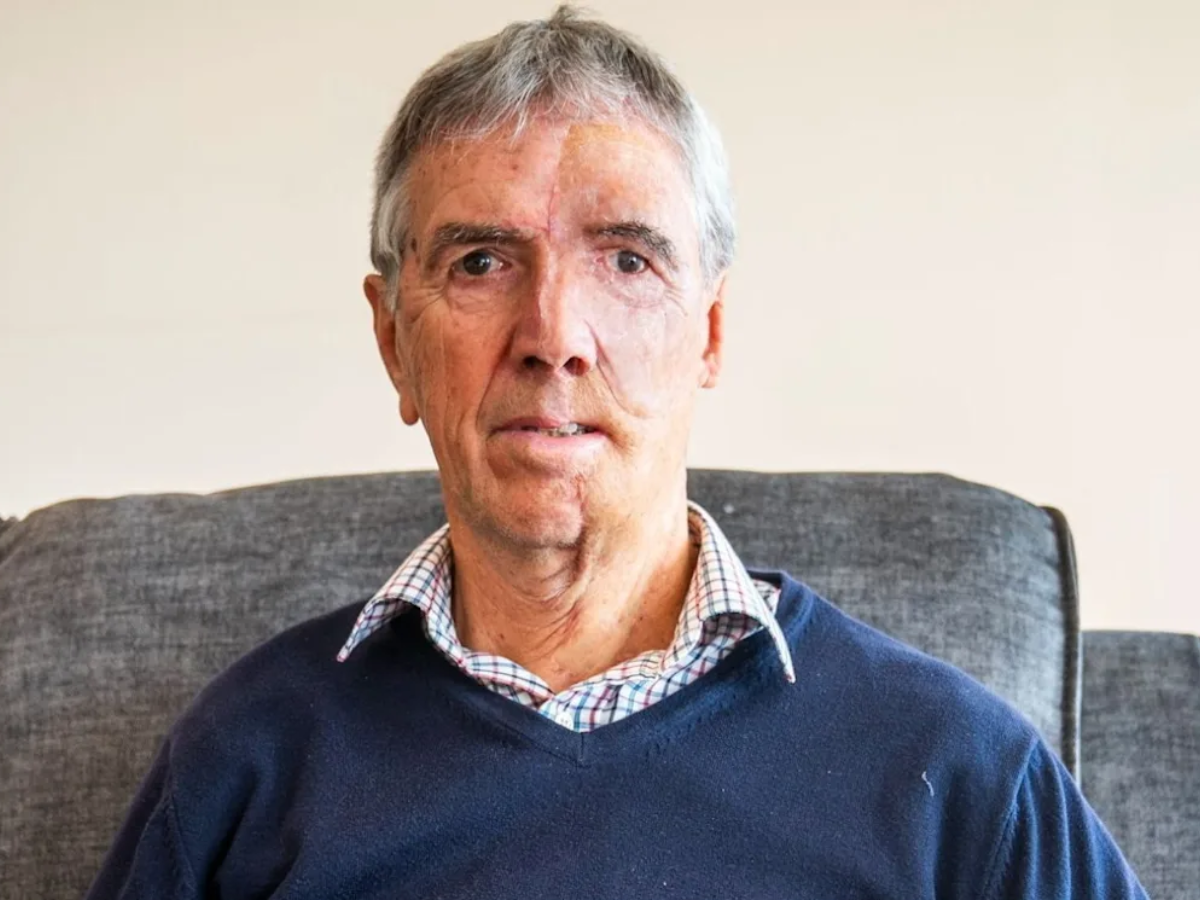
Dave Richards, a 75-year-old cyclist from Devon, has been supplied with a 3D-printed prosthetic face after he was left seriously burned when a drunk motorist collided with him while cycling. His treatment, which is being coordinated by the NHS’s new Bristol 3D medical centre, represents a huge step in advancing 3D technology for reconstructive medicine.
How Was the 3D Prosthetic Designed and Fitted?
The prosthetic was especially designed to fit well on Richards’ face, duplicating his skin color, eye color, and hair, restoring his confidence and sense of self. “I was fortunate to make it through,” Richards recalled of the accident that left him with catastrophic injuries. “Early on in my recovery, I felt extremely vulnerable and didn’t want to subject myself to social interactions but I’ve come a long way since then.”
During recuperation, Richards had multiple complicated surgeries, such as the removal of one eye to stop infection. The surgeons also conducted a free flap procedure, where they used tissue from a different location on his body to reconstruct his face prior to constructing the 3D prosthetic to finish the rebuild.
Amy Davey, North Bristol NHS Trust’s senior reconstructive scientist, said the new centre is the first in the UK to have 3D scanning, design, and printing housed within a single NHS facility. “Surface scanning enables patients to be scanned in motion, so the prosthetic can respond to natural movement,” she said. “The high-performance resins we utilise are skin-friendly, enabling long-term wear and comfort.”
What Exactly Happened to Dave Richards?
The life-altering crash took place in July 2021 when Richards and his two friends were out on their bikes in a sunny afternoon in Devon. A speeding, drunk, and phoned driver lost control of his car and plowed into the group.
Richards’ two friends were rolled clear, but he was trapped under the car — one half of his body crushed, the other half charred by the exhaust of the vehicle. He had multiple fractures, serious burns, and permanent trauma. “I was rolled along with the engine burning through one side of my body,” he said.
The driver was subsequently given three years behind bars and a seven-year driving ban, but released after just 18 months for good behaviour and an early guilty plea — something that left Richards “not best pleased,” as he still suffers with ongoing pain and permanent scars from the accident.
How Did the NHS’s 3D Medical Centre Help Him Recover?
Richards’ was one of the first cases treated at the NHS’s newly opened 3D medical centre in Bristol, which brings digital scanning, modelling, and 3D printing into patient care.
This new technology enabled medical teams to recreate facial characteristics with unerring precision, producing a prosthetic that restores form and function. Mapping Richards’ facial structure in 3D allowed specialists to ensure that every curve, line, and tint of colour replicated his natural look.
What Makes This 3D Prosthetic So Revolutionary?
The prosthetic’s realistic look and movement render it the most realistic facial reconstruction ever created in the UK. It was printed with biocompatible resins that mimic real skin and can be worn on a daily basis without causing discomfort.
The 3D process also minimized production time significantly, enabling Richards to get his prosthetic in weeks rather than months a benefit for patients waiting for reconstructive operations.
How Did Richards Recover Emotionally Following the Accident?
Aside from the physical injury, Richards was also subjected to great psychological trauma. The face injuries made him become withdrawn and isolated. “I didn’t want to go out or see anyone. It felt like people would stare,” he conceded.
But the success of his 3D treatment has restored his confidence. He now freely talks about his experience, urging others with facial disfigurements to consider contemporary reconstructive alternatives.