
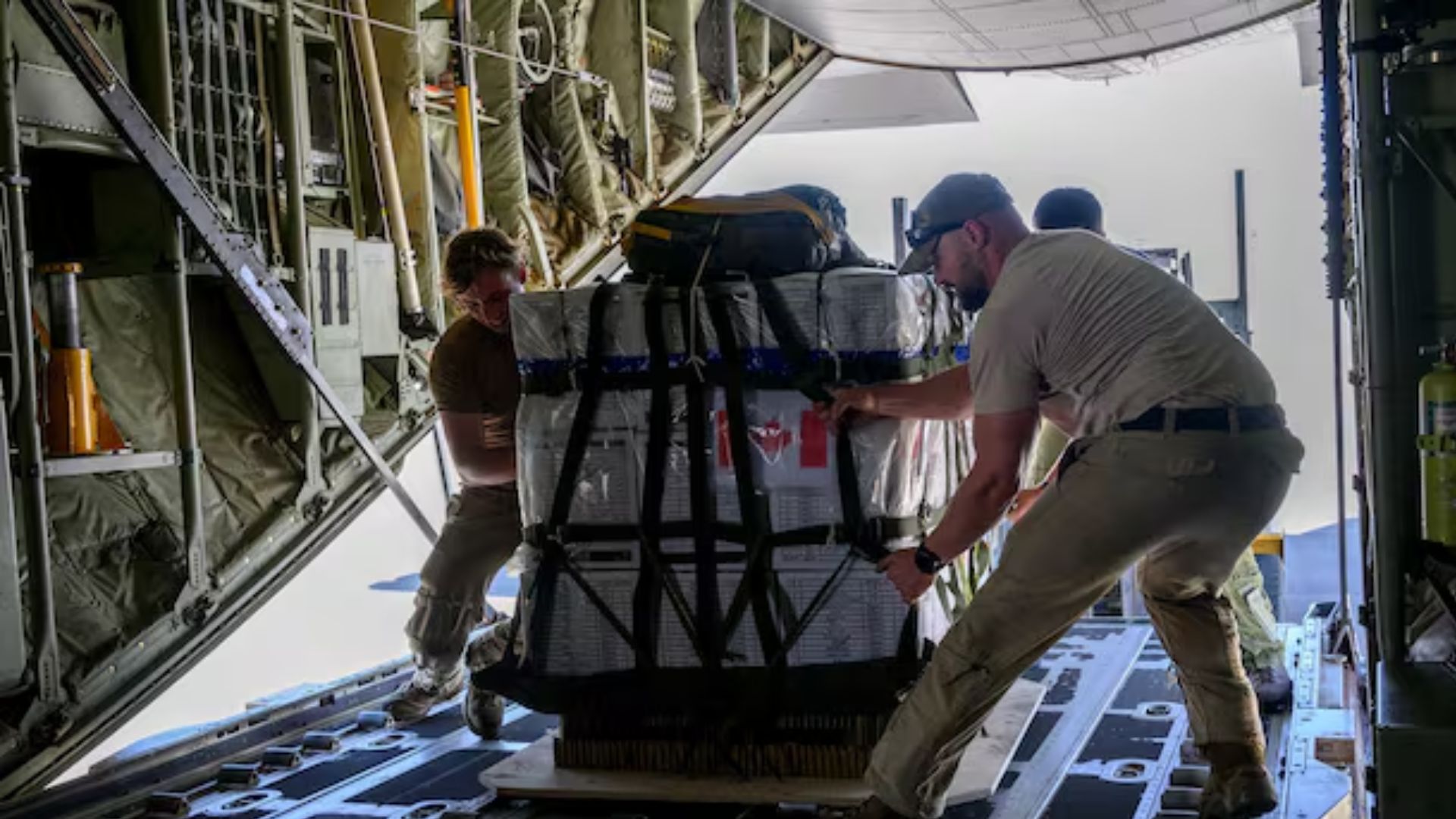
For the first time, the Canadian Armed Forces carried out a humanitarian airdrop over Gaza on Monday, delivering 9,800 kilograms of essential supplies to Palestinians in need. The airdrop was part of a joint mission involving six countries, aimed at combating the severe hunger crisis in the region.
Supplies Dropped from Canadian Aircraft
The Canadian aid—consisting of lentils, powdered milk, cooking oil, and pasta—was dropped using a CC-130J Hercules aircraft that departed from a Jordanian airbase. CBC News, which had exclusive access to the operation, confirmed the mission was coordinated with Global Affairs Canada.
“Exceptional Measures” Amid Blocked Aid Access
In a statement, Global Affairs Canada said, “Canada is taking these exceptional measures with our international partners as access to humanitarian aid in Gaza is severely restricted and humanitarian needs have reached an unprecedented level.”
It also pointed out that despite the immense needs on the ground, aid delivery by land remains difficult due to ongoing restrictions from the Israeli government.
Morale High Among Canadian Forces
Major Cam MacKay of the 436 Transport Squadron told CBC News, “There are people very much in need of that aid… It feels very good to be able to assist.”
\According to the Israel Defence Forces (IDF), the mission involved six countries: Canada, Jordan, the UAE, Egypt, Germany, and Belgium. France and Spain participated in previous drops.
As aid landed in central Gaza’s Nuseirat area, chaotic scenes unfolded with men, women, and children scrambling to retrieve supplies. Some children reportedly climbed over others in desperation.
Aid Airdrops Criticized for Inefficiency
While airdrops have become more common, experts warn they are far less effective than ground convoys. Some pallets have reportedly fallen into the sea, and at least one fatality occurred when a pallet hit a person on the ground.
Israel Responds to Starvation Claims
Facing global pressure over starvation in Gaza, Israel has slightly relaxed its restrictions on aid. Measures include airdrop cooperation, limited daily pauses in fighting, and designated protected routes for aid delivery.
However, Israel continues to blame Hamas for Gaza’s suffering, while maintaining its overall control of humanitarian access.