
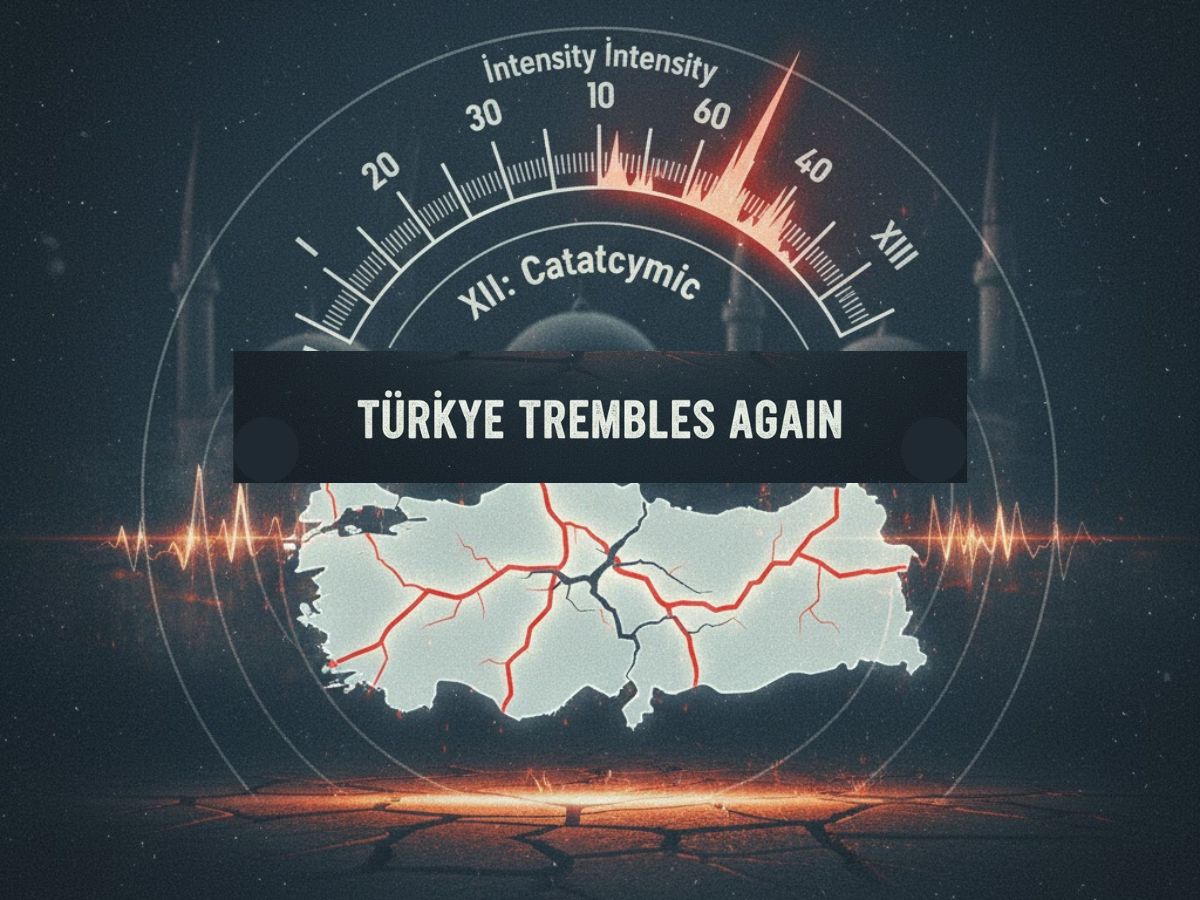
Turkey experienced another tremor in the early hours of Thursday when a magnitude 4.7 earthquake struck, according to the German Research Centre for Geosciences (GFZ). Initially, the quake’s intensity was recorded at 5.33, but the official GFZ report later confirmed the magnitude as 4.7. At a shallow depth of 10 kilometers (6.21 miles), the earthquake struck at approximately 2:54 am local time, causing tremors to be felt throughout the surrounding districts.
What exactly happened?
The United States Geological Survey (USGS) also reported the same event, measuring the magnitude at 4.9 and pinpointing the epicenter about 17 kilometers southwest of Emet. The USGS placed the depth at 7.4 kilometers, slightly shallower than GFZ’s estimation. Despite the early morning shock, there were no immediate reports of casualties, injuries, or major structural damage.
Also Read: Earth Narrowly Misses Undetected Asteroid Over Antarctica | Just 482 kms from Earth?
A Series of Quakes Shake the Region
This is not the first time Turkey has faced seismic activity in recent weeks. On September 28, a magnitude 5.4 earthquake struck the town of Simav in Kutahya province at a depth of eight kilometers (5 miles). The tremor hit at 12:59 pm and was followed by a 4.0 magnitude aftershock, forcing residents to rush outdoors in fear. Though tremors were felt as far away as Istanbul, about 100 kilometers north, Turkish authorities confirmed that no casualties were reported.
Why is Turkey experiencing so many quakes lately?
Positioned on highly active fault lines, Turkey lies along the Anatolian Fault Zone—one of the planet’s most earthquake-prone areas. Because of these tectonic forces, the country experiences regular quakes, prompting scientists to stress the need for safer buildings and better readiness.
Kyrgyzstan Feels the Jolt Too
Just days before the Turkish tremor, the European-Mediterranean Seismological Centre (EMSC) reported a magnitude 5.5 earthquake striking Kyrgyzstan on October 6. Although the afflicted regions differ geographically, both shocks show notable seismic movement over parts of Central Asia in the past month.
Also Read: Has Winter Arrived in Delhi? IMD Says Chill is Temporary, Warmer Days Ahead | Know Your City
Could there be a regional pattern?
Scientists say the earthquakes may be linked by wider tectonic forces, though they caution that each event should not be directly connected without proper data. Still, repeated tremors across this region keep governments on high alert, particularly because of the devastating history of past quakes.
Disclaimer: All data in this report is based on official sources. Details may evolve as agencies continue their geological assessments.