
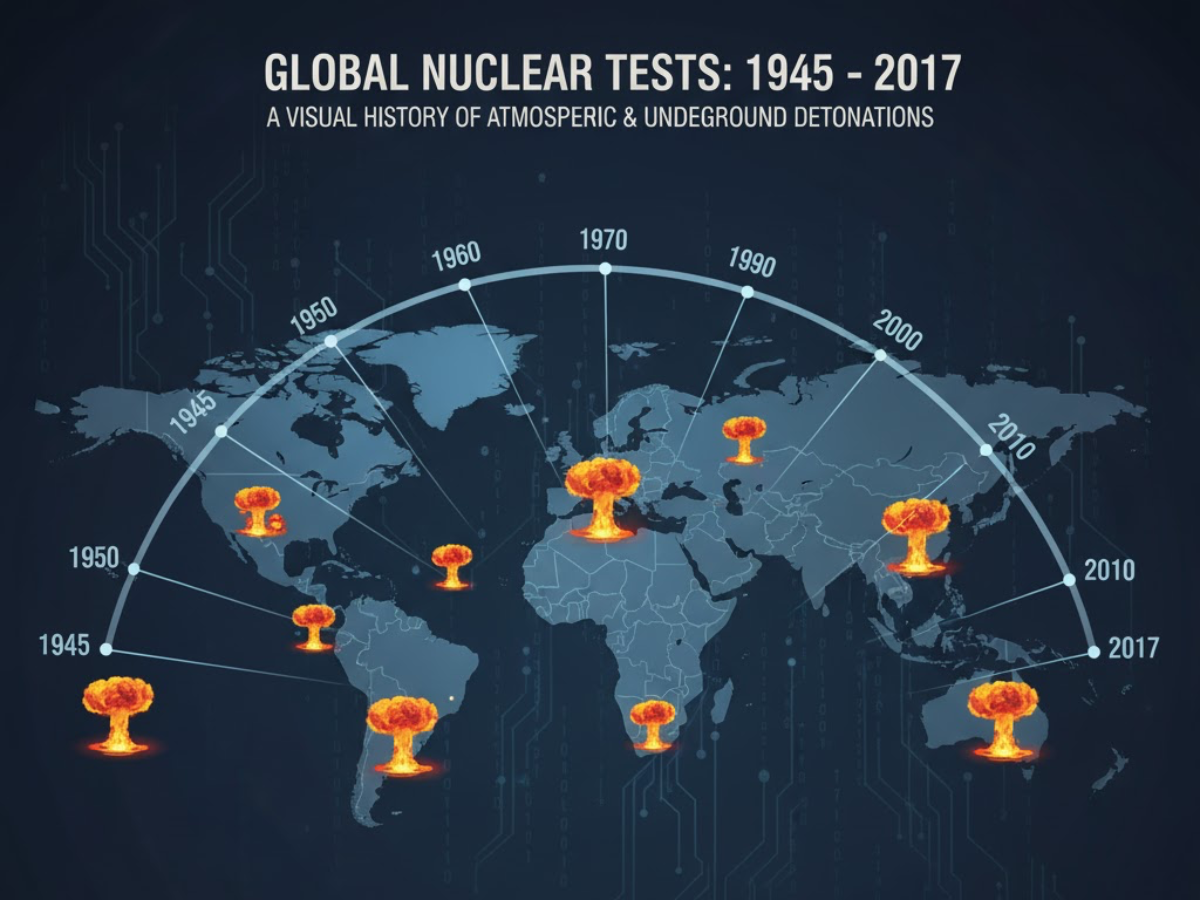
It all started with the United States Trinity Test in July 1945 in New Mexico, marking the beginning of the atomic era. The U.S. conducted 1,030 nuclear tests between 1945 and 1992 the most by any state which established its strategic primacy during the Cold War. While Washington signed the CTBT in 1996, it has not ratified it yet, leaving a major gap in the world’s disarmament arrangement.
Soviet Power & the Cold War Race
The Soviet Union, not wanting to fall behind the U.S., carried out a total of 715 nuclear tests between 1949 and 1990, starting with the RDS-1 bomb. These tests made the USSR a superpower that was equal in nuclear potential.
The Russian government after the dissolution of the Soviet Union, acceded to the treaty commitments and ratified the CTBT in 2000 demonstrating its support for non-proliferation and arms control.
ALSO READ: What is the 9M729 Missile Controversy: Why Ukraine’s Claim Should Worry Trump and the West
What is the Pursuit of Nuclear Independence for France
From 1960 through 1996, France conducted a total of 210 nuclear tests, starting in the Sahara and continuing through French Polynesia. This allowed it to maintain its independent deterrent from NATO’s nuclear umbrella. France stopped testing in 1996 and signed the CTBT in 1998, demonstrating support for the halt of nuclear explosions globally.
What is the United Kingdom & Strategic Partnership
The United Kingdom joined the nuclear club in 1952 with Operation Hurricane, conducted off the coast of Australia. It conducted, in total, 45 tests over a period of more than four decades, many of them jointly with the U.S. Its last test was in 1991, and it signed the CTBT in 1998, consistent with broader Western efforts toward disarmament.
ALSO READ: Fact Check: Did Barack Obama Really Spend $376 Million on the White House Basketball Court?
China & the Cautious Approach
China conducted a total of 45 nuclear tests between the years 1964 and 1996, starting at the Lop Nur test site. In becoming the fifth declared nuclear power, China pursued steady weapons development. It signed the CTBT in 1996 but has not ratified it so far, keeping a cautious attitude because of regional security and strategic considerations.
Rising Powers & Renegade States
A series of newer or defiant nuclear powers followed suit. North Korea conducted six tests from 2006 until 2017, drawing wide condemnations and sanctions as it remains outside the CTBT. India and Pakistan, impelled by regional security dynamics, tested in 1974 and 1998 declaring themselves nuclear states. Both have refused to ink the CTBT, citing concerns over fairness and sovereignty.
ALSO READ: Prince William & Kate Middleton Move Into Forest Lodge | Fresh Start in Windsor
Disclaimer: This article provides historical and factual context on global nuclear testing. It does not promote or justify nuclear weapons or related activities.