
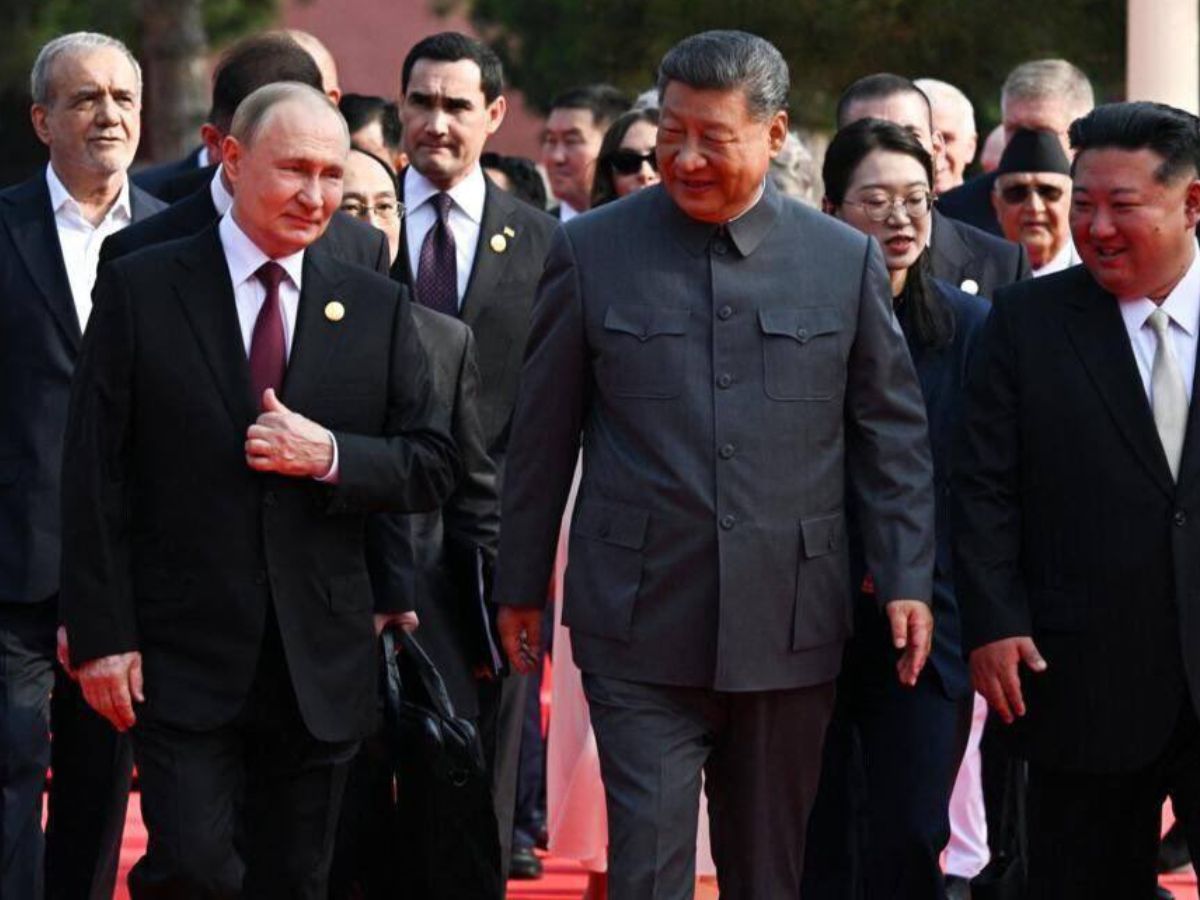
US President Donald Trump congratulated China on its Victory Day celebrations, but his message also carried a sharp warning aimed at Beijing, Moscow, and Pyongyang. While extending greetings, Trump reminded China of the sacrifices the United States made during World War II, when thousands of American soldiers died fighting Imperial Japan. He questioned whether President Xi Jinping would acknowledge that “massive amount of support and ‘blood’” from the US in securing China’s freedom. At the same time, Trump added a sarcastic note: “Please give my warmest regards to Vladimir Putin, and Kim Jong Un, as you conspire against the United States of America.”
What is China’s Victory Day?
China’s Victory Day marks the defeat of Japan in 1945, ending the Second Sino-Japanese War one of the deadliest conflicts in Asia. Millions of Chinese lost their lives in the long war against Imperial Japan during the 1930s and 1940s. The conflict later merged into World War II after Japan launched its attack on Pearl Harbor in 1941.
Since 2015, Beijing has celebrated the day with grand military parades, both to honor sacrifices and to project modern China’s strength. For the Communist Party, the event reinforces narratives of resilience, national unity, and a reminder that China stood among the victors of WWII.
Xi’s Strong Message to the World
At this year’s event, President Xi Jinping declared that China’s rise could not be halted. “The rejuvenation of the Chinese nation is unstoppable and humanity’s cause of peace and development will prevail,” he said, adding that the world now faced a choice between “peace or war.”
His words carried a dual message: remembering wartime suffering while signaling to today’s rivals especially the US that Beijing will not bow to outside pressure.
A Diplomatic Showcase: Xi, Putin, and Kim Together
The parade drew global attention because North Korea’s Kim Jong Un appeared alongside Xi and Russian President Vladimir Putin. This was Kim’s first joint appearance with them and only his second foreign trip in six years.
For China, the sight of Xi, Putin, and Kim together was a carefully staged moment of solidarity, suggesting that Beijing can rally allies at a time of growing global polarization.
Connection to the SCO Summit
The timing also overlaps with the Shanghai Cooperation Organization (SCO) Summit, where Xi, Putin, and Indian Prime Minister Narendra Modi gathered with other leaders. While the SCO is officially about regional security and economic cooperation, it has become a stage for non-Western powers to challenge US-led influence.
At the summit, Xi criticized “bullying behaviour” a veiled reference to the United States while Putin defended Russia’s war in Ukraine. Modi, meanwhile, struck a balancing act, calling for dialogue and stability without fully aligning with either side.
Seen together, Victory Day and the SCO Summit highlight how China is blending history and geopolitics: honoring WWII sacrifices while showcasing current partnerships that present an alternative power bloc to the US and its allies.
Why It Matters
For Trump, this emerging alliance is troubling. His tariff-heavy trade policies have already stirred global tensions, and now the sight of Xi, Putin, Kim, and Modi sharing platforms signals the rise of a multipolar world order.
While Trump insists that the US once helped China win its freedom, today Beijing uses events like Victory Day to emphasize its independence and to remind the world that America is no longer the only superpower shaping global narratives.
Also Read: Kim Jong Un Arrives in Beijing with Daughter for China’s Grand Victory Day Parade