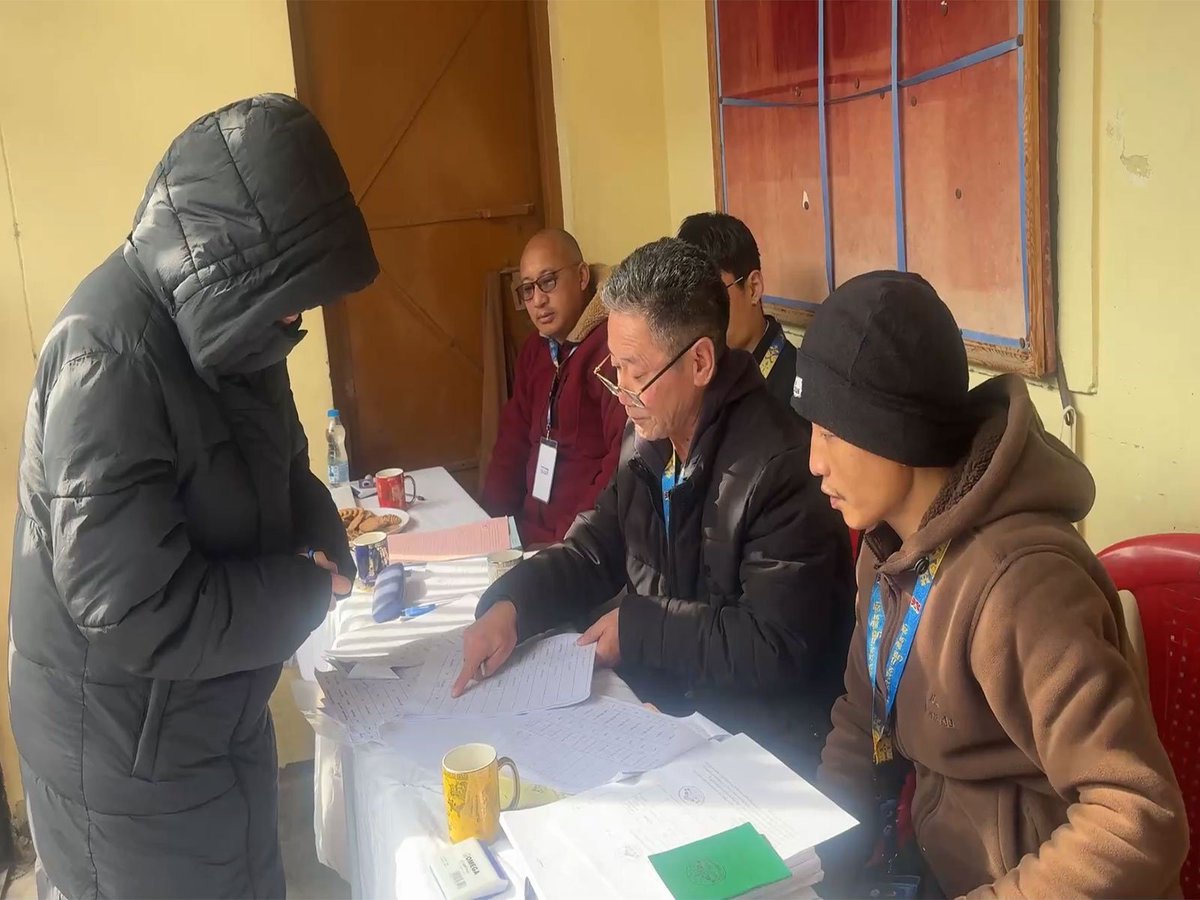
SHIMLA: The Tibetan community living in exile on Sunday participated in the first phase of elections to choose the Sikyong (President of the Central Tibetan Administration) and members of the 18th Tibetan Parliament-in-Exile, with the preservation of Tibetan identity, culture and unity emerging as the central concern.
Polling was held across the world, including in Shimla, Himachal Pradesh, where the Central Tibetan Administration set up three polling booths at different locations to facilitate voting by Tibetans residing in the state.
Members of the community cast their votes not only to run the Tibetan government-in-exile, but also to strengthen the decades-long Tibetan freedom struggle.
Speaking to ANI, Tenzin, a candidate for the Assembly of Tibetan People’s Deputies (ATPD), said the biggest challenge facing Tibetans is the gradual erosion of the community itself.
“The biggest challenge at present is that the Tibetan community is slowly disappearing. Tibetans are mixing into different countries and societies. If this continues, a time will come when only photographs of Tibetans will remain, just like dinosaurs exist only in pictures,” Tenzin said.
He added that he was nominated to be a candidate by members of his own community.
“My people made me a candidate this time. I am not asking anyone to vote for me, but I am interested in serving, which is why I am contesting,” he said.
Explaining the electoral process, Tenzin said the elections are held in two parts, one for the Parliament-in-Exile and the other for the head of the government-in-exile, known as the Sikyong.
“Earlier we called this post Prime Minister and later President, but now we call it Sikyong. These elections are held across the world wherever Tibetans live, to unite our people,” he said.
He noted that parliamentary elections are conducted under four categories, three based on Tibet’s traditional geographical regions and one representing the four main schools of Tibetan Buddhism. “We function like a government so that our traditions, religion and culture are protected, and the welfare of our people is ensured. This is the first phase of elections, and the final phase will be held in April,” he said.
If elected, Tenzin said his priority would be rebuilding unity and strengthening the Tibetan population.
“Tibetan children inside Tibet are being forcefully separated and assimilated. Those in Nepal, India and abroad are also gradually mixing into other societies. We want to promote the Tibetan community, increase our population, document our problems and work towards solutions,” he added.
Meanwhile, a young first-time voter, Tenzin Kulsang, expressed both pride and pain while exercising her democratic right.
“I feel very happy and proud that I can vote for our Parliament and government-in-exile. At the same time, I feel unhappy because I do not have a free country of my own,” she said.
She said her dream is to one day vote in a free Tibet.