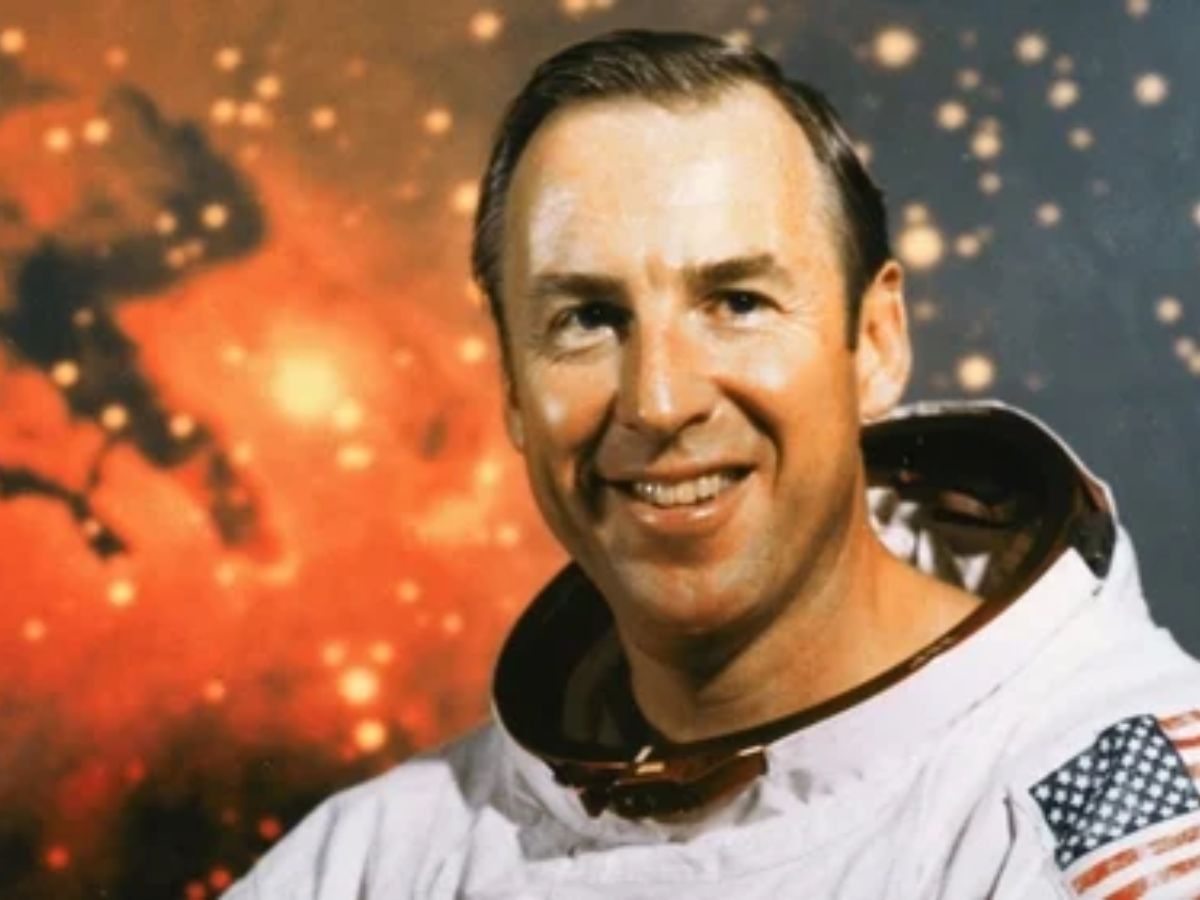
The world mourns the loss of astronaut Jim Lovell, who passed away aged 97. Best known for his heroic role in the Apollo 13 mission, Lovell turned what could have been a devastating tragedy into a triumph of human resilience and ingenuity. His story is a tribute to persistence, imagination, and faith rather than merely one of space flight.
From Humble Beginnings to the Stars
Born on March 25, 1928, Jim Lovell’s journey started in Wisconsin. As a boy fascinated by airplanes and rockets, he built a homemade rocket that exploded 80 feet into the air—a risky experiment that showed early signs of his daring spirit. Lovell had a difficult journey to fame because he was raised by a single mother after his father passed away when Jim was five years old.
Unable to afford college, Lovell joined the U.S. Navy, where he trained as a fighter pilot. He transferred to the Naval Academy because of his love of rocketry, where he wrote a thesis on liquid-fuel rocket engines, a topic that was innovative at the time.
Also Read: Fact Check: Did President Trump ‘Own Slaves’ in Dubai? Viral Social Media Claim Debunked
Becoming a NASA Legend
Lovell’s dream came true when he was selected as part of NASA’s elite “New Nine” astronauts in 1962 — a group tasked with fulfilling President Kennedy’s goal of sending Americans to the Moon.
He made his mark early, spending 14 days in orbit aboard Gemini 7, proving humans could endure long spaceflights.
Later, Lovell and Buzz Aldrin, who were in charge of Gemini 12, showed that astronauts could work outside of their spacecraft, opening the door for moonwalks.
Earthrise: A Moment That Changed Perspectives
As navigator of Apollo 8 in 1968, Lovell helped guide the first humans to orbit the Moon. The mission took the now-iconic picture of Earth rising over the lunar horizon, known as the “Earthrise.” Amid turmoil on Earth, this sight united humanity with a shared vision of fragility and beauty. During a Christmas Eve broadcast, Lovell’s reading from the Book of Genesis turned into a moving moment that represented harmony and optimism.
Apollo 13: The Greatest Rescue in Space History
In April 1970, Lovell commanded Apollo 13 on what was supposed to be a lunar landing. Midway to the Moon, however, an oxygen tank exploded, transforming the mission into a last-ditch struggle for survival.
With power failing and life-support systems compromised, Lovell and his crew improvised. They used the lunar module—designed only for Moon landings—as a lifeboat to keep alive. The difference was made by Lovell’s composed leadership and the hard work of NASA’s ground crew.
Millions watched anxiously as Apollo 13 re-entered Earth’s atmosphere. A world-record rescue was signaled by the crew’s successful splashdown in the Pacific after agonizing minutes of radio silence.
Also Read: Trump’s Trade Gamble: Record Gains Today, Depression Fears Tomorrow
A Legacy of Optimism and Courage
Beyond his missions, Lovell embodied optimism and humor, qualities his family said made him “truly one of a kind.” He was a devoted husband to Marilyn for over 70 years and inspired generations to believe that even the impossible is achievable.
NASA’s acting head, Sean Duffy, praised Lovell for helping forge “a historic path” in space exploration.
Jim Lovell’s life is an example of how teamwork and a pioneering spirit can win out even in the most trying circumstances. The force of perseverance is embodied in his journey from a Wisconsin youngster with a homemade rocket to a legendary astronaut.
Lovell’s legacy endures as we continue to push the limits of space exploration, encouraging future generations to aim high while honoring the importance of bravery, ingenuity, and hope.