The whole world sees India’s power and defence system when we introduced the Russian S-400 ballistic missile during Operation Sindoor. Even after the ceasefire, when PM Modi addresses the people of India then he takes this into his mind and also keeps an S-400 in the background of the frame.
Russian President Vladimir Putin is on a two-day visit to India and might sign a deal with India for the advanced S-500. India successfully integrated the S-400 Triumf air defence system into its defence network in 2018, enhancing its ability to detect and neutralize aerial threats. Deployed along strategic locations near the Western and Northern borders, the system is now operational and providing coverage against both Pakistan and China.
Unlike earlier plans to acquire additional Russian systems such as the S-500, India currently relies on its existing S-400 regiments, trained personnel, and advanced radar networks to secure national airspace.
Did India have Options Other than S-400?
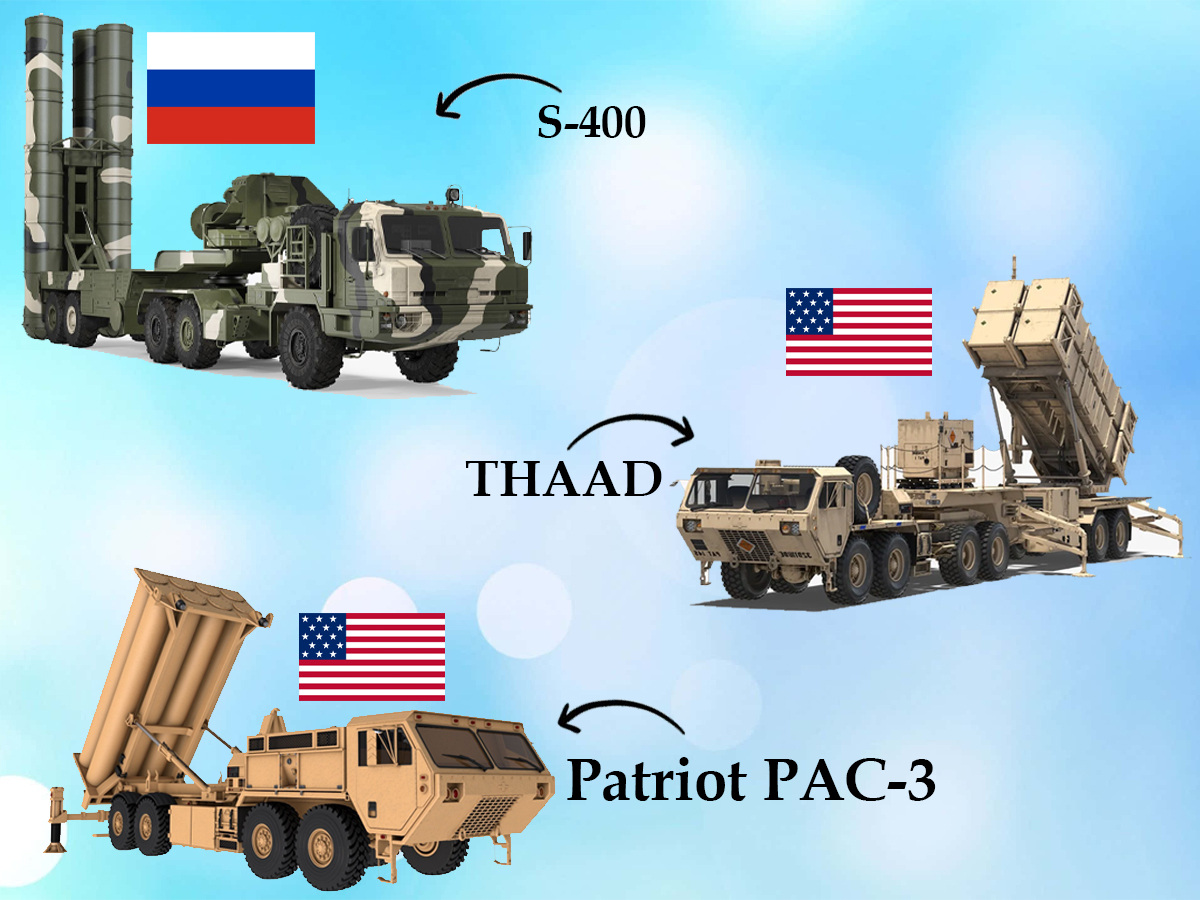
When India first considered options for long-range air defence, the US offered THAAD and Patriot PAC-3 systems. However, none matched the multi-role capabilities of the S-400, which can intercept both fighter jets and cruise missiles at a range of up to 400 km.
A senior officer noted, “India needed the S-400 to strengthen air defence, given threats from Pakistan and China. Alternatives did not provide comparable coverage.”
The S-400’s mobility, rapid assembly, and multi-layered intercept capability made it the clear choice.
As of 2025, the Indian Air Force operates multiple S-400 regiments strategically positioned near the Western border to counter threats from Pakistan, while also providing a deterrent along the Northern border in areas sensitive to Chinese military activities.
Comparison of S-400 vs Thaad vs Patriot Pac 3
S-400:
The S-400 Triumf is one of the world’s most advanced long-range air defence systems, capable of tracking and destroying aircraft, drones, and missiles up to 400 km away. This comes along with a S-400 battery.
India cleared the purchase of the S-400 in 2015–16, during the tenure of then Defence Minister Manohar Parrikar, who strongly pushed for modernising India’s air defence shield. Parrikar played a key role in fast-tracking discussions with Russia and ensuring the deal moved forward despite geopolitical pressure.
Thaad (Terminal High Altitude Area Defense):
The US-made THAAD system is operated or deployed by a select group of countries that face high ballistic missile threats. The United States is the primary user, with multiple THAAD units stationed across its bases.
South Korea hosts THAAD batteries in Seongju to counter North Korean missile launches, while Japan also allows US THAAD deployments as part of its layered regional missile defence strategy.
The United Arab Emirates (UAE) became the first foreign country to officially purchase THAAD, using it to strengthen its defence against potential regional missile attacks. Saudi Arabia later signed a major multi-billion-dollar deal and is integrating THAAD into its national air defence network.
Patriot PAC-3 (Patriot Advanced Capability – 3):
Patriot PAC-3 is a US-made advanced surface-to-air and ballistic-missile defense system. It uses “hit-to-kill” missiles that rely on kinetic impact (not explosive warheads) to intercept incoming missiles, aircraft, or drones. The system is mobile, all-weather, and suitable for defending cities and military installations.
Its interceptor missiles travel at high speeds (around Mach 5) and use active radar guidance for precise targeting.
| Parameter | Patriot PAC-3 MSE | S-400 Triumf | THAAD |
|---|---|---|---|
| Primary Mission | Tactical air & short-range BMD | Regional air dominance & limited BMD | Strategic exo-atmospheric BMD |
| Interception Altitude | 20–35 km | Up to 30–60 km (40N6E) | 40–150 km |
| Interception Range | 160 km (Aerial), 60 km (Ballistic) | 400 km (Aerial), 60 km (Ballistic) | 200 km (Ballistic only) |
| Guidance System | Active radar homing + Ka-band | Active/Semi-active radar guidance | Infrared homing (IIR) + KKV |
| Radar System | AN/MPQ-65 (C-band) | 92N6E “Grave Stone” (S/X-band) | AN/TPY-2 (X-band AESA) |
| Interceptor Speed | Mach 5+ | Mach 14 (40N6E), Mach 6 (48N6) | Mach 8.2+ |
| Mobility | High (15 min deploy/stow) | Medium (30+ min deploy/stow) | Medium (theater deployment) |
| Unit Cost | $4–6 million | $2–3 million | $11–13 million |
| System Cost | $1 billion | $400–500 million | $3 billion |
Operational Advantages of S-400
Multi-layered Defence: Can intercept fighter jets, drones, and cruise missiles at long distances.
- Rapid Deployment: Fully operational in minutes and mounted on mobile platforms.
- Radar Superiority: Tracks multiple targets simultaneously over 250–600 km.
- Cost-effective: Provides world-class capabilities at roughly half the cost of THAAD systems.
According to experts, “The S-400 gives India a significant deterrent advantage in both conventional and asymmetric warfare scenarios.”
India’s air defence strategy in 2025 emphasizes self-reliance, integration, and operational readiness. The S-400 forms a cornerstone of this approach, complemented by radar networks, fighter aircraft, and other surface-to-air missile systems.
Future upgrades may include domestic or imported systems, but for now, the S-400 provides unmatched aerial defence, ensuring India can protect its airspace effectively against regional threats.