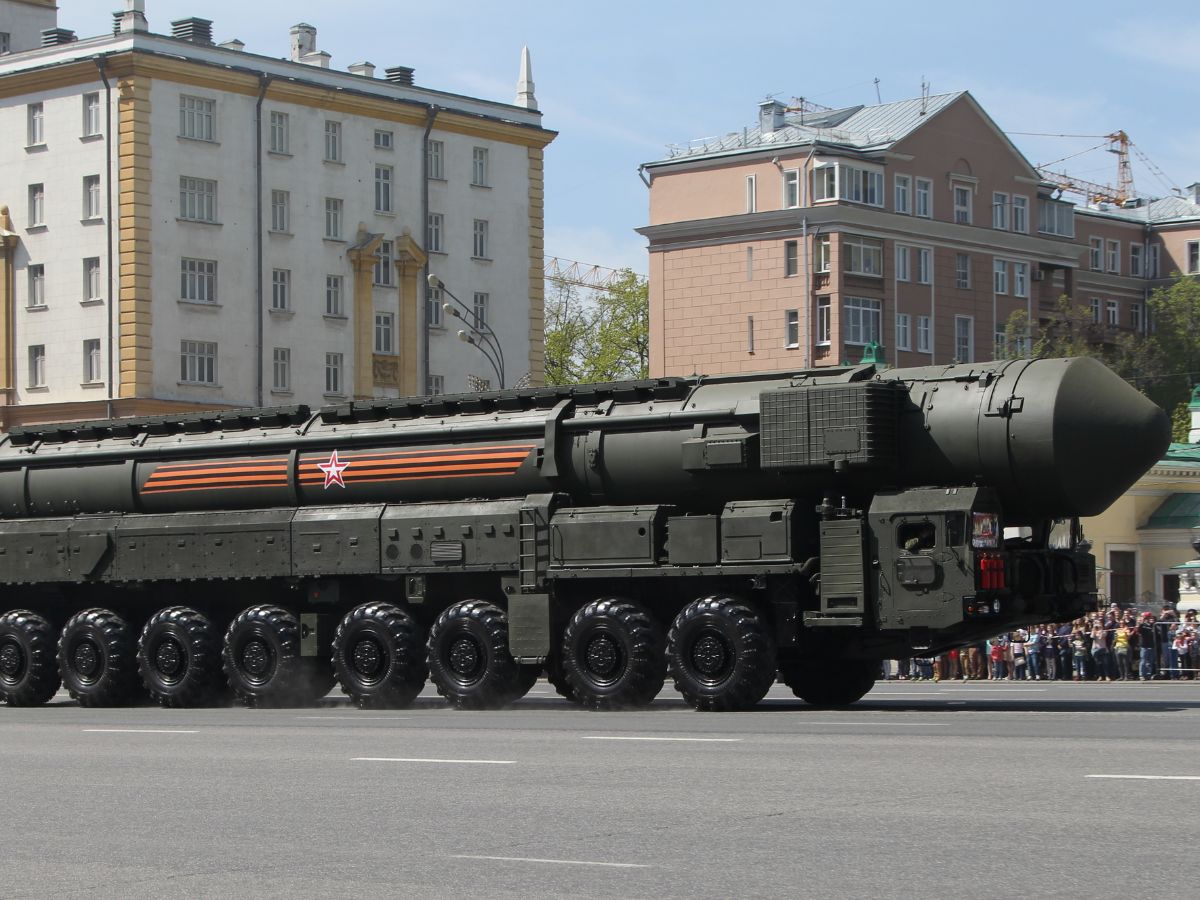
With rising tensions between Russia and United States, the global attention has turned to RS-28 Sarmat, Russia’s most powerful intercontinental ballistic missile (ICBM). Also known as ‘Satan 2’ in NATO terminology, the super missile is an essential component of President Vladimir Putin’s nuclear deterrence strategy, made to surpass both Chinese and US-based missile systems in terms of range and payload.
The focus shifted to the missile after the reports of US deploying nuclear submarines near Russian territorial waters. This prompted Moscow to showcase its power. Russian leaders claim that Sarmat can ‘render Western defense systems obsolete’.
ALSO READ: US-China Trade Talks Hit Roadblock Over Chinese Oil Imports from Iran and Russia
RS-28 Sarmat: A Game-Changer
RS-28 Sarmat is Makeyev Rocket Design Bureau and is very heavy. It is a liquid-fueled missile built to take over the aging Soviet R-36M (SS-18 Satan). It’s development started in 2000s with its first successful test launched on April 20, 2022.
One of it’s most prominent feature is its extensive range that can go up to 18,000 km. It can reach targets anywhere in the world, even via polar routes. This feature makes it harder to detect, interpret or alarm the Western defense officials.
The missile weighs 208 tonnes and is 35 meters in length. However, it’s greatest strength is hidden in its payload system. It can carry 10-15 nuclear warheads using a MIRV (Multiple Independently targetable Reentry Vehicle) system. Selected models may also feature in Avangard hypersonic glide vehicles, capable of changing trajectory mid-air to dodge missile defenses.
ALSO READ: 7.0 Quake Hits Russia’s Kuril Islands as Dormant Kamchatka Volcano Erupts After 600 Years
Its speed, estimated at Mach 20, places it squarely in the hypersonic class, which drastically reduces the window for detection by radar or satellite-based warning systems.
the RS-28 Sarmat is looked as a direct strategic challenge to US and NATO defense systems. It outshines the US’s LGM-30G Minuteman III (Approx: 13,000 km range) and China’s DF-41 (approx: 12,000-15,000 km range) in both range and capacity.
ALSO READ: 600 Years Later, the Ground Shakes and a Volcano Wakes
Strengths and Weekness of RS-28 Sarmat
Key Strengths:
Over the pole strike range of 18,000 km
High payload capacity with multiple warheads
Hypersonic velocity and unpredictable flight.
Key Weakness
Liquid-fueled design will require longer prep time than solid-fueled design.
There is a reported explosion during testing in 2024.
Vulnerability to space-based surveillance and potential future intercept systems like the US SBIRS (Space-Based Infrared System)
Although, the RS-28 Sarmat is viewed as a game changer by Russian officials, its emergence also notes a renewed global arms race in nuclear missile technology.