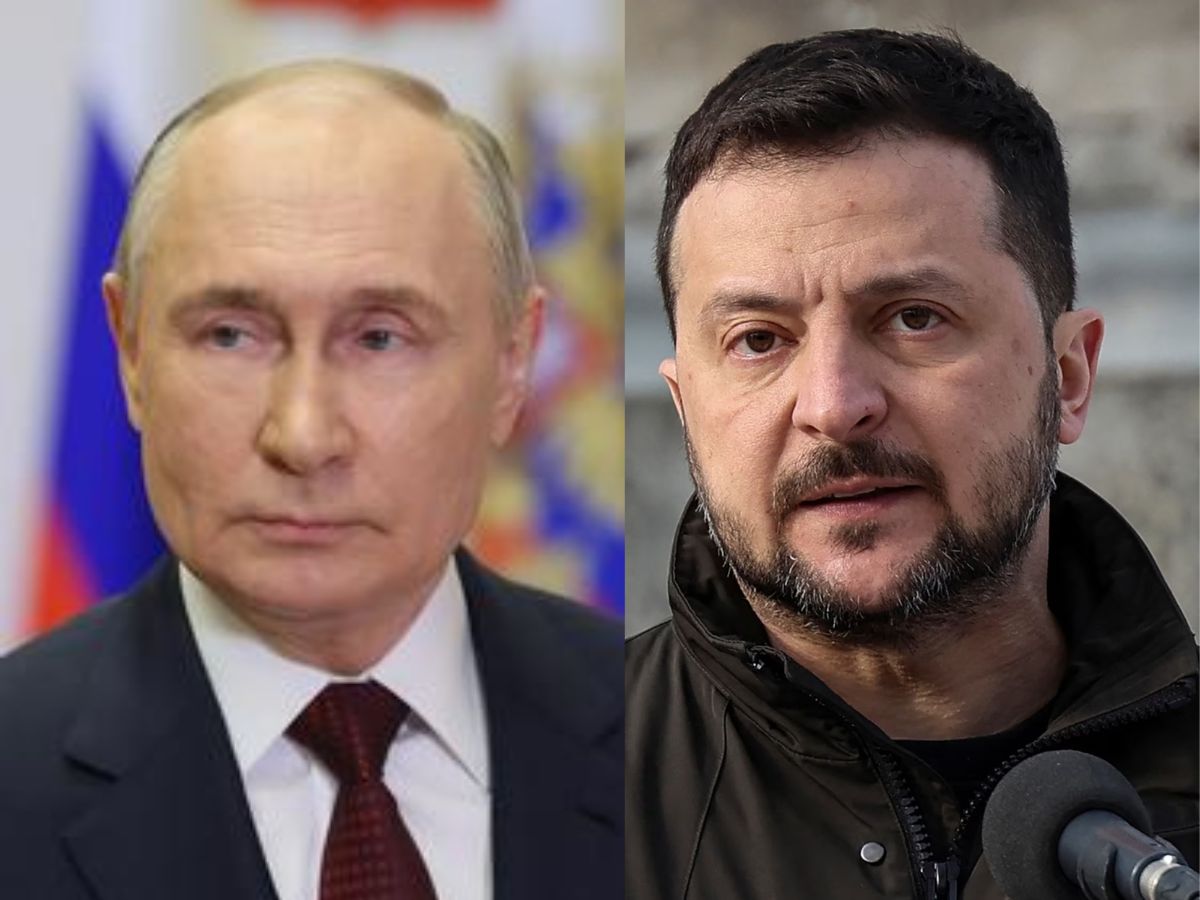
Russian President Vladimir Putin said on Saturday that a newly drafted 28-point peace plan, worked on by Moscow and Washington together, “could form the basis of a final peace settlement” to end the war in Ukraine.
However, for Kyiv and much of Europe, the proposed plan crosses several long-standing “red lines.” Even though US President Donald Trump reportedly is pushing Ukraine to take the deal, it is unlikely that Kyiv will go easily.
Here are some major reasons why Ukraine might resist the proposal:
The Plan Recognises for the First Time Russian Control Over a Fifth of Ukraine
Clause 21(a) of the plan states: “Crimea, Luhansk and Donetsk will be recognised as de facto Russian, including by the United States.
While that falls short of Moscow’s demand for formal, legal recognition – de jure – Kyiv has invariably resisted even de facto acceptance of Russian control of territories that it considers integral to Ukraine. That would, in effect, legalize the territorial gains Russia made during the war.
Clause 21(d) goes even further: “Ukrainian forces will withdraw from the part of Donetsk Oblast they currently control and this withdrawal zone shall be a neutral demilitarised buffer zone, internationally recognised as territory belonging to the Russian Federation. Russian forces shall not enter this demilitarised zone.”
Donetsk has been a focal point of the war in the eastern region of Ukraine’s industrial and mineral-rich Donbas since Russia’s 2022 invasion. The region is of strategic importance for both countries, with a considerable part of its population ethnically Russian. Kyiv believes that conceding control over Donetsk would provide Moscow with a springboard for further offensives, while it does not believe that Russia will respect the “demilitarised” status.
After three years of fighting, the Russians have still not fully occupied Donetsk. According to the Institute for the Study of War, Russian forces currently occupy more than 75% of the oblast. Clause 21(d) essentially demands that Ukraine cede territory still under its control, which would be damaging to Kyiv militarily, economically, and politically. It could also put President Volodymyr Zelenskyy in a precarious position.
Security Guarantees for Ukraine Not Clearly Stated
Security is entrenched in the roots of the conflict between Russia and Ukraine. Ukraine has struggled for robust security guarantees from the West, in particular through membership in NATO, to which Russia is strongly opposed.
It is considered essential by Ukraine as a deterrent against the much stronger Russian military, while for Russia, it is a red line against its national security. As the article says, “The expansion of NATO presents Russia with a classic ‘security dilemma,’ a situation in which the actions of one state to make itself more secure tends to make another state less secure, and prompts them to respond in ways that result in a spiral of hostility.” Russia has said time and again that securing its 2,000-km land and sea border with Ukraine is key. Moscow went as far as to warn that any membership by Ukraine in NATO would amount to “a declaration of war.”