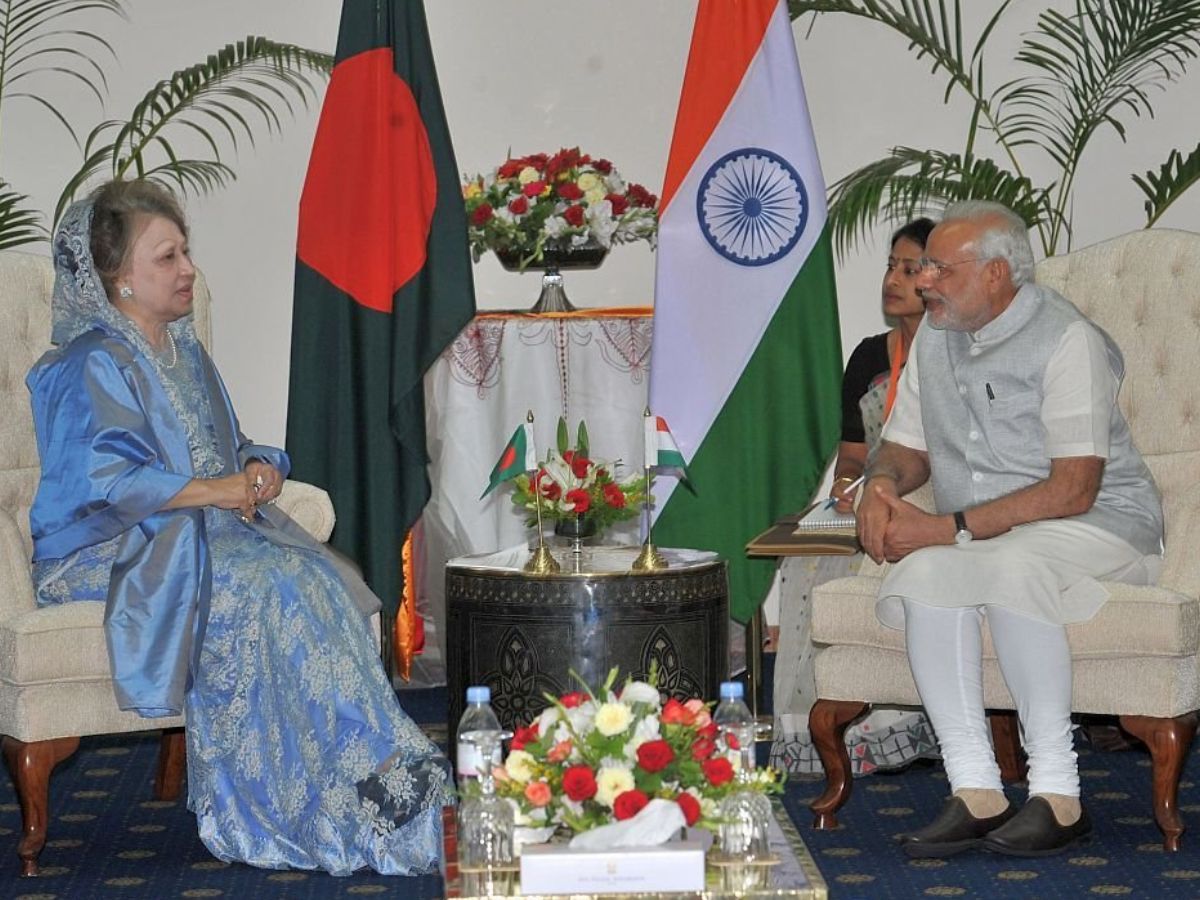
Prime Minister Narendra Modi on Tuesday expressed sorrow over the death of former Bangladesh Prime Minister and BNP chairperson Begum Khaleda Zia. He remembered meeting her in 2015 and said her leadership and ideas should continue to guide the relationship between India and Bangladesh.
Posting on X, PM Modi wrote, “Deeply saddened to learn about the passing away of former Prime Minister and BNP Chairperson Begum Khaleda Zia in Dhaka. Our sincerest condolences to her family and all the people of Bangladesh. May the Almighty grant her family the fortitude to bear this tragic loss.”
He also praised her contribution to Bangladesh and regional ties, saying, “As the first woman Prime Minister of Bangladesh, her important contributions towards the development of Bangladesh, as well as India-Bangladesh relations, will always be remembered.”
Recalling their meeting in Dhaka, PM Modi added, “I recall my warm meeting with her in Dhaka in 2015. We hope that her vision and legacy will continue to guide our partnership. May her soul rest in peace.”
Deeply saddened to learn about the passing away of former Prime Minister and BNP Chairperson Begum Khaleda Zia in Dhaka.
Our sincerest condolences to her family and all the people of Bangladesh. May the Almighty grant her family the fortitude to bear this tragic loss.
As the… pic.twitter.com/BLg6K52vak
— Narendra Modi (@narendramodi) December 30, 2025
India and BNP Relations: A Troubled History
India’s relationship with the Bangladesh Nationalist Party (BNP) has remained uneasy for many years. When the BNP was in power between 2001 and 2006, India raised concerns about border security and the presence of anti-India groups in Bangladesh.
In 2004, Indian agencies found ten truckloads of weapons at the Chattogram CUFL jetty. India said these arms were meant for separatist groups in northeast India, which further damaged trust.
In 2013, India also became concerned about BNP leader Tarique Rahman’s alleged links to extremist groups and Pakistan’s ISI. The BNP’s alliance with Jamaat-e-Islami added to New Delhi’s worries. Because of this, India built closer ties with Sheikh Hasina’s Awami League and kept its distance from the BNP.
Khaleda Zia’s Position on India
Khaleda Zia often took a firm and cautious approach toward India. She believed in protecting Bangladesh’s sovereignty.
She opposed allowing India to transport goods through Bangladesh to reach its northeastern states, saying it could threaten national security. She also criticised plans that allowed Indian trucks to use Bangladeshi roads without tolls, calling them slavery.
She rejected renewing the 1972 Indo-Bangladesh Friendship Treaty, arguing that it had “shackled” Bangladesh.
However, she was not fully against cooperation. She wanted Bangladesh to gain clear benefits in return. A 2014 Dhaka Tribune report quoted her as saying that India should sign the Teesta water-sharing agreement before getting transit rights.
Bangladesh Political Shift After Sheikh Hasina’s Exit
After Sheikh Hasina’s government ended on 5 August last year, Bangladesh entered a new political phase. An interim government led by Muhammad Yunus took charge.
For years, India had mainly worked with the Awami League. After Hasina’s exit, India had limited contact with the BNP, even though it became a major political force again. Earlier efforts by BNP leaders to connect with India had not led to meaningful dialogue.
India Begins Fresh Talks With BNP
Following the political change, India started talking with all major parties, including the BNP. Officials met BNP Secretary General Mirza Fakhrul Islam Alamgir and also contacted acting chairman Tarique Rahman in London, as reported by Swarajya.
Rahman said he was willing to rebuild ties with India. Indian officials said they were open to working with any party that could form a future government. The BNP welcomed this and said India’s support was important for stability and dealing with pressure from Western nations and the interim government.
A “Turning Point” in India–BNP Ties
On 22 September last year, Indian High Commissioner Pranay Verma met BNP leaders in Dhaka. Alamgir called it a “turning point”.
The BNP promised that Bangladesh would not be used for anti-India activities. The party also gave an “iron-clad guarantee” to protect religious minorities, including Hindus, according to Swarajya.
Also Read: Khaleda Zia, Bangladesh’s First Female Prime Minister, Dies at 80
BNP members provided security during Krishna Janmashtami and Durga Puja. The party also opposed demands by Islamist groups to ban the Awami League and ISKCON after the arrest of an ISKCON monk, saying the move was driven by “vested interests.” The BNP warned that such actions could cause unrest and harm Bangladesh’s global image.
Bangladesh Elections and Tarique Rahman’s Return
By late 2024, India quietly supported the BNP’s demand for early elections to restore political stability. The interim government later announced elections would be held in 2026.
Bangladesh is now preparing for national elections expected by February next year. With the Awami League barred, the BNP is the main party in the race.
Also Read: Who Was Khaleda Zia Khan? The Woman Behind BNP’s Rise to Power
Tarique Rahman, who has lived in London for 26 years, said in October that he plans to return and contest the elections. According to IANS, relations between India and Bangladesh remain tense after Hasina’s exit, but PM Modi has said India will continue to engage with Dhaka.
The BNP has cut ties with Jamaat-e-Islami and promised that Bangladeshi land will not be used against India. It has also said it wants peace, stability, and an end to political violence.