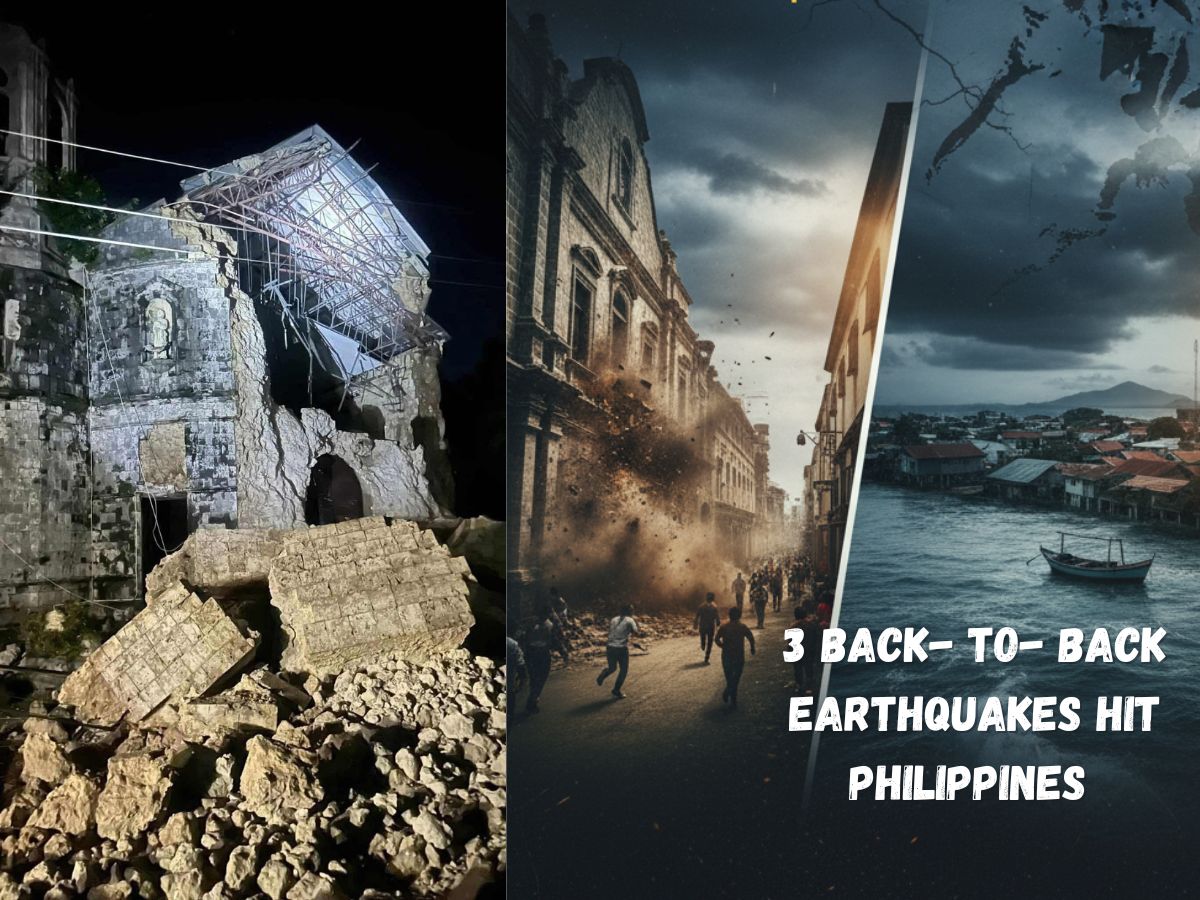
On Tuesday, September 30, the Eastern Visayas region of the Philippines experienced three significant earthquakes within minutes, prompting mass evacuations and further challenging a population still recovering from a recent deadly storm.
The tremors struck at a shallow depth of 10 kilometers and had a powerful magnitude of 7.0, 7.0, and 6.9, according to the United States Geological Survey (USGS). The quakes were centered roughly 20 kilometers from Bogo city, causing significant shaking in populated areas like Cebu City, which is home to nearly one million people. While the Pacific Tsunami Warning Centre confirmed there was no major tsunami threat, the Philippine Institute of Volcanology and Seismology (PHIVOLCS) immediately warned of expected damage and ongoing aftershocks.
What Was the Immediate Impact of the Earthquakes?
The rapid succession of strong tremors triggered instant chaos and damage. In the streets of Cebu City, terrified residents shouted as they rushed out of buildings for safety. The quakes knocked out power in the provincial town of Daanbantayan and caused physical damage to a stone church in the same area.
No casualties were immediately reported, but the quakes’ shallow depth of just 10 kilometers made the tremors more intense, raising the risk of damage. The USGS later logged a 5.2 aftershock, underscoring the region’s continuing instability.
Why Was a Tsunami Warning Issued and Then Lifted?
Authorities exercised considerable caution due to the severity of the earthquakes and their coastal location. Shortly after the tremors, PHIVOLCS advised residents in coastal areas to move farther inland and stay away from the beach.
The agency warned of a possible “minor sea-level disturbance” with waves of up to 1 meter (3 feet) possible for the coasts of Cebu, Leyte, and Biliran. However, the Pacific Tsunami Warning Centre, which models potential tsunami activity across the ocean basin, subsequently confirmed there was no widespread tsunami threat. This comparison draws attention to the distinction between a local, warning tsunami and a full-scale, Pacific-wide tsunami warning.
UPDATE | Ito ang kalagayan ng 139-taong gulang na Daanbantayan Church o ang Archdiocesan Shrine of Sta. Rosa de Lima kasunod ng 6.9-magnitude na lindol na tumama sa Bogo City, Cebu noong Martes ng gabi (Setyembre 30, 2025).
Itinayo ang simbahan noong 1886 at idineklara itong… pic.twitter.com/k1Q6VqMMbK
— Radyo Pilipinas (@radyopilipinas1) September 30, 2025
How Does This Crisis Compound the Existing Situation?
The earthquake triple-strike compounds a major humanitarian crisis already unfolding in the Central Philippine provinces. The region was only beginning to recover from a storm last Friday that killed at least 27 people, cut power across wide areas, and forced tens of thousands to evacuate.
This new disaster stretches emergency resources thin and adds a layer of trauma for a population already dealing with loss and disruption. The devastating storm and subsequent significant seismic activity highlight the archipelago’s severe vulnerability.
Also Read: Stress and Inflation Are Pushing Married People to Cheat? Survey Finds
Why is the Philippines So Prone to Such Disasters?
The Philippines’ position on the Pacific “Ring of Fire” makes it one of the most disaster-prone countries in the world. This huge horseshoe-shaped area is known for its frequent quakes and volcanoes, caused by tectonic plates constantly shifting and colliding.
The Philippines regularly endures earthquakes and volcanic eruptions, compounded by nearly 20 typhoons annually, leaving residents in a constant cycle of preparation and recovery.