
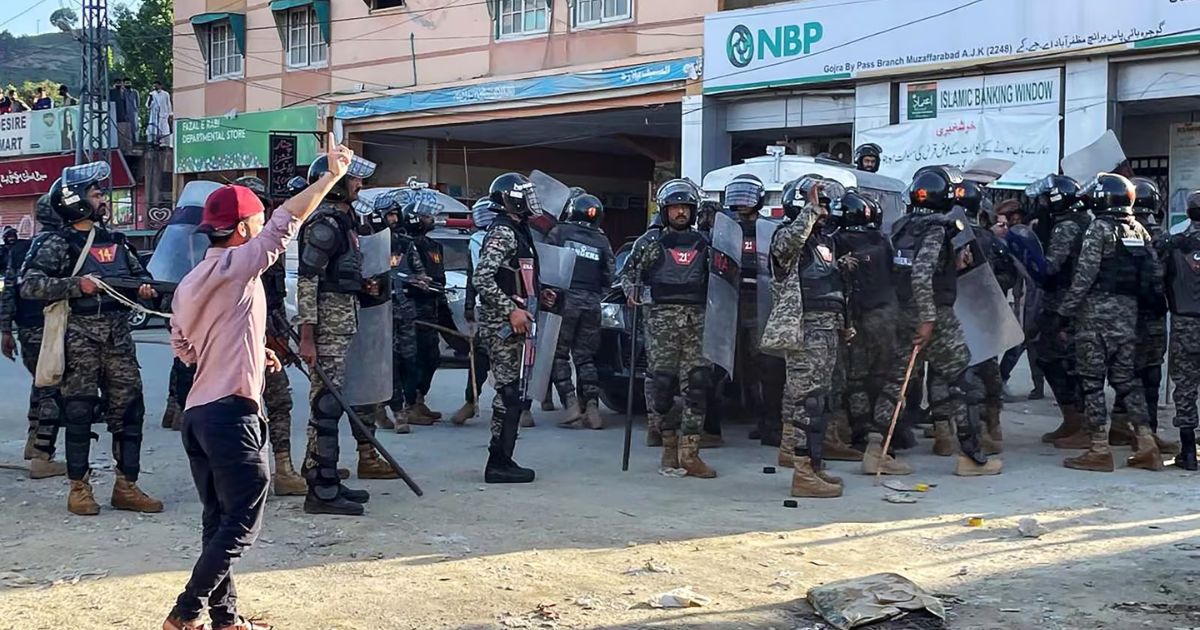
Gunmen attacked a rally in Pakistan’s Khyber Pakhtunkhwa (KPK) province on Sunday, killing seven people and injuring many more. The protest was held outside a military complex at Bagh-Maidan Markaz. Demonstrators assembled to call for action for the murder of a minor girl in Tirah, caused by a mortar attack during an anti-terror operation.
Hundreds marched the body of the girl to the Brigade Headquarters and a surrounding security checkpoint, demanding justice. Later, officials confirmed that the protesters were attacked by terrorists. The attack has re-ignited public outrage against Pakistan’s counter-terrorism policy and entrenched human rights abuses.
Fragile State Under Constant Fire
Terrorism in Pakistan—particularly KPK and Balochistan—remains endemic. Militants of organizations such as Tehrik-i-Taliban Pakistan (TTP), Islamic State (IS) offshoots, and Baloch separatist groups frequently target both civilians and security forces. In spite of several military operations like Zarb-e-Azb and Radd-ul-Fasaad, the menace continues to exist.
Pakistan openly professes itself to be a victim of terrorism. However, it invites international condemnation for supporting extremist elements like Lashkar-e-Taiba and Jaish-e-Mohammed, especially in actions against India.
Military Operations Stoke Human Rights Violations
Within the nation, the military’s counter-terror operations have occasioned severe abuse. Extrajudicial killings, enforced disappearances, and arbitrary arrests are reported regularly.
The heavy-handed approach has stripped the military of the people’s trust and bred resentment, particularly in tribal and border areas. The Sunday protest against the death of the minor illustrates this widening gulf. The military’s refusal to take responsibility only fuels the fire.
Balochistan: Land Forsaken and Mistreated
Things are even worse in Balochistan. Its people have long protested political abandonment and economic exploitation. Activists and students often vanish without a word.
Human rights groups such as Amnesty International and Human Rights Watch have documented widespread torture, arbitrary detentions, and institutional abuse, often traceable to state institutions. Protests go on despite a virtual lack of justice.
Quashing Protests, Exacerbating the Crisis
Families of the missing have frequent sit-ins. They hold up pictures of relatives and ask questions. There are thousands of unresolved cases. The state does not pursue most of them.
Activists are certain that these disappearances are a calculated move to silence opponents of the China-Pakistan Economic Corridor (CPEC) and muzzle Baloch nationalism. There was a lack of transparency, which only increased the gulf of distrust between the state and the locals.
Strategy that backfires
Pakistan’s security policy now threatens to turn against it. By using entire communities as collateral in the war against terror, the state has created new flashpoints.
Rather than containing militancy, its actions are radicalizing greater numbers of civilians. The Sunday attack is not a one-off tragedy—it’s a warning that the public is losing patience. The regime of ruling by fear has started to succumb to its weight.
The Pakistani government needs to shift gears. It cannot triumph in this war by murdering its way to peace. Unless it stops abuses, reinstates the rule of law, and hears its citizens, protests such as these will continue to come back, just louder, angrier, and deadlier.