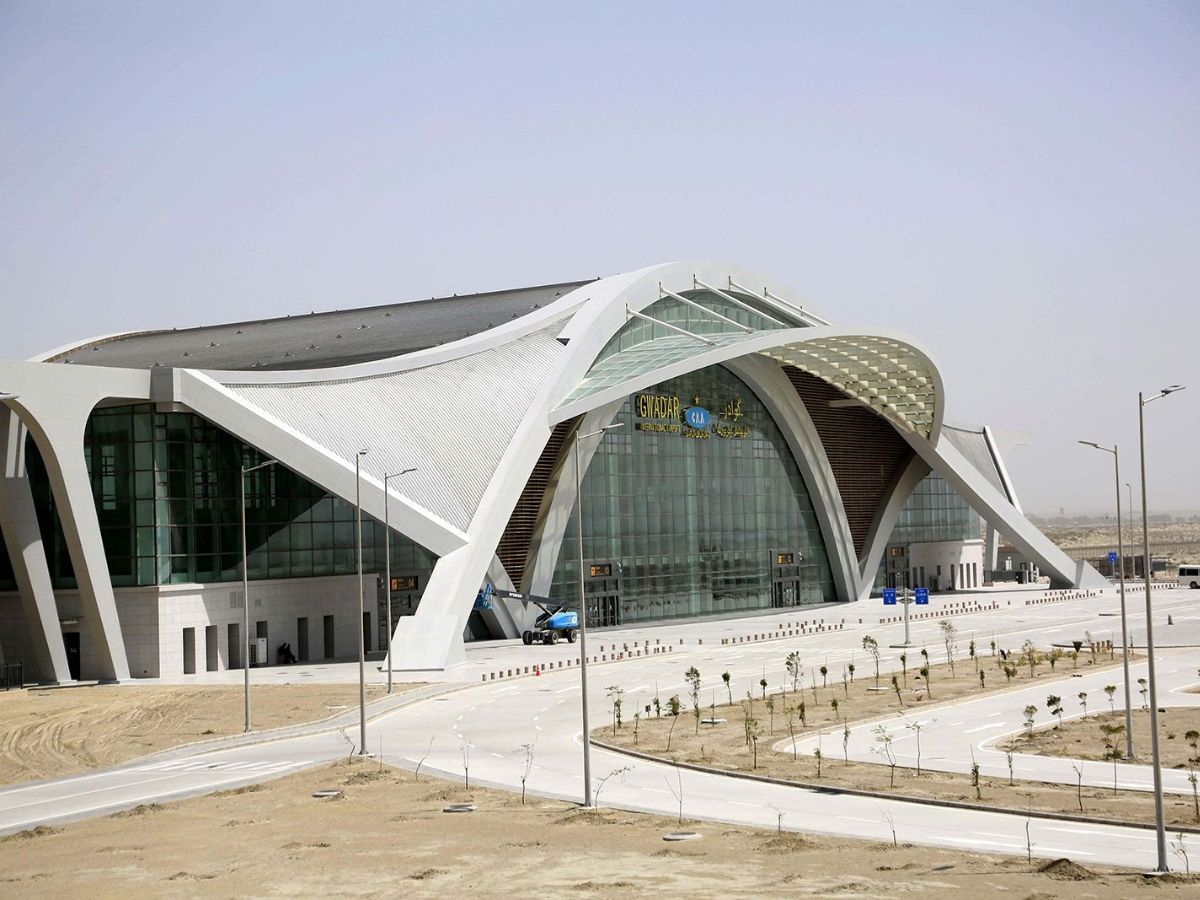
In the coastal city of Gwadar, Pakistan’s newest and most expensive airport stands eerily empty. Completed in October 2024 at a cost of $240 million, entirely financed by China, the New Gwadar International Airport boasts the capacity to handle 400,000 passengers a year. Yet it has no flights, no passengers, and no visible connection to the needs of the city’s 90,000 residents.
The gleaming terminal is a stark contrast to the poverty of southwestern Balochistan, where Gwadar lies. The city still lacks basic infrastructure: it isn’t connected to Pakistan’s national power grid, relying instead on electricity from neighbouring Iran and scattered solar panels, and clean water remains scarce.
China’s Gateway to the Arabian Sea
For more than a decade, Gwadar has been at the heart of the China–Pakistan Economic Corridor (CPEC), a multibillion-dollar network of roads, railways, ports and energy projects linking China’s western Xinjiang region to the Arabian Sea. Islamabad hails CPEC as a game-changer, but the visible benefits for Gwadar’s residents remain minimal.
“This airport is not for Pakistan or Gwadar,” said Azeem Khalid, an international relations expert on Pakistan–China ties. “It is for China, so they can have secure access for their citizens to Gwadar and Balochistan.”
The province’s strategic location and resource wealth have long fuelled a separatist insurgency, with militants targeting both Pakistani security forces and Chinese workers.
A City Under Guard
Security in Gwadar is heavy. The streets are dotted with checkpoints, barbed wire, watchtowers and armed patrols. Roads close without warning to allow convoys carrying Chinese workers or Pakistani officials to pass. Intelligence officers shadow visiting journalists, and even the city’s fish market is off-limits for filming.
“Nobody used to ask where we are going or what we are doing,” said 76-year-old local resident Khuda Bakhsh Hashim. “Now we are asked to prove our identity in our own city.”
Security concerns were among the reasons the airport’s opening was delayed. Officials feared militants could use nearby mountains as vantage points for an attack. When it finally opened, the inauguration was a virtual affair hosted by Pakistani Prime Minister Shehbaz Sharif and Chinese Premier Li Qiang. The first flight was closed to the public and media.
Also Read: Inside the high-stakes Moscow talks: Ajit Doval Meet With Putin as US tariffs hit India
Locals Left Out
For many in Gwadar, the new airport has brought no economic relief. “Not a single resident of Gwadar was hired to work at the airport, not even as a watchman,” said Abdul Ghafoor Hoth, district president of the Balochistan Awami Party. He pointed out that the city’s CPEC-built port also employs few locals.
In December, Hoth led daily protests demanding better access to electricity and water. The demonstrations ended after 47 days when officials promised to act—but residents say no progress has been made.
Without local jobs, contracts or services tied to CPEC, experts warn, the promised economic transformation will remain out of reach. “As Chinese money came to Gwadar, so did a heavy-handed security apparatus that created barriers and deepened mistrust,” Khalid said.
“The Pakistani government is not willing to give anything to the Baloch people,” he added, “and the Baloch are not willing to take anything from the government.”