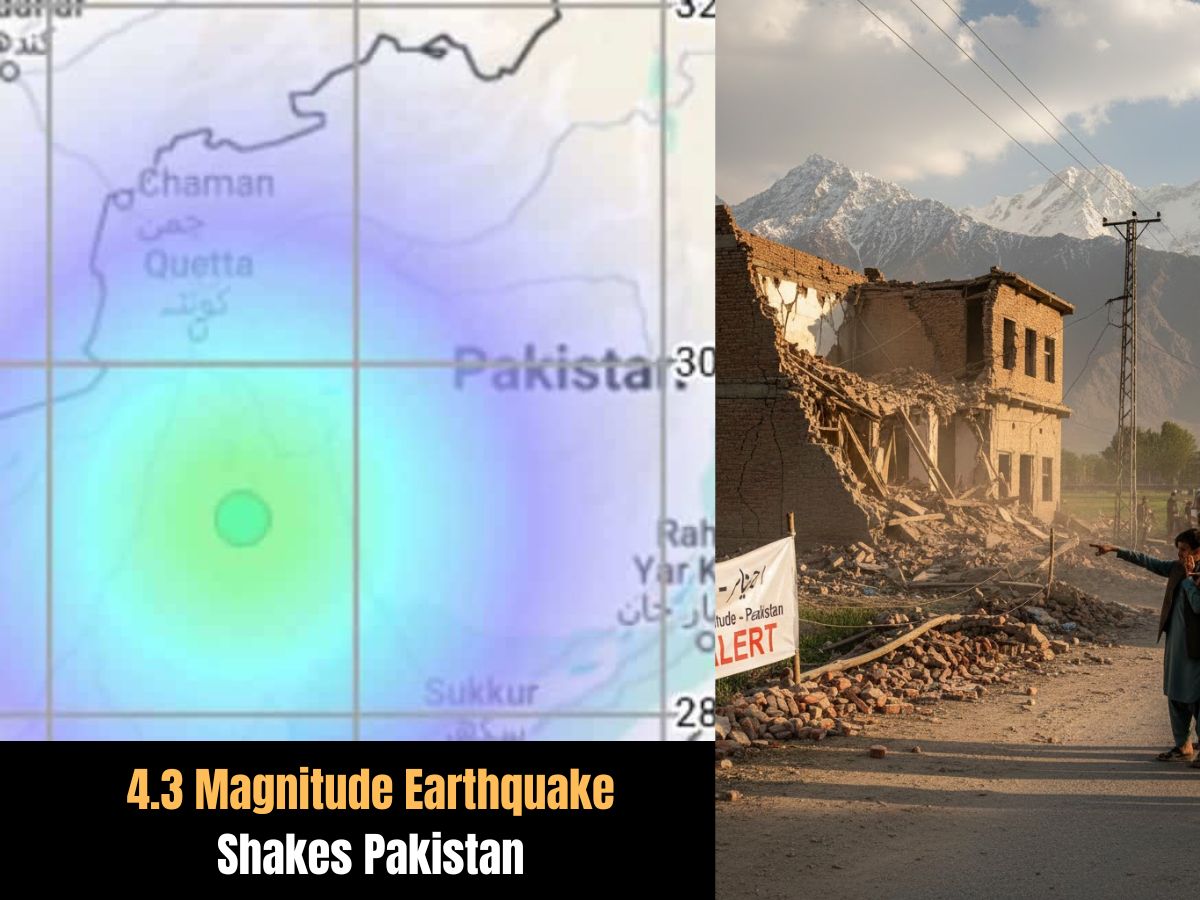
An earthquake with a magnitude of 4.3 struck parts of Pakistan on the evening of Saturday, December 13. The tremor, which occurred at approximately 6:44 PM local time, sent vibrations through the region but initial reports confirm no injuries or significant damage. The seismic event serves as a fresh reminder of the constant geological activity beneath the nation’s surface.
Where Did the Earthquake Originate?
Seismic data show the earthquake’s epicenter was at 30.14°N and 69.57°E. Pinpointing it helps scientists identify active fault lines and lets authorities estimate which areas experienced the strongest shaking. Although this was a moderate quake, the location lies in a zone prone to much stronger seismic events.
EQ of M: 4.3, On: 13/12/2025 18:44:56 IST, Lat: 30.14 N, Long: 69.57 E, Depth: 10 Km, Location: Pakistan.
For more information Download the BhooKamp App https://t.co/5gCOtjdtw0 @DrJitendraSingh @OfficeOfDrJS @Ravi_MoES @Dr_Mishra1966 @ndmaindia pic.twitter.com/WGFQmotYFW— National Center for Seismology (@NCS_Earthquake) December 13, 2025
Why Is Pakistan So Prone to Earthquakes?
This tremor is one of many. Last month, a stronger 5.2-magnitude earthquake struck Pakistan. Its high quake frequency is due to the country’s position in a major seismic zone, where the Indian and Eurasian plates grind against each other, causing frequent earthquakes felt in Afghanistan and northern India.
Which Areas of Pakistan Are Most at Risk?
The entire country is susceptible, but some provinces face a greater threat due to their position directly on or near major fault lines. Balochistan, Khyber Pakhtunkhwa, and Gilgit-Baltistan lie along the southern edge of the Eurasian plate. Sindh and Punjab are near the northwestern edge of the Indian plate. Balochistan is especially at risk, being close to the active boundary between the Arabian and Eurasian plates, making it prone to earthquakes.
What Should You Do During an Earthquake?
Knowing how to react can save lives. Safety experts universally recommend the “Drop, Cover, and Hold On” protocol.
- DROP to your hands and knees immediately.
- COVER your head and neck by taking shelter under a sturdy table or desk. If no shelter is nearby, crouch in an inside corner of a room and cover your head with your arms.
- HOLD ON to your shelter until the shaking stops.
- Stay away from windows, glass, outside doors, and anything that could fall, like light fixtures or tall furniture. Do not run outside during the shaking, as falling debris from buildings is a major hazard.
How Can You Prepare Your Home?
Being prepared helps lower earthquake risks. Secure heavy furniture and appliances, place heavy objects on lower shelves, and repair deep cracks in ceilings or foundations. Also, make sure your house is built according to the seismic (BIS) codes for your area to improve safety.
Key Immediate FAQs:
Q: Was anyone hurt in the December 13th earthquake?
A: No. Initial reports confirm no injuries or casualties from the magnitude 4.3 tremor.
Q: How does this quake compare to the one in November 2025?
A: The November 2025 earthquake was stronger, measuring 5.2 in magnitude and 135 km deep. The tremor on December 13 was milder, with a magnitude of 4.3.
Q: Why do earthquakes frequently hit Pakistan and Afghanistan?
A: The area lies at the meeting point of the Indian and Eurasian tectonic plates. The collision builds huge pressure, which is frequently released as earthquakes.
Q: What is the single most important safety step during a quake?
A: The “Drop, Cover, and Hold On” method is the most critical immediate action to protect yourself from falling objects and debris.