The Political Gamble That Redrew a Map
In August 1947, the Indian subcontinent saw one of the most dramatic and most significant events of the 20th century: the Partition of British India into two independent states India and Pakistan. The monumental shift was not just a cartographic exercise; it was the culmination of decades-long political jockeying, ideological differences, and vying visions of independence.
The call for Pakistan, led by the Muslim League’s Muhammad Ali Jinnah, emerged from Muslims concerns that a non-partitioned India with a Hindu-dominated leadership would suppress their political and cultural identity. Opposite them, Indian National Congress leaders advocated an integrated, secular India.
British officials, exhausted from World War II and emergent nationalist movements, wanted an immediate withdrawal. The last Viceroy of India, Lord Mountbatten, brought independence forward by almost a year. The hasty schedule did not allow much time for thoughtful preparation laying the ground for mayhem.
A Border Drawn in Ink, Sealed in Blood
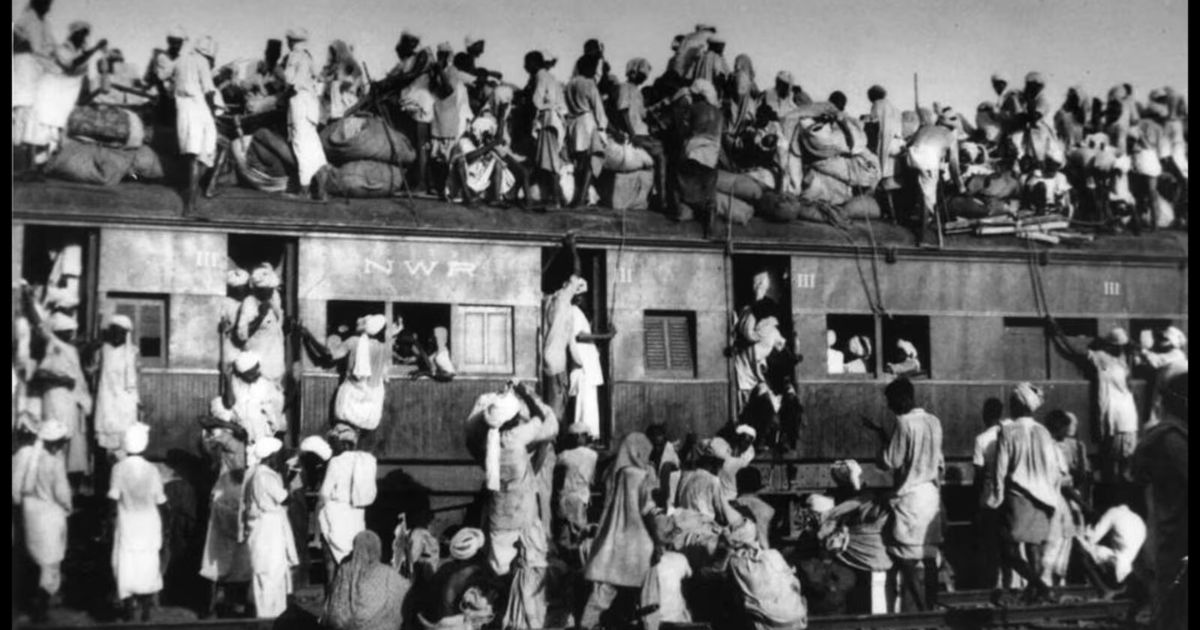
The Radcliffe Line, which was delineated in a mere five weeks by British lawyer Cyril Radcliffe, partitioned Punjab and Bengal on a religious basis. What was proposed as an administrative measure soon turned into a humanitarian disaster. The new borderline instigated one of the biggest and quickest mass migrations in the history of mankind.
Estimated 10 to 15 million people had traversed the newly drawn borders Hindus and Sikhs to India, Muslims to Pakistan. Along the way, centuries-old communities had turned against one another. Trains were death wagons, villages burned down, and the streets flowed red with communal killing.
The number of deaths is also disputed, with estimates ranging from 500,000 to more than two million. Millions more were uprooted, forced to start anew in refugee camps in the aftermath of loss and uncertainty.
The Psychological and Cultural Scars
Partition was not merely a political breakup it was a break in the social fabric. Families were broken up overnight, homes left vacant, and ancestral homelands lost irretrievably. Survivors’ oral accounts continue to resonate with tales of hasty goodbyes, secret treasures, and the deafening silence of those who crossed but did not survive.
For others, trauma knew no borders. Refugees came to new countries only to be met with suspicion, poverty, and estrangement. The emotional residue found its way into art, literature, and film becoming the leitmotif of works by authors such as Saadat Hasan Manto and Khushwant Singh, and then the films Garam Hava and Earth.
The pain also expressed itself as a shared nostalgia a painful memory of pre-Partition neighborhoods, festivals, and friendships that once erased religious boundaries.
From Past to Present: The Politics of Memory
Pakistan’s founding was celebrated by its advocates as the realization of the “Two-Nation Theory,” a political philosophy maintaining that Hindus and Muslims were two nations in need of different homelands. Partition in India was a cautionary story regarding communal divisions and the vulnerability of unity.
Years later, the Partition still has a long shadow over India-Pakistan relations. Three wars, an arms race, and continuing disagreements most importantly, over Kashmir have their origins in that August. Political elites on both sides of the divide continue to cite the events of 1947 to mobilize their constituencies, often reopening old wounds.
But there are attempts at reconciliation too. Partition museums, cross-border cultural festivals, and oral history projects attempt to hold on to memories without fuelling hatred. Younger generations, dissociated from direct experience of Partition, tend to view the history with interest rather than anger, although nationalist rhetoric sometimes drags them into inherited grievances.
A History Still Being Written
Seventy-eight years later, Partition continues to be both an independence moment and a rupturing moment. It is commemorated in opposing terms liberation for some, tragedy for others. The events of 1947 were no clean closure but the start of a multifaceted, at times turbulent, relationship between India and Pakistan.
The memories for survivors are intensely personal. For historians, the controversies regarding causes and consequences still persist. And for both countries, the test is to recognize the common past without letting its differences control the future.
The Partition was more than the coming into existence of two nations. It was a test of human endurance, a lesson in the price of hurried politics, and a reminder that borders on a map cannot sever the threads of history that tie people together.