
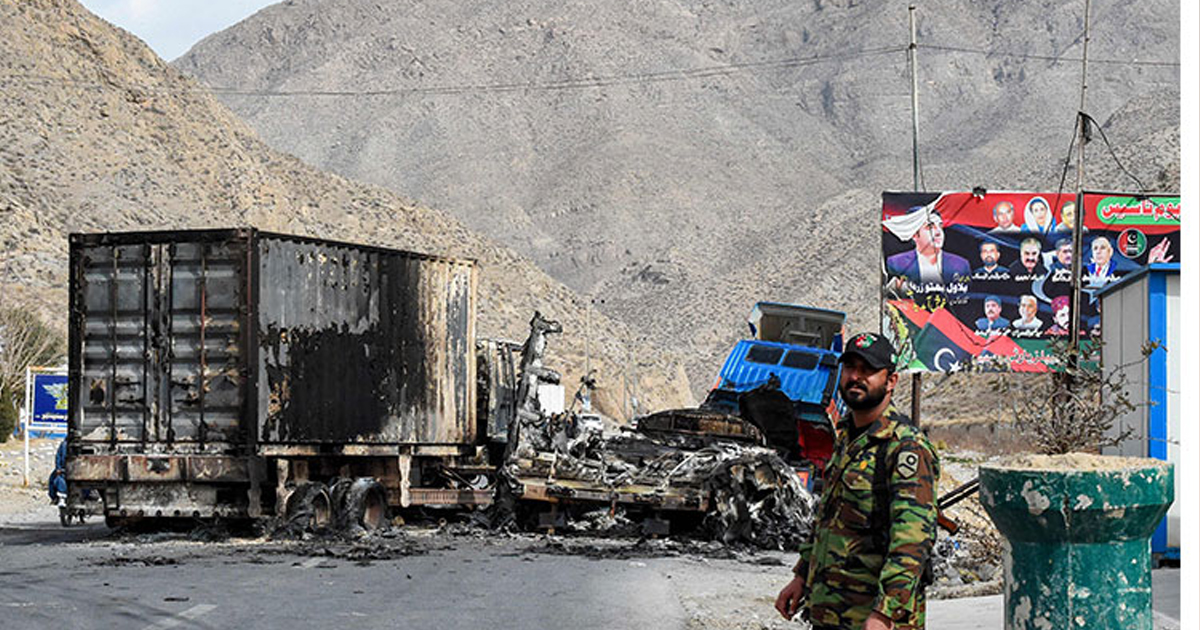
The unstable security situation in Balochistan grew more heated this week as two outlawed separatist organizations, the Balochistan Liberation Front (BLF) and the Baloch Liberation Army (BLA), took credit for a string of fatal attacks on Pakistani military convoys in Kalat, Jhau, and Quetta. The attacks, conducted during July 15–16, left dozens of soldiers killed, with one senior officer among them.
The Pakistan Army confirmed “multiple encounters with militants” but disputed the heavy casualty reports released by the insurgents as “exaggerated and propaganda-ridden.”
BLF Conducts Targeted Attacks in Kalat and Jhau
The Balochistan Liberation Front (BLF) took responsibility for two attacks. On July 15, a remote-controlled improvised explosive device (IED) went off on the Quetta-Karachi highway in Khazinai area of Kalat, destroying a military vehicle and killing four soldiers and injuring two.
On July 16, BLF militants ambushed in the Gujro Kaur area of Jhau, Awaran district. The organization asserted they acted on local intelligence, targeting Pakistani soldiers in pursuit of a captured ration vehicle. Six of the soldiers were reportedly killed, including Muzaffarabad’s Major Syed Rab Nawaz Tariq. BLF reported that their sniper units compelled the rest of the convoy to withdraw.
The correct version is that the group also conducted retaliatory “fake encounters” — a euphemism for extrajudicial killings—a charge often denied by Islamabad.
BLA Ambushes and IED Attack
The Baloch Liberation Army (BLA), on the other hand, attributed two high-profile attacks on July 16. In the Nimrag Cross area of Kalat, the organization’s Fateh Squad had ambushed a military bus carrying troops from Karachi to Quetta. Based on real-time monitoring by its intelligence unit ZIRAB, the BLA reported that 27 soldiers were killed in the attack, with several more wounded.
The BLA indicated that civilians, such as Qawwali singers on the bus, were not to be targeted. The organization also made a public notice cautioning civilians against approaching military bases and convoys to minimize risk.
BLA militants later the same day detonated an IED near Quetta’s Hazar Ganji, killing two soldiers and wounding seven, said their statement.
BLA spokeswoman Jeeyand Baloch characterized the operations as their ongoing armed struggle against what they refer to as the “Pakistani occupation” of Balochistan.
Pakistan Army Launches Retaliatory Operations
In a statement, the Inter-Services Public Relations (ISPR) confirmed the actions in Kalat and Awaran, giving credence to casualties, including the death of an officer. It, however, denied the insurgents’ numbers and said at least three militants were killed and several others injured in counter-attacks.
“Continuation of clearance and search operations is afoot,” the ISPR said. “No matter how many cowardly terrorist attacks are launched, our resolve will not be weakened. Our martyrs’ sacrifices shall not prove to be futile.”
Sustained Balochistan Insurgency
Balochistan, the biggest but most sparsely populated province of Pakistan, has been engulfed in a low-scale insurgency for decades. Separatist militants have been asking for independence or autonomy, pointing to decades of political marginalization and human rights abuses.
Despite significant military deployment and multi-billion-dollar investments by the China-Pakistan Economic Corridor (CPEC), targeting Pakistani troops has become more intense and sophisticated.
Human rights groups have gone on complaining about enforced disappearances, extrajudicial executions, and forced displacement of civilians, underscoring the growing complexity of the conflict.
With the newest bout of violence, the province is once again at the center of Pakistan’s internal security problems, and there is little indication of a resolution to come.