
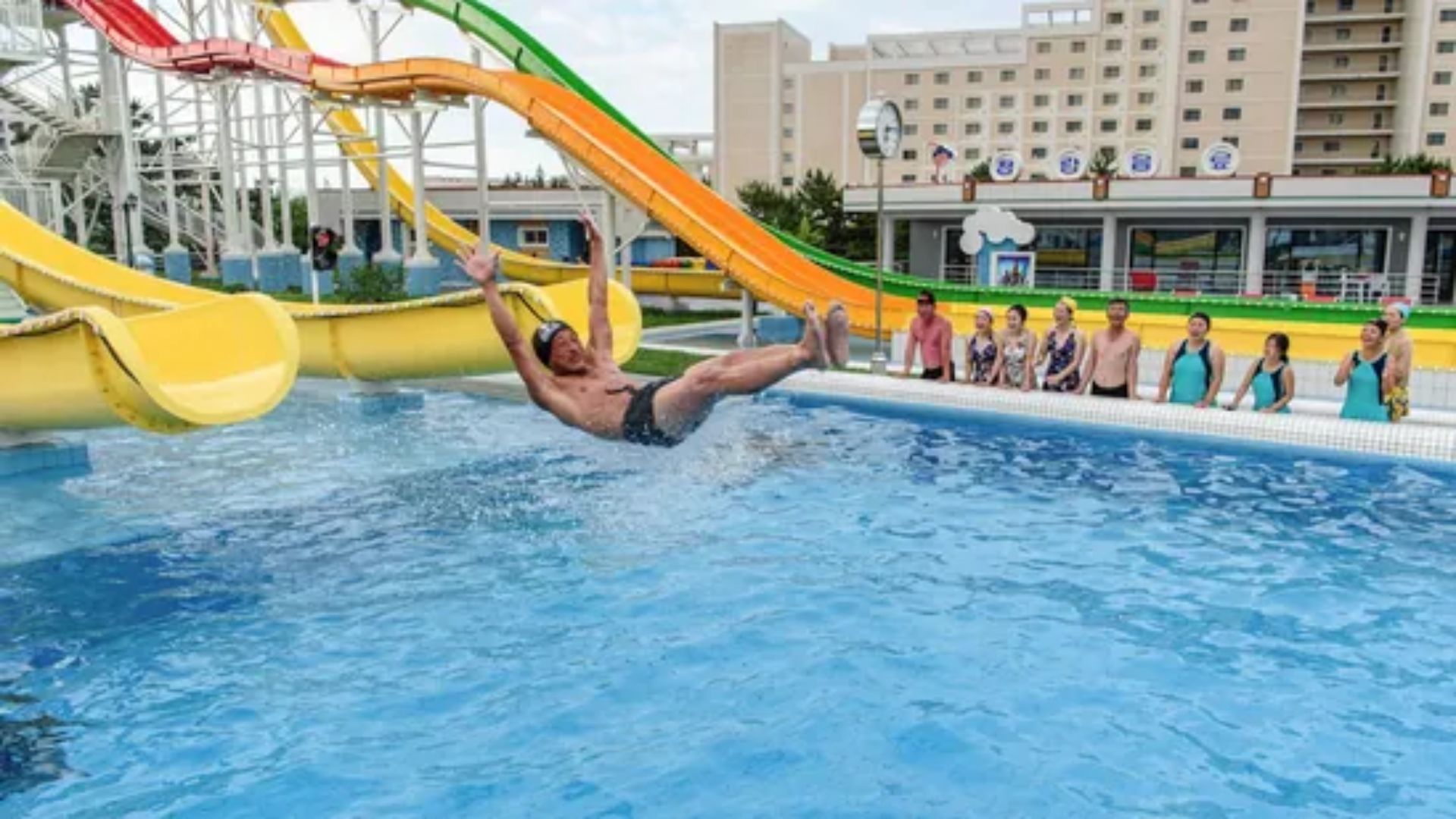
North Korea has temporarily closed its newly opened Wonsan-Kalma beach resort to foreign tourists, throwing doubt over the future of a project touted by Kim Jong Un as ‘one of the greatest successes this year’.
As DPR Korea Tour, a travel site operated by North Korean officials, put it, the coastal resort along the east coast is ‘temporarily not receiving foreign tourists’. The notice, posted Wednesday, did not offer any reason for the action or provide any prediction of when the halt might end.
The beach complex, which opened to the public in North Korea on July 1, was intended to accommodate close to 20,000 visitors. It has just received a small contingent of Russian visitors, and analysts had expected the Chinese tourists to be the next in the inbound international arrivals.
Chinese tour groups made up more than 90% of North Korea’s foreign tourism before the pandemic. Still, even after the regime gradually began phasing out COVID-era measures, it has not officially stated that it will resume international tourism in full.
In one previous example, Pyongyang permitted a few foreign tourists to visit the Rason region in February, only to suspend the program after a month.
The foreign entry suspension occurs just days after Russian Foreign Minister Sergey Lavrov traveled to the Wonsan-Kalma complex to meet with Kim Jong Un and North Korean Foreign Minister Choe Son Hui. At the time of his sit-down, Lavrov stated, “I am sure that Russian tourists will be increasingly eager to come here,” and vowed to facilitate travel from Russia to the zone.
Those positive words aside, officials believe that the suspension was caused by a scathing article from a Russian reporter who had been traveling with Lavrov. The piece intimated that the North Korean ‘tourists’ who had shown up at the resort during the visit had probably been mobilized by the regime and were not real tourists. This description might have spooked the regime.
“The North Korean side seems to have concluded that it will suffer some adverse effects when the site is opened to foreigners,” said Oh Gyeong-seob of the Korea Institute for National Unification.
Other experts, such as Lee Sangkeun of Seoul’s Institute for National Security Strategy, think financial and logistical reasons could be at play as well. “It can be related to the problems with attracting Russian tourists as many would find it too distant and costly,” he said.
Even the setback, however, is not expected to last long, say experts. The resort is a huge financial investment by the regime, which is going through tough economic times. Ahn Chan-il, director of the World Institute for North Korean Studies, added, “If foreigners can’t visit the destination, no Russian rubles, Chinese yuans and dollars will come in. Then, North Korea can’t cover the costs and it has to close down the resort.”
Kim Jong Un had termed the resort as ‘the proud first step’ to give a boost to North Korea’s tourism sector. State media still reports that the resort is full of domestic tourists. But the actual economic dividends are anticipated only if foreign visitors, mostly from Russia and China are permitted to visit.