
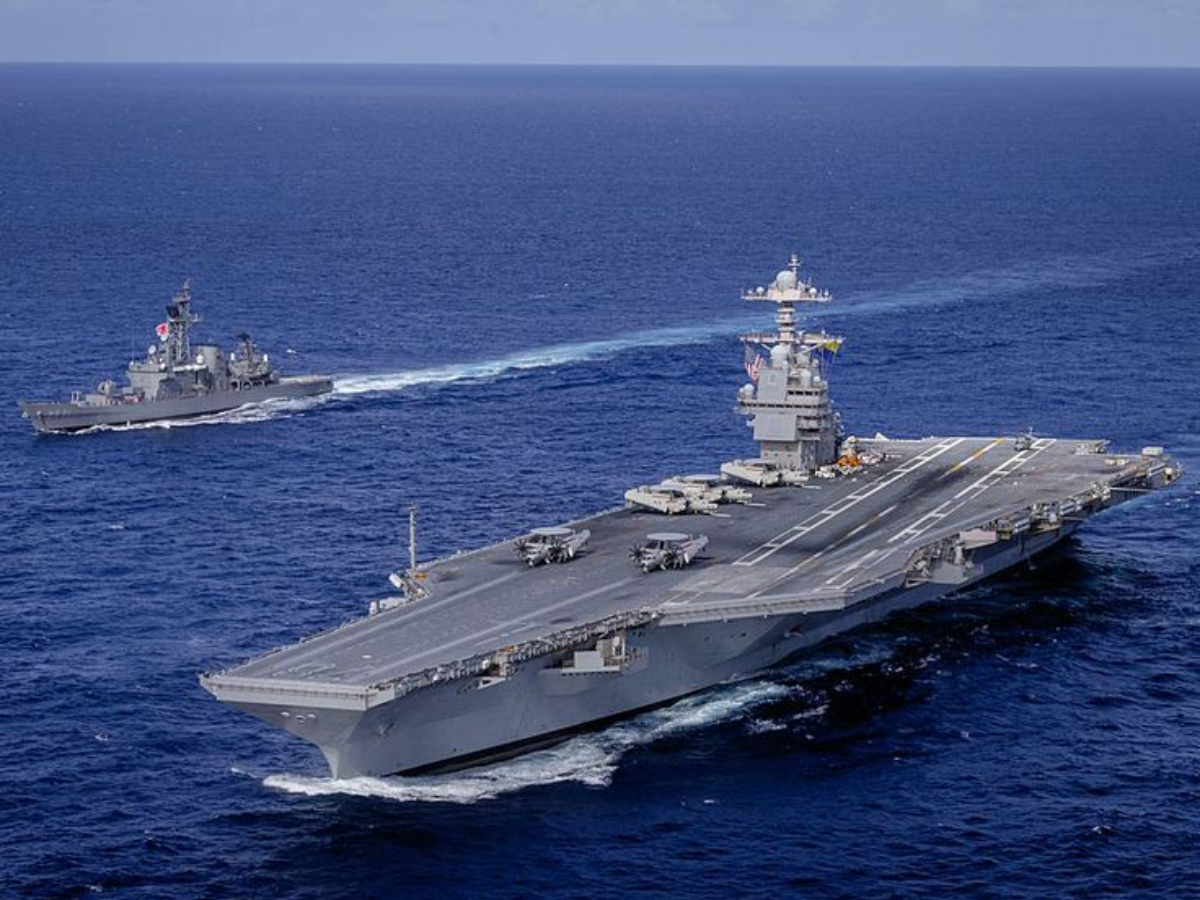
The arrival of the USS Gerald R. Ford in the Caribbean has sparked a new round of debate about the direction of Washington’s security strategy in the region. Framed as part of a campaign to disrupt drug routes, the deployment of this carrier is being read by many observers as a deeper push into South America at a politically sensitive moment.
Operation Southern Spear Expands
With the Ford now in place, the United States has assembled one of its largest regional naval buildups in decades, involving nearly a dozen Navy vessels and roughly 12,000 personnel.
Military officials say their aim is to tighten control over maritime smuggling routes, especially after a series of U.S. strikes on small boats accused of carrying drugs which have left at least 80 people dead since early September.
A Mission Framed Around Security
Rear Adm. Paul Lanzilotta, who heads the Ford’s strike group, says the carrier’s presence enhances an already sizeable fleet positioned to stem narcotics trafficking. Defense officials say halting drugs at sea is just part of the bigger endeavor.
ALSO READ: Iran Has Stopped All Uranium Enrichment, Says Foreign Minister Abbas Araghchi
The Trump administration has said it might expand the mission to include land based routes too, but so far it has disclosed no public evidence to link the individuals killed in prior strikes to narcoterror groups.
Pressure Grows on Venezuela
To regional analysts, the carrier’s arrival reads as much like a political signal as a counterdrug initiative. Washington’s rejection of Nicolas Maduro as Venezuela’s legitimate leader has shaped nearly every decision tied to security near the country’s borders.
Secretary of State Marco Rubio has long accused Maduro’s government of enabling the drug trade where caracas calls the U.S. campaign a manufactured pretext for intervention.
New Partnerships Across the Region
The operation has expanded cooperation with Caribbean countries, where U.S. Marines are working in Trinidad and Tobago on joint exercises targeting violent crime and interrupting trafficking routes.
ALSO READ: Iran Begins Cloud Seeding as Worst Drought in 50 Years Pushes Nation to the Brink
The work is part of a longer partnership, local officials said, that reflects increasing worry about the ways criminal networks move through the region.
Shifting U.S. Focus on Latin America
Training in Panama and joint exercises off the southern Caribbean suggest that Washington’s strategic attention is drifting back toward the hemisphere.
How much the Ford deployment actually disrupts trafficking and how much it heightens political tensions will become clearer in the months ahead that this show of force represents a turning point in the U.S. posture vis-a-vis Latin America.
ALSO READ: US Cuts Tariffs on 250+ Food Products: What It Means for India’s Spices, Tea & Coffee Exports
Disclaimer: This article provides independent analysis based on available information and should not be interpreted as legal, political or official policy guidance.